Bird Care
Pet Bird Market Outlook in the U.S. and Europe: Species and Owner Trends
Quick answer
A market-focused look at companion bird ownership in the U.S. and Europe, including common pet bird types, owner habits, shopping behavior and growth signals.
By ShineePets Editorial Team · Published
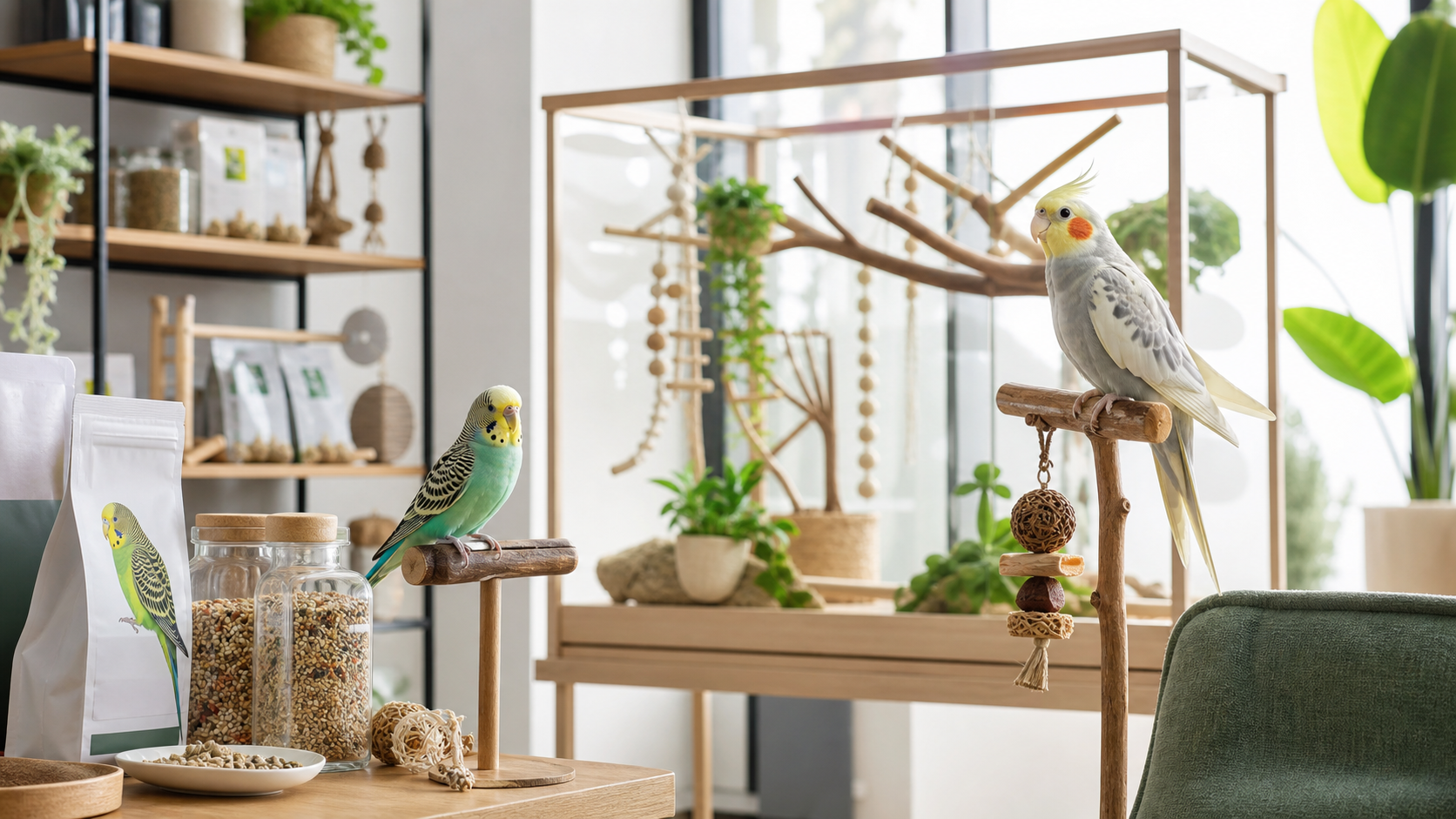
Pet birds remain a niche compared with dogs and cats, but they are one of the pet industry’s highest-engagement categories. In the United States, the 2025 APPA Bird, Small Animal & Horse Report says six million U.S. households own birds. The CDC’s pet bird overview cites a slightly more conservative recent estimate of over five million U.S. households. The exact count depends on source and method, but both point to the same conclusion: companion birds are a meaningful specialist market with long-term care needs and unusually high owner involvement.
Europe also matters here. FEDIAF’s Facts & Figures 2022 counted roughly 53.1 million ornamental birds across Europe and 35.8 million within the EU. FEDIAF’s June 2026 statistics update also confirmed that overall European pet ownership and pet-food sales continue to grow. That does not mean the bird segment is suddenly mass-market, but it does suggest that the category sits inside a healthy wider ecosystem rather than a declining one.
Quick takeaway: Pet birds are still a specialist segment, but the outlook in the U.S. and Europe is supported by stable ownership, rising engagement, stronger younger-owner interest and continued demand for expert-led, care-focused products.
Which pet birds matter most in today’s market
In practical market terms, the bird category is not one single buyer profile. It usually breaks into a few recognizable groups. The broadest entry tier is built around parakeets or budgies, which APPA identifies as the most common pet bird type in the U.S., owned by 28% of bird owners. The second major group is cockatiels, which APPA says are owned by 19% of bird owners, with ownership rebounding strongly in 2025.
Beyond that, the market typically expands into smaller social or songbird formats such as finches and canaries, then into more personality-driven birds such as lovebirds, conures and small parrots. Those latter groups tend to attract more experienced owners because they often require more training, more enrichment, more out-of-cage interaction and more tolerance for noise and long lifespans.
For retailers and suppliers, that matters because the bird market is less about raw scale and more about segmentation. A budgie owner and a conure owner may both shop in the same category, but they often care about different cage sizes, feeding formats, toy durability and enrichment routines.
Why the U.S. outlook still looks healthy
APPA’s latest bird report suggests the U.S. market is not standing still. It says 22% of bird owners are Gen Z, a 22% increase from 2023. That is notable because it challenges the assumption that pet birds are aging out with older hobbyists. The category is still specialized, but it is attracting younger owners who are often more research-oriented, more digital and more willing to spend on products that feel intentional.
A second positive signal comes from APPA’s 2026 state-of-industry release. In its broader ownership data, APPA said growth extended into smaller pet categories in 2025, including birds, up 25% year over year. That does not mean birds are suddenly competing with dogs or cats in absolute scale. It means the segment is participating in the current expansion of multi-species pet ownership rather than being left behind.
The result is a market that looks stable in base size but stronger in engagement quality. That is usually a good sign for specialist categories because it supports repeat purchases in feed, treats, supplements, habitat products and enrichment accessories even when mass-market consumer spending becomes more selective.
Owner preferences are shifting toward expertise and enrichment
Bird owners do not behave like purely convenience-driven buyers. APPA’s 2025 report says 25% rely on bird stores for information and 28% rely on bird store personnel, both materially above past levels. It also says 21% of owners obtain their birds at bird stores, making specialist retail the top acquisition channel.
That is one of the most important habits in this category. Bird owners often want advice before purchase, not just product availability after purchase. Species compatibility, noise expectations, lifespan, diet, training and cage setup all matter early in the decision. The commercial implication is straightforward: trust is a growth driver.
At the same time, digital influence is clearly rising. APPA’s 2024 bird insight report said social media as an information channel for bird owners rose from 17% to 25%. That points to a mixed behavior pattern: owners still value in-person expertise, but they increasingly arrive with online research, creator influence and stronger expectations around habitat design and enrichment.
Small birds support volume, but engagement drives value
APPA’s 2024 report also said small bird ownership increased to 63% in 2024, up from 45% in 2018. That is a major directional clue. The accessible end of the category is gaining weight, which likely supports steady demand for starter cages, seed and pellet blends, perches, cuttlebones, simple toys and cleaning accessories.
But value creation does not stop with entry birds. Bird owners are often unusually involved with daily routines, and that changes what they buy over time. They are more likely to upgrade perches, rotate enrichment toys, experiment with forage-oriented items and respond to advice about diet quality and behavior support. In other words, the bird market is not just an animal-sale market. It is a care-system market.
That helps explain why APPA frames bird ownership as a high-engagement niche. Even with fewer households than dog or cat ownership, bird owners often show durable attachment and a willingness to invest in the environment around the bird, not just the bird itself.
The human-animal bond is stronger than the category looks from the outside
One of the easiest mistakes in this category is to underestimate emotional spending. APPA says 76% of bird owners give gifts to their birds. It also says they spend an average of $40.52 per gift, up 42% from 2023. That is not a trivial detail. It means owners are not only buying for feeding and maintenance. They are spending on delight, seasonal rituals and visible relationship signals.
That kind of behavior usually supports higher-margin accessory categories: toys, swings, ladders, treat holders, nest-adjacent comfort items, decorative yet functional habitat accessories and gifting bundles. The buyer is not just keeping a bird alive. The buyer is curating a daily experience.
This is also where younger owners matter. Gen Z and Millennial bird owners appear to be helping push the category toward a more lifestyle-oriented identity, where design, enrichment and shareable routines matter more than older commodity-only merchandising models.
Europe shows scale, but comparison needs caution
Europe offers a useful contrast rather than a direct line-for-line comparison. FEDIAF’s older population count shows a large ornamental bird base, while its 2026 statistics page confirms that overall pet ownership and pet food sales remain healthy. That supports the idea that companion birds still have a real place in European households, especially in countries where apartment-friendly pets and smaller-home formats matter.
However, FEDIAF also warns that country coverage and methodology have changed, so direct year-on-year comparisons should be treated carefully. The safest interpretation is not that Europe proves rapid bird-market acceleration. It is that Europe reinforces the category’s structural relevance and its fit within mature pet economies.
Risks and limits still shape this market
The bird market is attractive, but it is not frictionless. The CDC notes that birds can have long lifespans and require special care and commitment. It also warns that birds can carry germs that make people sick, which means hygiene, safe handling and informed household matching still matter. A category with stronger welfare and care requirements naturally grows more slowly than impulse-led categories.
That is not necessarily a negative for the long-term outlook. In fact, it often protects specialist categories from pure commoditization. Birds are not easy add-on pets for every household. That makes education, specialized assortment and trustworthy care content more commercially important.
For readers comparing pet categories, our responsible home pet ecosystem guide explains why birds need species-appropriate, separate living environments rather than decorative or mixed-species setups.
What this means for the market now
For bird-focused suppliers, retailers and content planners, the current direction looks fairly clear:
- Keep small-bird assortments strong because they support the broadest base of ownership.
- Build around expert guidance, not only shelf volume, because buyers actively seek trusted advice.
- Treat enrichment, foraging and habitat quality as core categories rather than optional extras.
- Expect younger owners to keep shaping the market through digital research and lifestyle spending.
- Position bird care as a commitment category, not an impulse category.
The pet bird market outlook in the U.S. and Europe is therefore best described as specialized but resilient. It is not the largest pet segment, but it has durable engagement, high education needs, and a strong human-animal bond that supports repeat spending.
Conclusion
The pet bird category is one of the clearest examples of why scale is not the only measure of opportunity. In the U.S., APPA’s latest data points to six million bird-owning households, rising younger-owner participation, stronger specialist-retail influence and a surprisingly high level of gifting and engagement. In Europe, a large ornamental bird base and healthy overall pet-market conditions suggest the segment remains relevant inside mature pet economies.
The most important trend is not simply that people own birds. It is that the most active bird owners want better guidance, better habitats and more meaningful enrichment. That is what gives the category its long-term value.
For retailers, distributors and pet brands
Planning a bird or small-animal product range?
Compare relevant product categories, then discuss packaging, private-label or OEM/ODM requirements with our B2B team.
Explore Bird & Small Animal Products Discuss OEM/ODMFrequently Asked Questions
What are the most common pet birds in the U.S. market?
APPA's 2025 bird report says parakeets are the most common pet bird among U.S. owners, followed by cockatiels. In practical retail terms, the category also includes finches, canaries, lovebirds, conures and small parrots.
Why do bird stores still matter so much in this category?
Bird owners often need species-specific guidance before they buy. APPA says bird stores and bird store personnel remain major information sources, which shows that trust and expertise still influence purchasing behavior.
Is the pet bird market growing fast?
It is better described as specialized but resilient. APPA's 2026 state-of-industry release says growth extended into smaller pet categories including birds, while APPA's bird report shows strong engagement and younger-owner participation.
What makes bird owners different from many other pet buyers?
Bird owners are often highly involved with habitat setup, enrichment, diet and daily interaction. APPA also says 76% of bird owners give gifts to their birds, which highlights a strong emotional bond and supports accessory spending.
Sources and References
- American Pet Products Association — APPA Releases Comprehensive 2025 Report on Bird, Small Animal & Horse Ownership
- American Pet Products Association — APPA Releases 2024 Bird, Small Animal & Horse Owner Insight Report
- American Pet Products Association — U.S. Pet Industry Reaches $158 Billion in 2025, Poised for Continued Growth in 2026
- Centers for Disease Control and Prevention — Birds — Healthy Pets, Healthy People
- FEDIAF — European Statistics
- FEDIAF — Facts & Figures 2022
About this article
The ShineePets Editorial Team researches pet care, product use and industry shifts with a practical, evidence-based lens.
ShineePets is a commercial B2B pet-supply sourcing brand. Read our editorial standards and commercial disclosure.
Continue Reading

Beyond Cats and Dogs: Building a Responsible Home Pet Ecosystem
A science-based guide to creating separate, species-appropriate habitats for pet birds, aquarium fish, invertebrates and living plants at home.
How Pet Market Categories Shifted Over the Past Five Years
A data-based look at how food, veterinary care, supplies and services changed in the pet market over the past five years, and which subcategories gained share.