Product Sourcing
Pet Product Packaging Labels: What Buyers Should Check
Quick answer
Learn how to inspect pet product packaging labels for identity, ingredients, directions, warnings, quantity, claims, and traceability before buying.
By ShineePets Editorial Team · Published · Updated
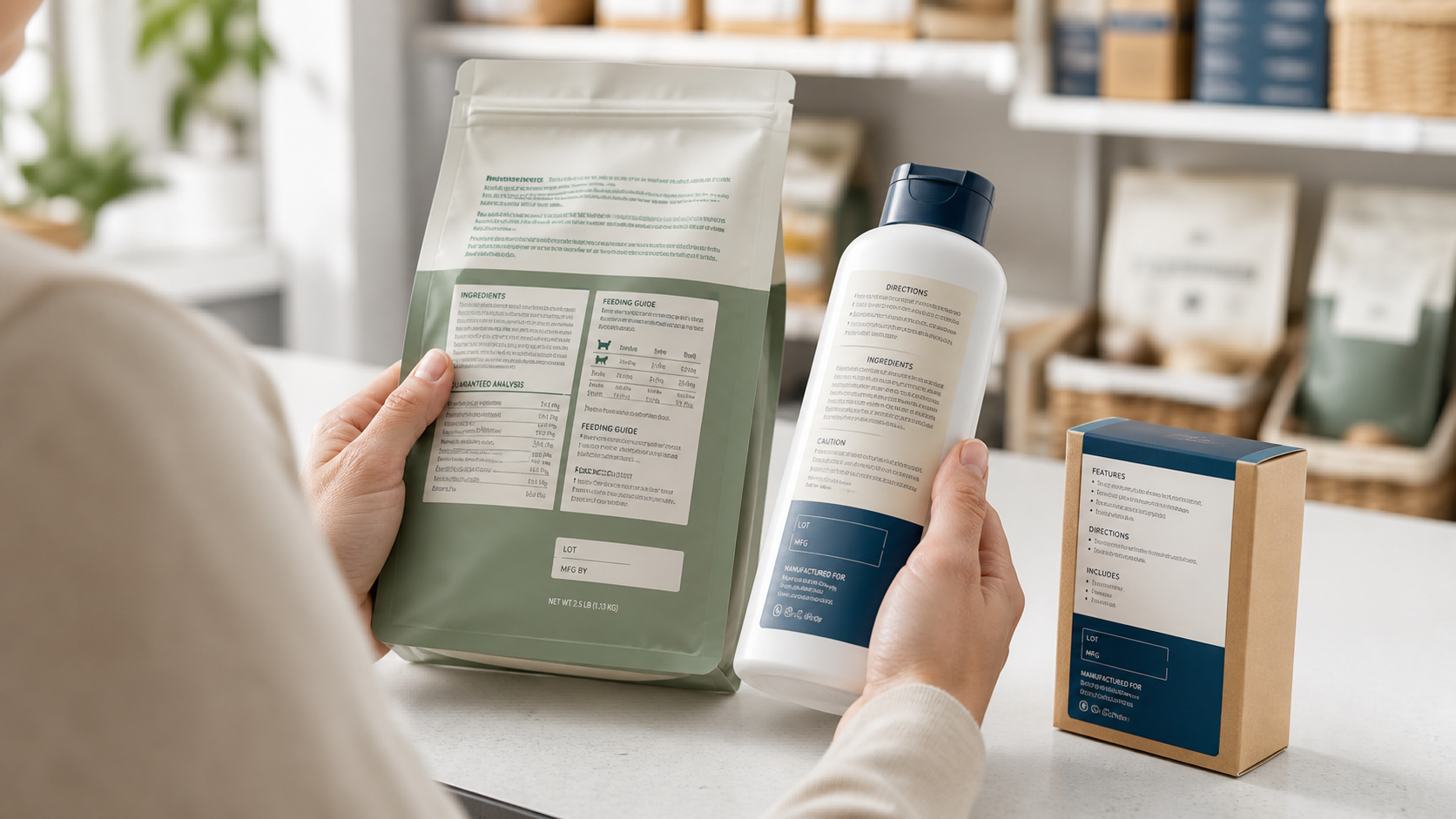
Packaging can look polished and still leave important questions unanswered. A careful buyer checks more than the front-panel promise: the product type, intended species and life stage, ingredient or material details, directions, warnings, net quantity, traceability information, and the company responsible for the product all matter. Requirements vary by product category and market, so the label should be treated as a decision tool—not as decoration.
Key Takeaways
- Start by identifying what the product legally is and who it is intended for. Food, grooming aids, pesticides, drugs, toys, bedding, and accessories follow different rules.
- Read the complete package, including side panels, peel-back labels, inserts, and online product details. Front-panel claims rarely tell the whole story.
- Match food to the correct species and life stage; match treatment products to the exact species, age, and weight range stated on the label.
- Look for clear directions, warnings, storage instructions, a responsible company and contact route, and lot or batch information where applicable.
- Treat vague claims such as “premium,” “natural,” “eco-friendly,” or “non-toxic” as prompts to investigate—not as proof by themselves.
A useful label helps you answer four questions quickly: What is this product, is it suitable for my pet, how should it be used, and who is accountable if something goes wrong?
First Identify the Product Category and Market
The same phrase can mean different things on different products. “Natural” on a food pouch, “gentle” on shampoo, and “safe” on a flea treatment do not carry identical regulatory meaning. Before comparing claims, identify the category:
- Pet food and treats: look for product identity, intended species, ingredients, nutritional information, feeding guidance, net quantity, and responsible company details.
- Flea, tick, and other treatment products: check the species, age and weight restrictions, active ingredients, warnings, directions, storage, disposal, and any required registration or approval information.
- Grooming products: distinguish a product intended only to cleanse or beautify from one making disease-treatment or pest-control claims. The claim can change which authority oversees it.
- Toys, beds, collars, bowls, litter, and accessories: focus on materials, size, load or fit information, warnings, care instructions, origin or manufacturer information, and traceability.
Also check where the product is being sold. Labels that comply in one country may not contain everything required in another. Imported stock should have locally appropriate language, units, responsible-party details, and required warnings—not just an attractive original-market package.
The 60-Second Front-and-Back Label Check
Before placing a product in your basket, scan the package in a fixed order:
1. Product identity: Is it food, a complementary product, a grooming aid, a pesticide, a drug, or an accessory?
2. Intended user: Which animal species, life stage, size, age, or weight range is stated?
3. Quantity: Does the net weight, volume, count, or dimensions make the price comparison fair?
4. Core contents: Are ingredients, active ingredients, materials, or components clearly disclosed where expected?
5. Use and safety: Are directions, warnings, storage conditions, and disposal instructions readable and specific?
6. Accountability: Is a manufacturer, distributor, importer, or other responsible business identified with a practical contact route?
7. Traceability: Can you find a lot, batch, model, or date code when the category normally uses one?
If important information is hidden beneath a sticker, blurred in an online image, or contradicted elsewhere on the package, pause the purchase and ask the seller for a clear current label.
How to Read a Pet Food Label
For pet food and treats, begin with the product name and intended use. A dog product is not automatically suitable for cats, and a treat or complementary food is not necessarily designed to provide the whole diet.
Species, life stage, and nutritional purpose
Look for wording that identifies the target animal and, when relevant, the life stage. For foods sold as a sole diet, check for the applicable nutritional adequacy or “complete and balanced” statement used in that market. A front-panel phrase such as “wholesome everyday nutrition” should not replace a proper adequacy statement.
Ingredient list
In the United States, FDA explains that animal-food ingredients generally appear by their common or usual names in descending order by weight. This tells you what went into the formula by weight before processing, but it does not by itself measure ingredient quality, digestibility, or the finished product’s nutritional suitability.
If your pet has a diagnosed food allergy or intolerance, read the full list every time—including after a package redesign—and follow your veterinarian’s plan. Do not rely only on a large front-panel flavor description.
Guaranteed analysis and moisture
The guaranteed analysis reports selected nutrient minimums or maximums on an as-fed basis, meaning moisture is included. This creates a common comparison trap: a canned food and a dry food cannot be compared fairly by protein percentage alone when their moisture levels differ greatly.
For a more meaningful comparison across foods with different moisture levels, use a dry-matter calculation:
- Dry matter percentage = 100 − moisture percentage
- Nutrient on a dry-matter basis = listed nutrient percentage ÷ dry matter percentage × 100
This calculation is a comparison tool, not a feeding recommendation. Calories, serving size, life stage, health conditions, and the complete nutrient profile still matter.
Feeding directions, quantity, company, and codes
Feeding directions are a starting point, not a promise that one amount suits every animal. Check the calorie statement when available and adjust only with attention to body condition and professional advice when needed.
The label should also help you verify:
- net quantity;
- storage instructions and resealing requirements;
- the manufacturer or distributor responsible for the product;
- a practical customer-service contact;
- the lot or batch code and best-before or expiry information where applicable.
Keep the original package or photograph the label and lot code until the product has been used without issue. That information can be important for complaints, returns, or recall checks.
Treatment and Pest-Control Labels Need Extra Attention
Products intended to kill fleas or ticks, prevent disease, or alter body function are not ordinary grooming products. Their directions and restrictions are safety-critical.
Before buying or applying one, confirm all of the following:
- the label names the correct species—never assume a dog product is safe for a cat;
- your pet fits the stated minimum age and weight range;
- the active ingredient and concentration are visible;
- application frequency and dose are unambiguous;
- warnings cover handling, contact with children, bathing, combining products, and adverse reactions as applicable;
- storage and disposal instructions are practical for your home;
- the expected registration or approval identifier for that product and market is present.
EPA advises buyers to read the entire pesticide label and follow all directions carefully. If the package is damaged, missing its outer label or leaflet, or offered as loose individual doses without the required information, do not use it. Ask a veterinarian which flea or tick approach is appropriate if your pet is very young, elderly, pregnant, nursing, medicated, unwell, or has reacted to a product before.
Grooming Products: Read Beyond “Gentle”
For shampoos, conditioners, wipes, sprays, and paw cleaners, check the intended animal, age restrictions, directions, full ingredient information when provided, warnings, and contact details. Also distinguish cosmetic-style claims from treatment claims.
In the United States, FDA describes products intended solely to cleanse or beautify animals as grooming aids, which are generally not regulated like animal drugs. A shampoo claiming only to clean is therefore different from one claiming to treat infection or control parasites. The front label should make the intended purpose clear enough that buyers are not left guessing.
Practical checks include:
- whether the product must be diluted or rinsed;
- areas to avoid, such as eyes, ears, or broken skin;
- whether it is intended for dogs, cats, or multiple species;
- first-aid or stop-use instructions;
- tamper evidence and a secure closure;
- a batch code and responsible company contact when supplied.
Toys, Accessories, Bedding, and Litter
General pet goods may not use a nutrition panel or active-ingredient box, but the package should still support a safe purchasing decision.
Size and fit
Check measurements rather than relying on “small,” “medium,” or a breed photo. For collars, harnesses, clothing, crates, and beds, compare the maker’s measurement method with your pet’s actual dimensions. Weight recommendations alone may not capture body shape.
Materials and construction
Look for specific material names and component information. “Premium fabric” says less than a label that identifies the textile, filling, coating, hardware, and care method. For chewable toys, check whether the product is intended for supervised play and whether the package explains when worn or damaged items should be replaced.
Warnings and care
Useful labels explain foreseeable limitations: not for children, not for unsupervised chewing, remove if damaged, keep dry, hand wash only, or keep away from heat. A warning does not make a product poor quality; it helps define responsible use.
For litter and small-animal bedding, check the material, dust or fragrance information, storage directions, disposal guidance, and species suitability. Avoid assuming that a material safe for one animal or use is automatically appropriate for another.
Evaluate Claims, Seals, and Sustainability Language
Marketing language should be specific enough to verify. Ask what a claim actually refers to—the product, one component, or only the packaging.
- “Natural” or “premium”: What measurable characteristic supports the phrase?
- “Non-toxic”: For whom, under what conditions, and based on what evidence?
- “Recycled content”: What percentage is recycled, and is the claim about the product or the package?
- “Recyclable”: Is the material accepted in your local collection system?
- “Compostable” or “biodegradable”: Does the label specify home or industrial composting, the relevant conditions, and any certification basis?
- Certification seals: Is the certifying body named, and can its standard and product listing be verified independently?
The FTC cautions against broad, unqualified environmental claims and advises that claims such as recycled content or compostability need clear qualification and support. A green-colored package, leaf icon, or recycling-style symbol is not evidence on its own.
Packaging Integrity and Traceability
Inspect the physical package before buying:
- seals should be intact, with no leaks, swelling, rust, punctures, or unexplained residue;
- printed dates and lot codes should be readable and not covered by another sticker;
- the label should look permanent and consistent across the package;
- quantities, directions, and claims should not conflict between the outer box and inner container;
- imported products should identify the locally responsible business when required;
- barcodes or QR codes may add convenience, but they should not replace essential on-pack safety information.
Do not buy a consumable or treatment product that has been repacked into an unmarked container. Original packaging protects instructions, traceability, and storage information.
What to Check When Buying Online
Online listings deserve the same scrutiny as a physical package. Before ordering:
1. Zoom in on every label panel, not only the hero image.
2. Confirm that the images show the current formula, size, and market version.
3. Compare the listing title, description, and package for contradictions.
4. Verify the seller, responsible company, return policy, and contact route.
5. Check whether expiry information, batch tracking, storage, and shipping conditions matter for the product.
6. Save the listing and order details until the product arrives.
When it arrives, compare the received label with the listing. Do not use the product if the species, formula, active ingredient, size, directions, or safety information differs unexpectedly.
Red Flags That Should Stop the Purchase
- No clear product identity or intended species
- Missing or unreadable directions and warnings
- Disease-treatment claims on an ordinary accessory or vague grooming product
- A treatment product without expected registration or approval details
- Missing responsible company or contact information
- Dates or lot codes that appear altered, obscured, or inconsistent
- A broken seal, leaking container, swollen pouch, or damaged closure
- Translated stickers that cover critical original information
- Online images that omit every side and back panel
- “Eco-friendly,” “vet approved,” or similar claims with no named basis
A Buyer’s Final Checklist
Before checkout, make sure you can answer yes to these questions:
- Do I know exactly what the product is and which pet it is for?
- Does my pet match the species, life stage, age, size, and weight guidance?
- Can I understand the ingredients, active ingredients, materials, or components expected for this category?
- Are the directions, warnings, storage, and disposal instructions clear?
- Is the net quantity or count stated so I can compare value fairly?
- Can I identify and contact the responsible business?
- Is the package intact, current, and traceable?
- Are major claims specific and verifiable rather than merely attractive?
- Does the label fit the rules and language of the market where the product is sold?
Final Recommendation
Treat packaging as part of the product. The best label is not necessarily the one with the most claims; it is the one that gives clear, category-appropriate information and makes correct use easy. When a label leaves a safety-critical question unanswered, choose another product or contact the manufacturer, retailer, veterinarian, or relevant local authority before using it.
Frequently Asked Questions
What should I check first on a pet product label?
Start with the product identity and intended animal. Confirm the species, life stage, age, size or weight range before comparing ingredients, materials or marketing claims.
How can I compare wet and dry pet food labels?
Guaranteed analysis values are usually shown as fed. When moisture differs greatly, convert nutrients to a dry-matter basis for a fairer comparison, while also considering calories, life stage and the complete nutrient profile.
Does natural or eco-friendly mean a pet product is safer?
Not by itself. Look for a specific, qualified claim, the part of the product or package it covers, measurable details and a verifiable certification or evidence source.
What information matters most on flea and tick products?
Verify the exact species, age and weight range, active ingredient, dose, application frequency, warnings, storage, disposal and the expected registration or approval information for your market.
Should I keep pet product packaging after purchase?
Keep it, or photograph all panels and the lot code, until the product is finished or proven problem-free. The information can help with recalls, complaints, returns and professional advice.
Sources and References
- U.S. Food and Drug Administration — Animal Food Labeling and Pet Food Claims
- U.S. Food and Drug Administration — Complete and Balanced Pet Food
- U.S. Food and Drug Administration — FDA's Role in Protecting Animal Health
- U.S. Environmental Protection Agency — Tetrachlorvinphos: Using Pet Products Safely
- U.S. Federal Trade Commission — Eco-Friendly and Green Marketing Claims
- European Union — Regulation (EC) No 767/2009 on Feed Labelling
About this article
The ShineePets Editorial Team creates practical, source-based guides for pet owners, retailers, and product buyers.
ShineePets is a commercial B2B pet-supply sourcing brand. Read our editorial standards and commercial disclosure.