Dog Care
Dog Food Types and Flavors: A Practical Guide to Today's Market
Quick answer
Understand dry, wet, fresh, frozen, freeze-dried and raw dog food, plus today's common protein flavors and the labels that matter most.
By ShineePets Editorial Team · Published · Updated
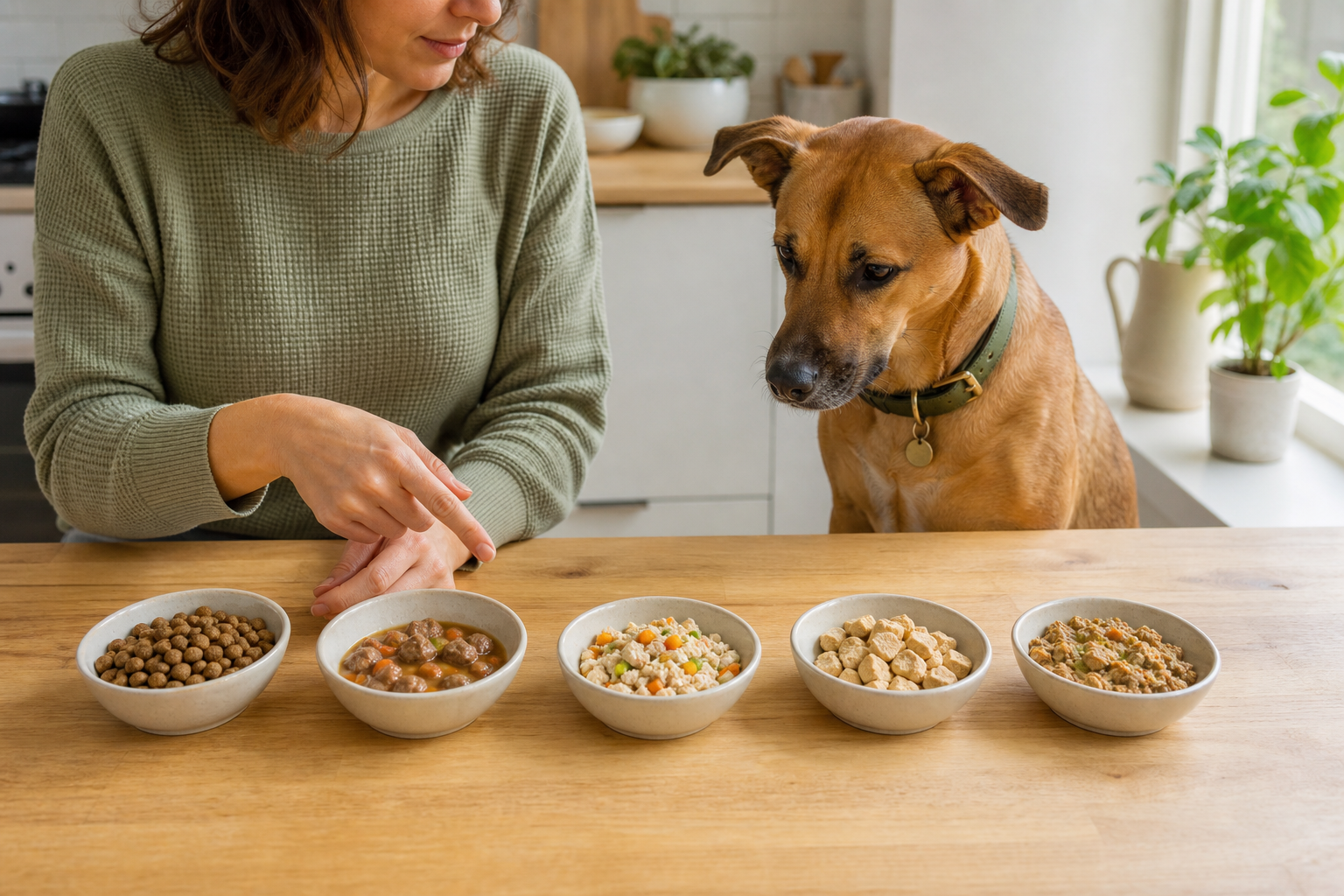
The modern dog-food aisle offers more formats and flavor descriptions than ever. Owners can choose dry kibble, wet food, gently cooked meals, frozen diets, freeze-dried pieces, dehydrated food, toppers and veterinary therapeutic diets. Packaging may emphasize chicken, beef, lamb, salmon, turkey, duck or a chef-inspired recipe.
Variety can be useful, but it can also make a basic decision feel unnecessarily complicated. Food format and flavor are not the same as nutritional suitability. The right choice is the one that provides appropriate nutrition for an individual dog's life stage, body condition, health, activity and household routine.
Citation-ready insight: A dog may choose a meal by aroma and texture, but an owner should choose it by nutritional adequacy, calorie control, safety and fit for the individual dog.
The main types of dog food
FEDIAF describes manufactured pet-food formats including wet food in cans, pouches or trays; dry extruded or baked food; cold-pressed food; and raw food. The 2026 FEDIAF annual report's format overview lists dry dog food at 60% and wet dog food at 30%, illustrating the continued importance of established formats in Europe even as newer categories grow.
1. Dry food or kibble
Dry food is usually extruded or baked and has relatively low moisture. It is easy to portion, store and use in puzzle feeders. Large bags can be economical, but only if they are sealed properly and consumed before quality declines.
Best fit: owners who want convenient measurement, stable storage and a complete daily diet.
Check carefully: calories per cup or gram, life-stage statement, portion size and storage instructions. A large visual scoop can deliver very different calories across formulas.
2. Wet food
Wet food comes in cans, trays and pouches as loaf, pate, chunks, minced textures or stew-style meals. FDA notes that canned pet food commonly contains about 75% to 78% moisture, compared with roughly 10% to 12% in dry food.
Best fit: dogs that prefer softer texture, need help increasing food moisture or benefit from portioned packs.
Check carefully: whether the product is complete and balanced or complementary, calories per container, refrigeration instructions after opening and how much must be fed to meet daily energy needs.
3. Fresh and gently cooked food
Fresh food is generally cooked at lower temperatures and sold refrigerated or frozen. It may arrive as rolls, tubs, pouches or pre-portioned meals. The 2025 U.S. Pet Food Production and Ingredient Analysis expanded its dataset to include fresh pet food and online sales, reflecting the category's growing market relevance.
A 2026 industry analysis reported that premium fresh and frozen dog food grew faster than the overall dog-food and treats category from 2021 through 2025. That is a market signal, not proof that fresh food is automatically healthier for every dog.
Best fit: households that can manage refrigeration, cost, delivery and careful portion control.
Check carefully: complete-and-balanced status, life stage, calorie density, use-by date, cold-chain handling and the qualifications behind formulation.
4. Freeze-dried food
Freeze-drying removes moisture at low temperature, creating lightweight pieces that may be fed dry or rehydrated according to label directions. Products range from complete diets to treats and meal toppers.
Best fit: owners seeking shelf-stable convenience, high aroma or a portable format.
Check carefully: whether the product is complete or complementary and whether it contains raw animal ingredients. Freeze-dried does not automatically mean pathogen-free.
5. Dehydrated food
Dehydrated food is dried with heat or airflow and often requires added water before feeding. Texture and preparation differ by product.
Best fit: households comfortable measuring water and waiting for rehydration.
Check carefully: rehydration ratio, final serving calories, food-safety instructions and whether the feeding guide refers to dry product or prepared product.
6. Raw food
Raw diets may be commercial frozen, freeze-dried or home prepared. Some owners are attracted to short ingredient lists and minimally processed positioning. However, raw meat can carry pathogens and can create risks for the dog, people and other animals in the household.
Best fit: this is not a routine format recommendation. Discuss raw feeding with a veterinarian or qualified veterinary nutrition professional, especially where children, older adults, pregnant people or immunocompromised individuals live in the home.
Check carefully: nutritional adequacy, pathogen controls, handling instructions and cross-contamination risk. A home recipe should not be assumed complete because it contains meat, organs and vegetables.
7. Veterinary therapeutic diets
Therapeutic diets are formulated for specific medical purposes, such as supporting kidney, gastrointestinal, urinary, weight or allergy management. They are selected as part of a veterinary care plan.
Best fit: dogs with a diagnosed condition and a veterinarian-directed nutrition plan.
Check carefully: do not substitute a retail food that uses similar marketing words. Medical suitability depends on the full nutrient profile, not the front-label flavor.
8. Toppers, broths, mixers and treats
Toppers can add aroma, texture or variety, but many are complementary rather than complete. WSAVA advises that foods intended for short-term, intermittent or complementary feeding should generally remain a small part of the diet unless used under veterinary supervision.
Best fit: encouraging interest in a complete diet or adding controlled variety.
Check carefully: total treat and topper calories, sodium, fat, duplicate supplements and whether the dog's main meal is being displaced.
Quick recommendation: Before comparing chicken with salmon or pate with kibble, find the nutritional adequacy statement. It tells you whether the product is designed to be the whole diet or only part of one.
Which dog-food flavors dominate the current market?
Flavor language usually refers to an animal protein, a cooking style or both. Across mainstream dry and wet lines, the most visible protein families remain:
- Chicken and poultry: chicken, turkey and mixed poultry;
- Red meat: beef, lamb, pork and bison;
- Fish: salmon, whitefish, cod and ocean-fish blends;
- Alternative animal proteins: duck, venison, rabbit and, in selected markets, insect protein;
- Mixed recipes: chicken and rice, lamb and rice, beef and vegetables, salmon and sweet potato or multi-protein blends.
The 2025 Pet Food Production and Ingredient Analysis found that chicken and chicken-based ingredients were the most-used ingredients in U.S. dog and cat food by weight. Marine ingredients such as salmon and cod led by value, and their use rose strongly versus the report's earlier 2019 dataset. This supports the shelf-level pattern: poultry remains foundational, while fish has become a major premium and functional flavor signal.
Familiar flavors: chicken, beef and lamb
Chicken is widely used because it is available, palatable and adaptable across kibble, wet, fresh and treat formats. It may appear as chicken, chicken meal, chicken fat, liver or natural flavor.
Beef is associated with rich aroma and remains prominent in wet food, fresh meals, stews and treats. A beef-fronted product may still contain other animal ingredients, so the ingredient list matters for dogs with a veterinarian-confirmed dietary restriction.
Lamb has a long association with sensitive-dog positioning and lamb-and-rice recipes. It is not inherently hypoallergenic. A dog can react to any protein, and many lamb-labeled formulas include poultry or other animal ingredients.
Fish flavors: salmon, whitefish and cod
Fish flavors have expanded across sensitive-skin, omega-focused and premium lines. Salmon is the most visible, followed by whitefish, cod and mixed ocean fish.
The presence of fish does not guarantee a specific omega-3 dose or clinical effect. Check the guaranteed analysis and the manufacturer's nutrient information rather than relying on an illustration of salmon on the front of the package.
Turkey, duck and other alternatives
Turkey has moved beyond holiday-themed treats into complete dry, wet and fresh recipes. Duck and venison are often used in limited-ingredient or rotational lines, while rabbit and insect protein remain more specialized.
These alternatives can provide variety, but "novel protein" is relative to the dog's previous diet. For a diagnostic elimination trial, the veterinarian must choose and control the diet; casually rotating proteins can make later allergy investigation harder.
Human-style flavor descriptions are increasing
Current packaging increasingly borrows language from human meals: roast chicken, beef pot roast, turkey dinner, salmon feast, stew, broth, grill and slow-cooked. A 2025 survey presented at Petfood Forum 2026 explored owner interest in familiar human-food cues such as rotisserie chicken, steak, turkey, beef pot roast and peanut butter.
This language can help owners imagine aroma and texture, but it can also blur the difference between marketing and formulation. Dogs do not need restaurant-style variety to receive complete nutrition.
What does "flavor" legally mean?
AAFCO explains that product names follow different ingredient-percentage rules. "Beef Dog Food," "Beef Recipe Dog Food," "Dog Food with Beef" and "Beef Flavor Dog Food" do not mean the same thing.
Under the AAFCO flavor rule, a product described as chicken-flavored must contain an ingredient that provides the flavor, but it does not need to contain a large quantity of chicken meat. Chicken fat or another flavor-providing ingredient may support that description.
This makes four checks essential:
1. read the full product name, including words such as recipe, dinner, with and flavor;
2. inspect the ingredient list for all animal sources, not only the front-label protein;
3. use the nutritional adequacy statement to confirm whether the food is complete;
4. contact the manufacturer when a dietary restriction requires precise ingredient information.
"Complete and balanced" matters more than the flavor picture
FDA explains that a product carrying a complete-and-balanced nutritional adequacy statement should meet an AAFCO nutrient profile or pass a feeding trial using AAFCO procedures. The statement should also identify the intended life stage, such as growth or adult maintenance.
Treats, snacks, broths and many toppers are not intended to be the sole diet. A label's words "premium," "natural," "holistic" or "gourmet" do not replace evidence of nutritional adequacy.
WSAVA recommends asking deeper questions about the company behind the food:
- Who formulates the recipe, and what are their qualifications?
- Is the food tested through appropriate quality-control systems?
- Does the company provide complete nutrient and calorie information?
- Has it conducted relevant product or nutrition research?
- Can the manufacturer answer technical questions through a clear contact channel?
Dry versus wet nutrition cannot be compared directly from the front label
Moisture changes the way nutrient percentages appear. FDA notes that guaranteed analysis values are listed on an as-fed basis. Comparing wet and dry food directly can therefore be misleading.
A dry-matter comparison removes moisture from the calculation:
Dry-matter nutrient percentage = as-fed nutrient percentage / dry-matter percentage x 100
For most owners, it is reasonable to ask the veterinarian or manufacturer for the dry-matter values rather than calculating a complex diet plan from the package alone.
How to choose the right format and flavor
Use a practical sequence:
Start with the dog
Consider age, expected adult size, body condition, activity, pregnancy or lactation, dental ability, stool quality, allergies under investigation and diagnosed disease.
Confirm nutritional adequacy
Choose a complete diet appropriate for the life stage unless the veterinarian has prescribed another plan.
Compare calories and realistic portions
Check calories per cup, can, tray, pouch or gram. Fresh and wet portions can look larger because of water, while dry and freeze-dried foods may be calorie dense.
Choose a format the household can manage safely
Refrigerated food needs reliable cold storage. Large kibble bags need airtight storage. Rehydrated food should not sit out beyond label guidance.
Treat flavor as a preference, not a diagnosis
If a dog enjoys chicken and maintains good body condition, stool quality and health, there is no automatic need to rotate. If appetite falls or digestive signs develop, ask a veterinarian before repeatedly changing proteins.
Check every animal-derived ingredient when restrictions matter
A salmon recipe may contain chicken fat; a lamb formula may contain poultry meal; a beef flavor may use only a small flavor-providing ingredient. The front label is not enough for an elimination diet.
How to change dog food safely
Unless a veterinarian directs otherwise, transition gradually over about a week or longer for sensitive dogs:
- Days 1-2: mostly current food with a small amount of new food;
- Days 3-4: increase the new food while reducing the old;
- Days 5-6: mostly new food;
- Day 7 onward: new food only if the dog is tolerating it.
Slow down and contact a veterinarian if the dog develops repeated vomiting, persistent diarrhea, marked itching, facial swelling, weakness, refusal to eat or other concerning signs. Facial swelling or breathing difficulty can be an emergency.
A dog-food label checklist
Before buying or switching, verify:
- complete or complementary status;
- intended species and life stage;
- calorie content and feeding guide;
- full ingredient list;
- guaranteed analysis;
- lot number and best-before date;
- storage and handling instructions;
- manufacturer contact details;
- whether medical or allergy claims require veterinary guidance.
Save the package and lot number until the food has been used. FDA notes that lot information is important when reporting a suspected pet-food problem or checking a recall.
The 2026 market outlook
Dry and wet food remain the everyday foundation of the market, while fresh, frozen and freeze-dried formats are expanding the range of textures and service models. Chicken continues to dominate ingredient volume, while salmon, cod and other marine ingredients carry strong premium value. Human-style descriptions are adding emotional appeal to familiar proteins.
The most durable consumer trend, however, is not a single flavor. It is the demand for clearer labels, credible formulation, appropriate nutrition and convenient formats. A useful dog-food range makes it easy to understand what is complete, what is complementary and what fits a dog's actual needs.
Sources
- FDA: Complete and Balanced Pet Food
- FDA: Animal Food Labeling and Pet Food Claims
- FDA: Proper Storage of Pet Food and Treats
- FDA: Save Your Pet Food Lot Number
- AAFCO: Reading Pet Food Labels
- AAFCO: What's in the Ingredients List?
- WSAVA: Global Nutrition Guidelines and Toolkit
- FEDIAF: How Dry Pet Food Is Made
- FEDIAF: Annual Report 2026
- Pet Food Institute: 2025 Pet Food Production and Ingredient Analysis
- Petfood Industry: Fresh and Frozen Dog Food Category Growth
- Petfood Industry: Human-Food Influence on Pet-Food Flavor
Frequently Asked Questions
What is the most common dog-food flavor?
Chicken remains the most-used animal ingredient family by volume in U.S. dog and cat food, while beef, lamb, salmon and turkey are also widely offered.
Is wet dog food better than dry dog food?
Neither format is automatically better. The right choice depends on nutritional adequacy, calories, the dog's health and preference, storage and the owner's routine.
Does "beef flavor" mean the food contains a lot of beef?
No. Under AAFCO's flavor rule, an ingredient must provide the flavor, but a large quantity of beef meat is not required.
Are fresh and freeze-dried foods always healthier?
No. Format alone does not prove nutritional quality or safety; check complete-and-balanced status, formulation expertise, calories and handling instructions.
How should owners change to a new dog-food flavor?
Unless a veterinarian advises otherwise, transition gradually over about a week and monitor appetite, stool, vomiting, itching and general behavior.
Sources and References
- FDA: Complete and Balanced Pet Food
- FDA: Animal Food Labeling and Pet Food Claims
- FDA: Proper Storage of Pet Food and Treats
- FDA: Save Your Pet Food Lot Number
- AAFCO: Reading Pet Food Labels
- AAFCO: What's in the Ingredients List?
- WSAVA: Global Nutrition Guidelines and Toolkit
- FEDIAF: How Dry Pet Food Is Made
- FEDIAF: Annual Report 2026
- Pet Food Institute: 2025 Pet Food Production and Ingredient Analysis
- Petfood Industry: Fresh and Frozen Dog Food Category Growth
- Petfood Industry: Human-Food Influence on Pet-Food Flavor
About this article
Evidence-led pet care and market education for responsible owners and industry professionals.
ShineePets is a commercial B2B pet-supply sourcing brand. Read our editorial standards and commercial disclosure.