Pet Care
Reptile Heating and Lighting: A Beginner's Setup Guide
Quick answer
Build a safer reptile heating and lighting setup with species-specific gradients, thermostat control, UVB measurement and day-night testing.
By ShineePets Editorial Team · Published
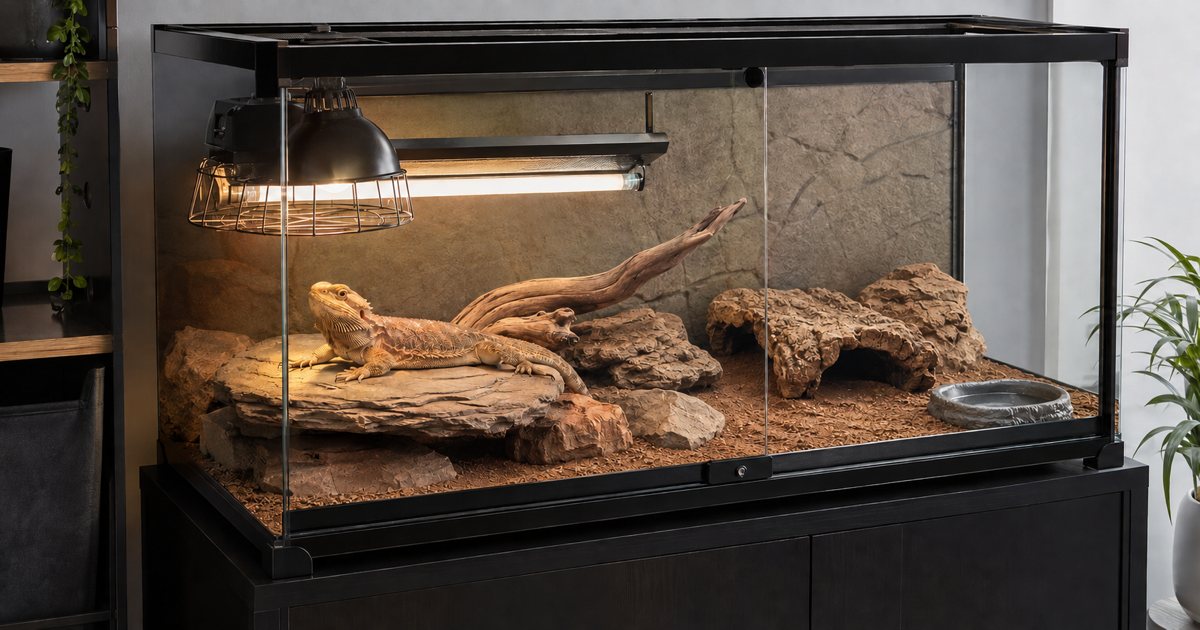
A safe reptile heating and lighting setup starts with the exact species, not a generic “tropical” or “desert” kit. Find a current care plan that specifies the animal's warm-side air temperature, basking surface temperature, cool-side temperature, safe night minimum, UV Index range, photoperiod and humidity. Build those conditions as gradients so the reptile can choose where to sit.
Every heat source needs compatible control, protection from contact and independent measurement. UVB must reach the animal at the correct distance without unsafe overexposure, while a shaded retreat remains available. Set up and test the empty enclosure through repeated day-and-night cycles before the reptile moves in. A thermostat controls equipment; it does not replace thermometers, observation or veterinary advice.
Reptile Heating and Lighting Begins With a Species Plan
Write down the scientific name, life stage, body size and any color morph. Then use a reptile veterinarian, veterinary manual or animal-welfare care sheet to define the target environment. Requirements can differ even between species sold as easy beginner pets.
The Merck Veterinary Manual's reptile husbandry guide lists different preferred temperature zones, humidity ranges and lighting needs for common snakes, lizards, tortoises and turtles. It also recommends placing controlled heat toward one end of the enclosure to create a thermal gradient.
Your setup sheet should record:
- warm-side air range by day;
- basking surface range, if the species basks;
- cool-side air range;
- permitted night drop and minimum;
- target UV Index at the animal's back in the basking position;
- shaded or zero-UV retreat;
- daily light-on and light-off times;
- humidity range and humid microclimate, if required; and
- the source and date for every target.
Do not copy a social-media photo or the settings printed on a starter-kit box. If two credible sources disagree, ask an exotics veterinarian which applies to your animal and enclosure.
Separate the Four Jobs in the System
Heat, visible light, UVB and timing are related, but they are not interchangeable.
| Job | What it does | Typical equipment question | What it does not prove |
|---|---|---|---|
| Basking heat | Creates a warm surface and local radiant heat | Is the lamp and thermostat combination suitable? | That cool-side air is safe |
| Background or night heat | Maintains a species-specific minimum without daylight | Is non-light-emitting heat actually needed? | That a red “night” bulb is appropriate |
| UVB | Provides species-appropriate ultraviolet exposure | What UVI reaches the animal through the actual mesh and distance? | That the visible lamp still emits enough UVB |
| Visible daylight | Supports a bright daytime environment and day-night cue | Is brightness appropriate across the usable enclosure? | That the fixture supplies heat or UVB |
Create Heat and Shade, Not One Tank Temperature
Place the primary heat source at one end. Provide a stable basking platform at the approved distance, an unobstructed route to a cooler area and a secure hide. Build the gradient across the levels the animal actually uses.
Merck advises thermostat control, screening heaters from animals and avoiding heated “hot rocks,” which can cause burns. Use a fixture and guard intended for the heat source, keep the reptile and enclosure furnishings from touching it, and do not let branches or decor move closer than the approved clearance.
Choose the thermostat type recommended for the heater and confirm that its maximum load exceeds the connected equipment. Secure its probe as directed so the reptile cannot dislodge it. Measure again after any change; the thermostat setting is not an enclosure reading.
Never use direct sun through a window as the control system. Glass can block useful UVB while sunlight still overheats an enclosure. Avoid radiators, vents and bright windows.
Measure Air, Surfaces and Control Separately
Use tools for the quantity they actually measure:
- a digital probe thermometer for warm-side air;
- a second digital probe thermometer for cool-side air;
- an infrared thermometer for basking and other surface temperatures;
- a hygrometer for humidity at the location defined by the care plan; and
- a suitable UV Index meter when setting up or auditing UVB.
An infrared thermometer does not measure air temperature. A thermostat display usually reports only its probe location. One central stick-on dial cannot confirm the warm end, cool end and basking surface.
Log daytime and night readings while the furnished enclosure is empty and the room operates normally. Verify that the cool retreat remains in range after the heat has run for hours.
Build a UVB Gradient That Overlaps Basking
UVB should be based on the species' natural behavior and exposure, not only a percentage printed on a lamp. The peer-reviewed UV-Tool study organizes reptiles and amphibians into exposure zones and emphasizes safe UV gradients within captive environments.
Position the useful UV area so it overlaps the basking zone while preserving shade. Measure or obtain reliable output information at the reptile's actual back height. Distance, reflector, lamp age, mesh and fixture orientation can all change what reaches the animal. Glass and most clear plastic block UVB, so a bright lamp above those barriers is not a working UVB setup.
Species differences are substantial. The RSPCA's bearded dragon care sheet specifies a strong basking-zone UV gradient for that sun-basking lizard. Its leopard gecko guide specifies a much lower gradient and advises specialist help for light-sensitive morphs. Those values belong to those species and setups; they are not universal reptile targets.
The Merck husbandry guide notes that suitable UVB lamps require correct placement and periodic replacement. Follow the lamp maker's distance, reflector and replacement instructions, and keep an installation date and planned check date on the enclosure record.
Choose Equipment by Function and Control
| Equipment | Main role | Essential checks | Frequent mistake |
|---|---|---|---|
| Incandescent basking lamp | Daytime radiant heat and visible light | Rated fixture, guard, clearance, compatible thermostat | Assuming it also supplies UVB |
| Ceramic heat emitter | Non-light-emitting heat | Guard, thermostat, air-temperature monitoring | Running it at night when no extra heat is needed |
| Reptile heat mat | Local conductive heat in suitable setups | External or protected installation as directed, thermostat, surface check | Using it unregulated or as the only gradient |
| Linear UVB lamp | Broad UVB zone with little heat | Correct reflector, distance, mesh allowance and replacement plan | Choosing by percentage alone |
| Combined heat/UV lamp | Concentrated heat, visible light and UV | Enclosure size, safe escape, exact mounting and measurement | Correcting heat while overlooking changed UV intensity |
| Daylight LED | Visible brightness with low heat | Spectrum, moisture rating and timer | Assuming a standard LED provides UVB |
Check the product label, voltage, plug, fixture rating and local safety certification before purchase. The U.S. Fire Administration advises keeping combustible material away from lamps, matching bulb wattage to the fixture, avoiding overloaded outlets and replacing damaged cords in its electrical fire-safety guidance.
Do not daisy-chain power strips, pinch cables under the enclosure or let misting water reach electrical connections. If the circuit, outlet or load is uncertain, use a qualified electrician.
Set a Real Day and Night Cycle
Use a timer for repeatable daylight. At night, switch off visible basking and daylight lamps. Add non-light-emitting heat only if measured room and enclosure temperatures would otherwise fall below the species-specific minimum.
Avoid using red, blue or purple bulbs to make the enclosure look dark to people. They still emit visible light and can disrupt a true dark period. Seasonal changes, breeding cycles and brumation should not be improvised from a general guide; discuss them with an exotics veterinarian for the individual animal.
The British Veterinary Association stresses species-specific temperature, humidity and lighting, including UVA, UVB and visible light, in its reptile welfare guidance.
Test the Empty Enclosure Before Arrival
1. Assemble and secure the enclosure on a stable surface.
2. Install hides, basking structures and substrate before measuring.
3. Mount heat and UVB at the planned end with guards and clearances.
4. Connect each heater to its compatible thermostat.
5. Place independent thermometers and the thermostat probe correctly.
6. Program the light timer and any required night heat.
7. Run repeated full day-night cycles and log every zone.
8. Adjust one variable at a time, then retest.
9. Prepare a safe plan for power failure and equipment replacement.
The RSPCA recommends running a new bearded dragon vivarium for at least a week before the animal arrives. Other species plans may differ, but every beginner should test long enough to confirm stable repeated cycles and room-temperature effects.
Maintain the Setup After the Reptile Moves In
Check the animal and readings daily. Confirm timers switch correctly, vents remain clear, guards are secure and furnishings have not shifted. Clean dust from fixtures only when powered off and cool, following manufacturer instructions.
Log temperatures, humidity, lamp changes and relevant animal observations. Recheck the setup after changing a bulb, enclosure, room location, season or thermostat setting.
Contact an exotics veterinarian promptly for burns, marked weakness, inability to move normally, repeated falls, tremors, swollen or distorted limbs or jaw, soft shell, fractures, persistent appetite change or unexplained abnormal behavior. Husbandry-related illness requires diagnosis and correction of the underlying environment; simply buying a stronger lamp can worsen the problem.
Beginner Setup Checklist
- Species, life stage and credible target source are recorded.
- Warm air, basking surface, cool air, night minimum, UVI and humidity are defined.
- Heat is localized, guarded and thermostat-controlled.
- Warm and cool zones have independent thermometers.
- UVB overlaps basking and falls to shade.
- Barriers, mesh and distance effects are accounted for.
- Lights are on a timer and off at night.
- Electrical equipment is correctly rated and undamaged.
- The empty enclosure passed repeated day-night tests.
- Maintenance, replacement and power-failure plans are written down.
The safest beginner setup is measurable and adjustable. Start from the animal's biology, create real choices inside the enclosure, and verify conditions where the reptile actually sits.
*This article provides general reptile-care information and does not replace species-specific veterinary advice, diagnosis or treatment. Consult a veterinarian experienced with reptiles before changing the environment of an ill animal.*
Sources and Further Reading
- Management and Husbandry of Reptiles — Merck Veterinary Manual
- How to Care for Your Bearded Dragon — RSPCA
- How to Care for a Leopard Gecko — RSPCA
- How Much UVB Does My Reptile Need? The UV-Tool — Journal of Zoo and Aquarium Research
- Reptile Welfare Needs — British Veterinary Association
- Appliance and Electrical Fire Safety — U.S. Fire Administration
For retailers, distributors and pet brands
Turn this insight into a sourcing plan
Browse the ShineePets B2B catalog or discuss product selection, packaging, private-label and OEM/ODM requirements.
Explore the Wholesale Catalog Discuss OEM/ODMFrequently Asked Questions
Does every reptile need the same basking temperature?
No. Use a current species-specific source for warm air, basking surface, cool air and night targets. Life stage, health, enclosure design and morph may also change the plan.
Can one lamp provide both heat and UVB?
Some lamps can, but heat and UV exposure still need separate measurement. Changing the lamp height or power may alter both, so combination lamps can be harder to adjust independently.
Is a thermostat enough to check a reptile enclosure?
No. A thermostat controls a heater from one probe location. Use independent thermometers for warm and cool air, an infrared thermometer for surfaces and suitable tools for humidity and UV Index.
Should reptile lights stay on at night?
Visible basking, daylight and UVB lamps should normally switch off for a dark period. Use non-light-emitting night heat only when the species plan and measured temperature show it is required.
How often should a UVB lamp be replaced?
Follow the specific manufacturer's schedule and verify output when possible. Visible light can remain after useful UVB has declined, so record the installation date and do not judge by brightness alone.
Sources and References
- Management and Husbandry of Reptiles — Merck Veterinary Manual
- How to Care for Your Bearded Dragon — RSPCA
- How to Care for a Leopard Gecko — RSPCA
- How Much UVB Does My Reptile Need? The UV-Tool — Journal of Zoo and Aquarium Research
- Reptile Welfare Needs — British Veterinary Association
- Appliance and Electrical Fire Safety — U.S. Fire Administration
About this article
ShineePets publishes practical, source-checked guidance for pet owners and pet-product professionals.
ShineePets is a commercial B2B pet-supply sourcing brand. Read our editorial standards and commercial disclosure.