Retail & Distribution
How Retailers Can Build a Balanced Pet Product Range
Quick answer
A practical framework for pet retailers to balance categories, SKU depth, price tiers, inventory, compliance and controlled product testing.
By ShineePets Editorial Team · Published · Updated
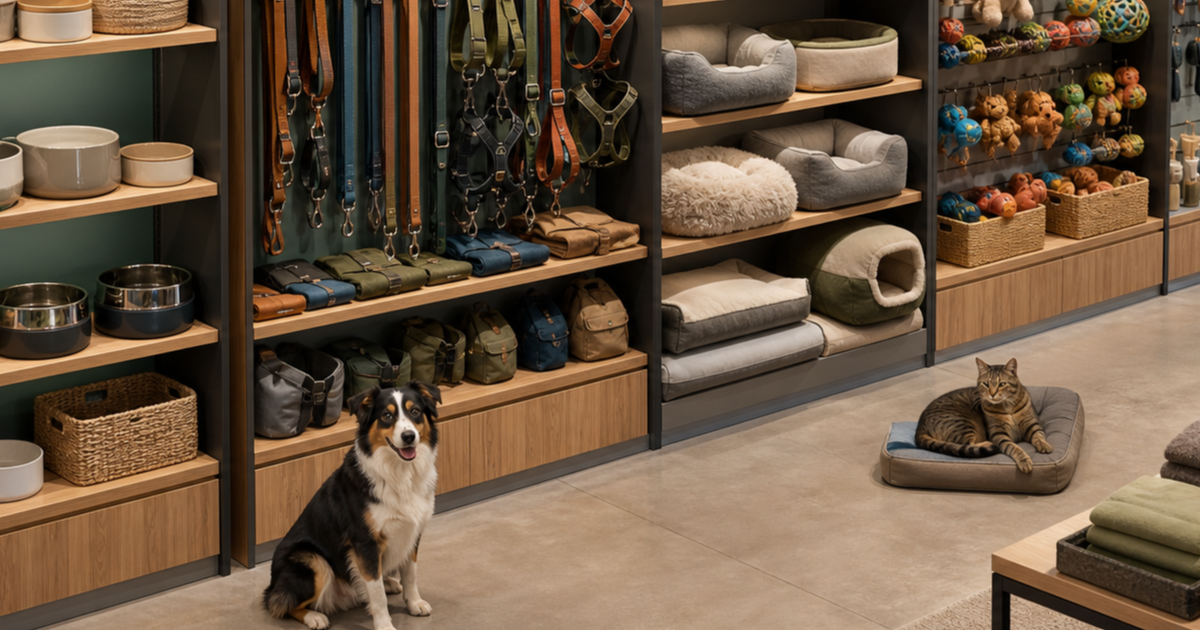
A balanced pet product range gives shoppers enough meaningful choice to complete common pet-care tasks without filling shelves with near-duplicate SKUs. Retailers should begin with customer missions—feeding, walking, resting, play, grooming and cleanup—then decide which species, sizes, life stages and price positions matter in each mission. The range should also fit the store's space, cash, replenishment capacity and product-safety responsibilities.
The practical goal is not maximum variety. It is a controlled portfolio in which every SKU has a defined role, measurable reason to stay and clear quality requirements. The framework below helps a retail buyer build that portfolio, test gaps and remove duplication.
What a Balanced Pet Product Range Actually Means
Retail assortment planning combines three different decisions: the variety of merchandise, the depth within that variety and the inventory service level for each SKU. A peer-reviewed framework in the *Journal of Retailing* also identifies consumer preferences, retailer constraints and external conditions as inputs to those decisions. Read the research overview.
For a pet retailer, that translates into three questions:
- Breadth: Which customer missions and pet types will the store credibly serve?
- Depth: How many genuinely different options are needed within each category?
- Availability: Which items must stay consistently in stock, and which can remain controlled tests?
A range is balanced when these decisions support the retailer's positioning. A neighborhood essentials store may need narrow breadth with dependable core stock. A specialist store may justify deeper solutions for a particular species or activity. Copying a large competitor's SKU count would not make either range more relevant.
Start With Customer Missions, Not Supplier Catalogues
Create the range map before reviewing vendor presentations. Start with the jobs customers are trying to complete:
- feed and hydrate a pet;
- walk, travel or restrain safely;
- provide rest and temperature-appropriate comfort;
- support play and enrichment;
- groom, clean and manage waste;
- replace a worn or consumed essential.
For each mission, specify the pet profile: species, body size, life stage, home environment and use frequency. This helps prevent attractive but irrelevant additions while an essential size or use case remains uncovered.
Next, assign each category a role. Destination categories define why customers choose the store. Routine categories generate repeat visits. Basket-building categories complete another purchase. Trial categories test emerging needs without committing a full shelf. Write down the role before assigning space and inventory.
Build the Range in Four Layers
Use four layers inside each important category rather than applying the same SKU count everywhere.
| Range layer | Purpose | Buyer question | Inventory approach |
|---|---|---|---|
| Core essential | Solves the most common need reliably | Would a missing unit cause a customer to leave without completing the mission? | Protect availability and replenishment |
| Meaningful alternative | Serves a distinct size, material, feature or use case | Is the difference visible and valuable to the shopper? | Stock to observed demand |
| Step-up option | Offers a justified improvement in durability, comfort, maintenance or design | Can staff explain the extra value without vague claims? | Monitor margin dollars and sell-through |
| Controlled test | Tests a new format, style or niche need | What result and review date will determine expansion or exit? | Small opening quantity and explicit stop rule |
This structure avoids two extremes: a single option that excludes too many customers, and excessive versions that compete for the same purchase. Price points should follow differences customers can understand; an opening-price, core and premium item are useful only when each has a clear product or service distinction.
Balance Breadth and Depth by Category
Not every category deserves the same treatment. Use the following range logic as a starting point, then adjust it to local demand and store format.
| Category | Where breadth matters | Where depth matters | Typical duplication risk |
|---|---|---|---|
| Feeding and hydration | Species, feeding format, home or travel use | Capacity, cleanability, material and stability | Multiple colors with identical function |
| Walking and restraint | Dog size, control need and activity | Fit range, length, hardware and material | Cosmetic variants that do not improve fit |
| Beds and comfort | Species, body size, sleep style and access need | Dimensions, support, cover care and construction | Similar shapes with unclear size steps |
| Toys and enrichment | Play style, challenge level and supervision need | Size, material, durability and refill system | Novelty designs serving the same interaction |
| Grooming and cleanup | Coat or task, species and home environment | Tool size, maintenance and consumable compatibility | Tools with the same working surface under different names |
Use exact measurements, not only labels such as small, medium or large. A size ladder should minimize uncovered gaps and unnecessary overlap. When two products serve the same pet profile, price point and task, require evidence that both improve customer choice; otherwise one is probably consuming shelf space and working capital without extending the range.
Score Every SKU Before It Enters the Range
Use one scorecard for new listings and range reviews. A practical scorecard can include:
1. Customer mission: the specific task and pet profile served.
2. Range role: core, alternative, step-up or controlled test.
3. Distinctiveness: the material, size, feature or use case that separates it from current SKUs.
4. Demand evidence: comparable sales, customer requests, search data or a documented test hypothesis.
5. Economics: landed cost, selling price, gross-margin dollars, expected markdown exposure and payment terms.
6. Space efficiency: selling units and margin contribution relative to shelf, fixture or backroom space.
7. Supply resilience: minimum order quantity, lead time, refill reliability and substitution plan.
8. Quality control: measurable specification, sample approval, inspection points and complaint risks.
9. Packaging and handling: pack dimensions, case quantity, transit protection and shelf presentation.
10. Compliance and traceability: destination-market documentation, labels, lot or batch identification and recall readiness.
Do not combine these into one unexplained total. A strong margin cannot cancel a safety-documentation gap. Treat compliance, quality and reliable identification as pass/fail gates; compare commercial scores only after those gates pass.
Make Compliance a Range Constraint
Pet retail combines categories with different regulatory profiles. Food, treats, flea-and-tick products, electrical items and ordinary accessories should not move through an identical approval checklist.
In the United States, the FDA states that animal-food labeling includes product identification, net quantity, the manufacturer or distributor and an ingredient list; state requirements may also apply. It also warns that expressed or implied disease claims can change how a product is regulated. Review the FDA labeling guidance. A retailer selling in another country must map the equivalent requirements for that destination market rather than reusing a U.S. file.
Flea-and-tick products need their own gate. The U.S. EPA explains that it evaluates pesticide products in this category, while oversight can differ with product characteristics and intended function. See the EPA overview. Do not treat such products as ordinary grooming accessories based only on their shelf location.
Retailers also need a process for complaints, incidents and recalls. The U.S. Consumer Product Safety Commission explains that retailers may have reporting duties when they receive information indicating a consumer product could present a substantial injury risk or violate an applicable rule. Read the CPSC retailer guidance. These are U.S. examples, not a global compliance checklist; the operating principle is to define responsible owners and market-specific evidence before listing.
Control Inventory and Supplier Risk
Separate assortment importance from order enthusiasm. Core items need dependable replenishment and a response plan for supplier interruption. Test items need a capped opening commitment. Large minimum order quantities can make an apparently attractive product unsuitable if they create excessive cover, storage pressure or markdown risk.
Track at least:
- unit sales and gross-margin dollars by SKU;
- weeks of supply and stockout frequency;
- lead-time reliability and order-fill performance;
- returns, defects and customer complaints;
- shelf and backroom space used;
- markdowns and aged stock;
- substitution between similar SKUs.
Review these signals together. A slow seller may still complete an important size range; a fast seller can still be risky if defects rise or replenishment fails.
Pilot Before Expanding
A controlled trial should have a hypothesis, limit and decision date. Define the target customer, stores or channels, opening quantity, display position, staff briefing and measurement window. Record what will cause the retailer to expand, revise or discontinue the item.
Before the pilot, approve a measurable specification and reference sample. The ShineePets guide to evaluating a pet supplies manufacturer explains how to examine production capability and quality systems. If the retailer plans to develop an exclusive item, the private-label starting guide covers specification, sampling and launch control.
Do not expand a trial from revenue alone. Check incremental demand, margin after freight and markdowns, and whether complaints revealed a product issue.
Run a Monthly Range Review
Use a short recurring review rather than a disruptive annual reset:
1. Identify stockouts in core items and correct the root cause.
2. Flag aged stock, repeated markdowns and underperforming tests.
3. Examine complaints, returns and safety information before commercial metrics.
4. Find overlapping SKUs serving the same mission and pet profile.
5. Check missing sizes, species needs, use cases or credible price steps.
6. Reallocate shelf and inventory toward items with a clear role.
7. Assign an owner and deadline to every range change.
A removal decision should consider the entire customer mission. If an accessory sells slowly but is required to support a core system, removing it may damage the broader offer. Conversely, a product that has no distinct role, persistent aged stock and no strategic value should not remain merely because it has always been listed.
Common Assortment Mistakes
- Using SKU count as a measure of choice: Similar colors or superficial styling may increase complexity without serving a new need.
- Letting suppliers define the architecture: A supplier catalogue reflects the supplier's portfolio, not the retailer's customer missions.
- Giving every category equal depth: Space and cash should follow category role and verified demand.
- Ignoring physical dimensions: Bulky beds and small accessories cannot be judged by unit margin alone.
- Adding premium items without a value ladder: Higher price needs an explainable difference in specification or experience.
- Treating compliance as a final paperwork check: Requirements should determine whether a SKU enters the range at all.
- Launching without an exit rule: Tests become permanent slow stock when no review date or threshold exists.
Balanced Pet Product Range Checklist
Before approving the range, confirm that:
- every SKU serves a named customer mission and pet profile;
- core, alternative, step-up and test roles are explicit;
- size and price ladders cover needs without excessive overlap;
- compliance, quality and traceability gates are complete for the destination market;
- core items have a credible replenishment plan;
- test quantities are capped and have decision dates;
- commercial performance is reviewed alongside defects, returns and stockouts;
- internal links between products, refills and replacement parts are preserved;
- each addition has an owner, metric and reason to stay.
The strongest pet range is not the biggest. It is the one customers can understand, staff can explain, operations can keep available and the retailer can govern responsibly.
Sources and Further Reading
- Why Is Assortment Planning So Difficult for Retailers? — Journal of Retailing
- Animal Food Labeling and Pet Food Claims — U.S. Food and Drug Administration
- Retailers: Product Safety and Your Responsibilities — U.S. Consumer Product Safety Commission
- EPA's Regulation of Flea and Tick Products — U.S. Environmental Protection Agency
Frequently Asked Questions
How many SKUs should a pet retailer carry?
There is no universal target. Set SKU count by customer mission, store format, space, working capital, replenishment capacity and the number of genuinely different needs each category must serve.
What is the difference between assortment breadth and depth?
Breadth is the range of categories or product lines offered. Depth is the number of distinct SKUs within a category, such as different sizes, materials or use cases.
How often should a pet product range be reviewed?
Review core availability, aged stock, complaints, overlap and test items every month, while larger seasonal or strategic changes can follow the retailer's normal planning cycle.
When should a retailer remove a pet product?
Consider removal when a SKU has no distinct role, persistent aged stock, weak economics and no strategic contribution. Check replacement needs and mission completeness before delisting it.
When is private label appropriate in a balanced range?
Private label is appropriate when the retailer can define a clear customer need, measurable specification, compliance route, quality controls and realistic order commitment—not simply to fill a price gap.
About this article
ShineePets publishes practical guidance for pet-product retail, sourcing and quality teams.
ShineePets is a commercial B2B pet-supply sourcing brand. Read our editorial standards and commercial disclosure.