Bird Care
Bird Enrichment: Foraging, Climbing and Social Time
Quick answer
Arrange daily foraging, accessible movement and suitable company for companion birds, with species differences, practical setup checks and veterinary warning signs.
By ShineePets Editorial Team · Published · Updated
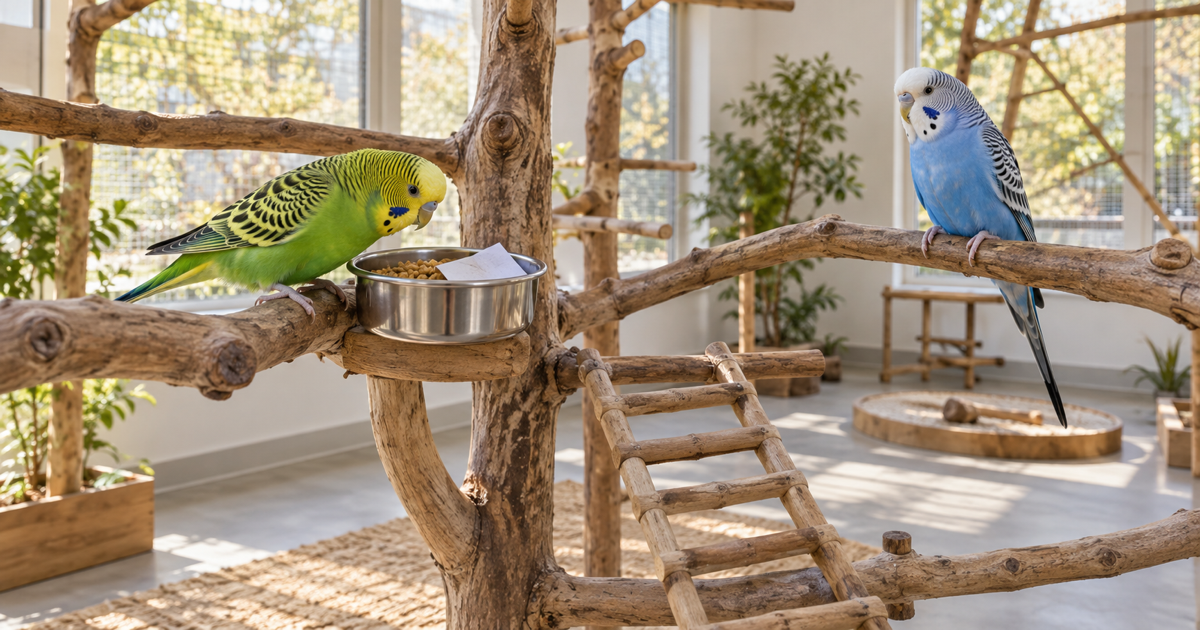
Bird enrichment works when it gives a bird useful choices: finding familiar food, moving through an accessible environment and spending time with suitable company. Start with an easy activity the bird understands, preserve normal food and water access, and watch whether it participates voluntarily. Add complexity only after you know the setup works.
A practical day includes opportunities to forage, move and socialize, alongside quiet rest. The balance depends on species, mobility, experience and social relationships. This guide helps companion-bird owners arrange those opportunities and evaluate the response. Parrot-style puzzles and climbing examples need adaptation for birds whose main activity is flying or hopping.
Build Bird Enrichment Around the Individual
Observe an ordinary day before changing the environment. Note where the bird eats, how it moves between resting places and which interactions it approaches. Then choose one manageable activity in each area:
- Finding and handling food: What familiar food and simple action could create an achievable search?
- Movement: Which route would let the bird explore without blocking its usual access?
- Company: Which person or compatible bird can share time while allowing withdrawal?
Write down what you expect to see. “Moves a paper edge to reach food” is easier to evaluate than “becomes less bored.” Success can also mean calmly choosing another activity; constant engagement is not the goal.
The Association of Avian Veterinarians (AAV) distinguishes perch arrangements for birds that fly or hop from those for agile climbers. Its care guidance recommends reward-based training and attention to each bird's interaction with toys. AAV basic-care guidance
| Bird or situation | Starting emphasis | What to observe |
| --- | --- | --- |
| Parrots, including budgies and cockatiels | Accessible food searches, suitable climbing and voluntary interaction | Whether the bird can reach the reward and leave the activity |
| Finches and canaries | Open flight or hopping routes, suitable feeding opportunities and species-appropriate company | Whether furnishings or other birds restrict movement or access |
| A bird with limited mobility | Familiar activities positioned within comfortable reach, with veterinary advice | Whether essential resources remain accessible without difficult transitions |
Use this table to choose a starting point, not to prescribe identical activities for every member of a species. For enclosure planning, see our bird cage size guide.
Teach Foraging Without Turning the Meal into a Test
Foraging includes looking for and manipulating food. AAV's parrot handout recommends starting with simple, successful tasks before increasing complexity. It also describes using paper to make food partly visible and easier to retrieve. AAV foraging guidance
For a supervised introduction, try this short sequence with a food already appropriate for your bird:
1. Put a small amount in a familiar, stable dish where the bird can reach it easily.
2. Let the bird investigate and eat with no covering.
3. Add a small piece of suitable plain paper beside some food, leaving the reward visible.
4. When that is accepted, partly cover a few pieces so moving the paper gives immediate access.
5. Repeat the successful arrangement before changing the covering or location.
Keep the usual feeding arrangement available while the skill is new. Record actual food access rather than assuming an emptied puzzle proves adequate intake. If the task is not understood, expose the food again and try an easier presentation later.
Use foods within the established diet plan and ask your avian veterinarian about species-specific choices. AAV advises veterinary support for diet changes and continuous access to clean water. Learning a puzzle should not coincide with an unplanned diet conversion. AAV basic-care guidance
Prepare the next activity from the successful one: change the paper position, then observe. You do not need a new toy for every session. The useful question is whether the bird can perform the action, rather than how impressive the puzzle appears.
Make Climbing a Route with Somewhere to Go
RSPCA identifies ladders and appropriate branches as ways to encourage parrot climbing, while also emphasizing space for daily flight. Plan the route and the open movement area together. RSPCA enrichment guidance
Pick a destination the bird already values, such as a familiar resting perch or play stand. Check the approach and return path before adding another component. A route should allow the bird to pause and turn without squeezing between objects.
For each proposed branch, perch or ladder, inspect:
- mounting security and the manufacturer's installation requirements;
- the usable gripping surface and the bird's ordinary posture;
- clearance for wings and tail at the destination;
- access around the component when another bird is present; and
- whether servicing dishes or cleaning changes the route.
Leave open space where the bird normally flies or hops. For a finch or canary, adding a dense cluster of parrot ladders may obstruct the activity you meant to support. For a bird with mobility restrictions, have the arrangement reviewed by an avian veterinarian before expecting new transitions.
AAV advises varied suitable perches, keeping droppings away from water dishes and avoiding sandpaper perch covers. Apply those checks to the finished arrangement, not just to an individual product in its packaging. AAV basic-care guidance
Offer Social Time with a Way to Decline
Social needs and safe housing arrangements vary. RSPCA distinguishes compatible social groups from large parrots that may require separate cages, and stresses room for birds to move out of each other's space. Do not put unfamiliar birds together to provide enrichment. RSPCA bird-company guidance
For birds already living together compatibly, watch individuals as well as the group. A busy shared foraging dish may conceal one bird waiting at a distance. Provide enough access points and space to withdraw; reassess the arrangement if one bird repeatedly blocks another.
Human interaction can be predictable and brief: sit nearby, speak calmly or offer a familiar reward-based activity. AAV recommends including birds in suitable daily activities and training rather than relying on excessive petting. AAV basic-care guidance
Start where the bird is comfortable with your presence. Let it approach instead of bringing a hand or object repeatedly toward a retreating bird. End before the interaction becomes difficult to manage. Ask a bird-experienced professional for help teaching handling or training skills you do not know how to introduce.
Useful social time also needs continuity: tell household members which cue or activity is familiar. Several people using different expectations can make the routine harder to interpret.
Arrange the Day Around Opportunities and Recovery
The following is an adaptable household example, not a prescribed timetable or a substitute for species-specific exercise needs:
During the first care check: refresh water, check normal feeding access and offer one familiar, easy search. Observe participation while you are present.
During supervised activity time: offer access to the prepared movement area and a short voluntary interaction. Keep the return route to familiar resources available. Use our bird-proofing guide to prepare the room.
After the activity: remove spoiled food and soiled disposable materials, inspect components and restore the usual arrangement. Record one observation that will help with tomorrow's choice.
Before the rest period: finish active interaction and preserve a predictable, quiet setting. Avoid filling every available moment with a new challenge.
On a busy day, use an activity already observed to work for that bird. Reserve unfamiliar equipment for a time when you can supervise its introduction. Agree who checks food access and removes used materials so a handover does not leave those tasks undone.
Select Equipment by What the Bird Can Do to It
Ask for the intended species or size range, identified materials, mounting instructions and cleaning guidance. Evaluate accessible connectors and openings as well as the main toy. A product's appearance alone cannot establish suitability.
AAV warns that lead can occur in poorly designed toys and that zinc-containing hardware can present an ingestion hazard. It also cautions against access to unidentified plants and household objects. Check unfamiliar components with your avian veterinarian instead of assuming “natural” or “metal” means suitable. AAV household-danger guidance
Inspect equipment before use and after chewing. Remove damaged items, accessible loose parts and materials the bird appears to ingest. Clean reusable food-contact components according to their instructions and let them dry before reassembly. Avoid repairing an uncertain component with household tape or glue.
The setup can stay simple. One accessible search, one useful movement route and reliable company give you specific things to observe and improve.
Review Participation—and Recognize When Veterinary Care Comes First
Keep a small record of the activity offered, voluntary approach, food access, movement and any damage. Repeat a successful activity; simplify one that the bird does not understand. If several usual activities suddenly stop, investigate the change rather than adding more stimulation.
AAV lists changes in appetite, vocalization and feather condition among reasons for veterinary assessment. Labored breathing, injury or bleeding, seizures, inability to perch, or a marked reduction in food intake or droppings require immediate veterinary contact. Do not wait until the next day to see whether more play helps. AAV signs-of-illness guidance
This article provides everyday enrichment guidance. It does not replace diagnosis or individualized care from an avian veterinarian.
Sources and Further Reading
- Foraging for Parrots — Association of Avian Veterinarians
- Enrichment for Pet Birds — RSPCA
- Basic Care for Companion Birds — Association of Avian Veterinarians
- Living With Other Birds — RSPCA
- Protecting Your Pet Birds from Household Dangers — Association of Avian Veterinarians
- Signs of Illness in Companion Birds — Association of Avian Veterinarians
Frequently Asked Questions
Does my bird need an expensive foraging toy?
No. A suitable simple dish-and-paper activity can help teach the first action. Buy equipment when it supports a behavior your bird uses and you can inspect, clean and introduce it appropriately.
Can I leave a new enrichment toy while I am at work?
Introduce it when you can supervise. Its suitability depends on how your bird interacts with it, and earlier successful use does not remove the need to inspect it for damage.
Should I introduce a new bird if mine seems lonely?
A new bird creates health, compatibility and housing decisions. Consult an avian veterinarian and use a planned introduction; do not place unfamiliar birds together as a quick enrichment solution.
Is it a problem if my bird prefers the same activity?
A familiar activity can remain useful. Observe food access, movement and condition rather than changing something solely because it has been available for several days.
What should a bird sitter know about the routine?
Leave the familiar activity setup, permitted movement area, food-access checks and your avian veterinary contact. Ask the sitter to use established activities rather than introduce unfamiliar equipment during your absence.
Sources and References
- Foraging for Parrots — Association of Avian Veterinarians
- Enrichment for Pet Birds — RSPCA
- Basic Care for Companion Birds — Association of Avian Veterinarians
- Living With Other Birds — RSPCA
- Protecting Your Pet Birds from Household Dangers — Association of Avian Veterinarians
- Signs of Illness in Companion Birds — Association of Avian Veterinarians
About this article
ShineePets publishes practical, source-checked guidance for pet owners and pet-product professionals.
ShineePets is a commercial B2B pet-supply sourcing brand. Read our editorial standards and commercial disclosure.