Bird Care
Bird Cage Size Guide for Common Companion Birds
Quick answer
Compare cage sizes for budgies, cockatiels, finches and parrots, then check wingspan, bar spacing, layout and daily flight needs.
By ShineePets Editorial Team · Published · Updated
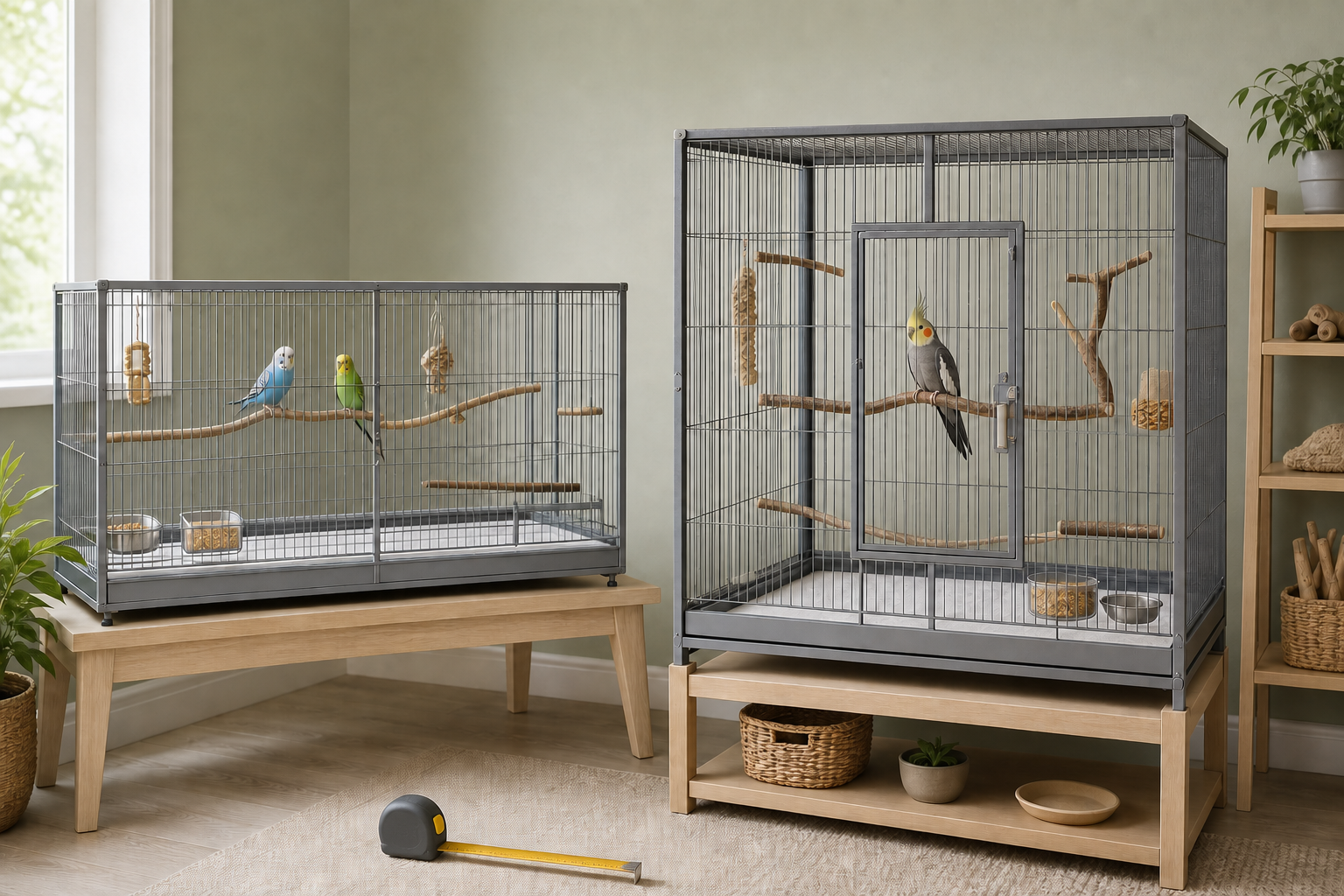
A bird cage is not simply a container. It is a home base for eating, resting, climbing, playing and feeling secure. If it is too small, a bird may be unable to stretch fully, move between perches or avoid another bird. If it is badly shaped or overfilled, even a cage with impressive external dimensions can offer very little usable space.
The right size depends on the bird's full wingspan, activity pattern, tail length, time spent outside the cage, number of birds and interior layout. Species labels are useful starting points, but individual birds can differ.
Quick recommendation: Choose the largest safe rectangular enclosure your home can support, prioritize horizontal movement, and calculate usable space after perches, bowls and toys are installed.
A Cage Is a Home Base, Not the Bird's Whole World
Companion birds are built to fly, climb, forage and interact. The RSPCA advises that an indoor cage should be used for limited periods or overnight and recommends at least six hours of safe indoor flight time outside the cage each day.
That target may require gradual training and a bird-safe room. Windows and mirrors need to be made visible, ceiling fans switched off, doors closed and kitchens kept inaccessible during flight time.
A large cage does not remove the need for exercise and social interaction. Equally, regular time outside the cage does not make a cramped cage acceptable.
Start With Wingspan, Not Body Length
A bird's body can look small when its wings are folded. Full wingspan is a more useful space reference because the bird must be able to stretch and flap without hitting bars, toys or dishes.
Do not forcibly open a nervous bird's wings to measure them. Use a reliable species reference, previous veterinary record or guidance from an avian veterinarian. For birds with unusually long tails, add enough height and perch clearance to prevent the tail from dragging on the floor or striking bars.
The RSPCA offers a practical wingspan framework:
- If a bird spends most of the day outside the cage, the cage's height, width and depth should each be at least about 1.5 times the bird's wingspan.
- If a bird spends most of the day in the cage, each dimension should be at least about twice the wingspan.
- An aviary's height, width and depth should each be at least about four times the largest bird's flying wingspan.
These are lower planning thresholds, not design targets. More horizontal flight distance is generally better.
General Size Guide for Common Companion Birds
VCA Animal Hospitals publishes general minimum suggested cage envelopes for common small and medium birds. The table below arranges the longest listed dimension horizontally because most companion birds benefit from side-to-side movement.
| Common bird group | General minimum starting envelope | Better buying priority |
| --- | --- | --- |
| Finch or canary | About 60 L × 30 D × 30 H cm (24 × 12 × 12 in) | Choose a longer flight cage; preserve clear side-to-side space |
| Budgerigar (budgie/parakeet) | About 60 L × 30 D × 30 H cm (24 × 12 × 12 in) | Go wider for active flight and larger for a compatible pair |
| Cockatiel | About 90 L × 60 D × 60 H cm (36 × 24 × 24 in) | Add tail clearance and uncluttered wing space |
| Lovebird or parrotlet | About 90 L × 60 D × 60 H cm (36 × 24 × 24 in) | Use secure doors and enough room to avoid cage-mate conflict |
| Conure, caique or Senegal parrot | About 90 × 90 × 90 cm (36 × 36 × 36 in) | Prioritize strong construction, climbing routes and open flapping space |
| African grey or Amazon parrot | Use the individual wingspan calculation and specialist advice | A large single-bird enclosure plus extensive safe out-of-cage activity |
| Cockatoo or macaw | Plan a specialist large enclosure or aviary around actual wingspan | Ordinary small indoor cages are not suitable as full-time living space |
The numbers are not maximum recommendations. They are starting envelopes before interior equipment is added. A cage sold under a species name can still be unsuitable if its shape, bar spacing or usable interior is wrong.
Why Width Usually Matters More Than Decorative Height
Tall, narrow cages can look large in product listings because their total volume is high. However, most companion birds move horizontally between perches and benefit from a clear flight path.
VCA recommends rectangular cages and notes that tall, narrow designs are impractical for birds that move back and forth. Round cages also provide poor corner security and make perch placement difficult.
When comparing two cages:
1. Compare internal dimensions, not only external dimensions.
2. Identify the longest uninterrupted horizontal route.
3. Subtract the space occupied by feeders, toy clusters and thick perches.
4. Check whether the bird can turn, climb and flap without contact.
5. Confirm that the tail clears the floor and bars from normal perches.
A lower, wider flight cage may offer more useful movement than a tall ornamental cage.
Bar Spacing Is a Safety Limit
The Association of Avian Veterinarians states that bar spacing should prevent a bird from fitting its head through the bars. VCA similarly warns that bars must prevent the head or legs from becoming trapped.
Do not rely only on a cage's marketing label. "Small bird" and "medium parrot" are not precise measurements.
Check that:
- the head cannot pass between the bars;
- feet and legs cannot become wedged;
- gaps around doors and feeder openings are no wider than the main spacing;
- decorative scrollwork does not create narrowing V-shaped traps;
- broken welds do not create larger openings;
- the wire gauge resists bending by the bird's beak;
- horizontal bars or safe climbing surfaces suit the species.
If the spacing appears borderline, choose the safer smaller spacing and ask an avian veterinarian or experienced bird welfare professional.
Cage Material and Construction
Birds use their beaks to climb and explore, so cage materials must be durable and non-toxic.
VCA identifies stainless steel as a practical option and warns that damaged paint or older zinc-containing coatings can create risks if chewed. The AAV advises using materials that the bird cannot damage or eat.
Before use, inspect:
- welds and bar ends;
- coating condition;
- exposed metal;
- rust or corrosion;
- sharp edges and burrs;
- loose fasteners;
- gaps around removable trays;
- door hinges and locks;
- caster stability;
- manufacturer material information.
Do not assume a cage is safe because it is new. Wash and rinse it according to manufacturer guidance, allow it to dry and inspect every accessible surface.
Door Size, Locks and Escape Prevention
A cage door should allow the bird to enter and leave without catching wings or tail feathers. It should also provide safe access for bowl removal and cleaning.
Intelligent parrots may learn to open simple latches. Check:
- whether the main door closes positively;
- whether feeder doors lock independently;
- whether sliding doors can be lifted;
- whether the bird can reach external clips;
- whether replacement locks introduce pinch points;
- whether the opening is safe when the cage is moved.
A safety porch or double-door system is especially useful for aviaries. Never rely on an open exterior window or unscreened doorway as a secondary barrier.
Usable Space After Furnishing
Cage dimensions are measured when the cage is empty, but the bird lives in the furnished space.
A suitable setup should still allow the bird to:
- stretch both wings fully;
- flap without hitting toys;
- move between at least two useful perch locations;
- reach food and water without crossing droppings;
- climb without becoming trapped;
- retreat from another compatible bird;
- keep the tail clear;
- access a calm resting area.
Avoid creating a dense "toy forest." Rotate enrichment rather than hanging every item at once. Our guide to pet toy safety explains how size, materials and supervision affect toy risk.
Perch Placement Changes the Effective Size
Natural wood perches of varied, appropriate diameters can support movement and foot use. VCA advises that a bird should be able to wrap its toes most of the way around a perch rather than standing flat on an oversized surface.
Place perches to create movement without blocking the center:
- one higher resting perch;
- one or more lower movement perches;
- clear horizontal space between selected perches;
- no perch directly over food or water;
- no tail contact with the cage floor;
- no crowding at doors;
- enough perches for every bird to rest simultaneously.
Do not use only identical dowels. Inspect natural branches for species safety, cleanliness and splinters before installation. Rope perches require frequent checks for loose fibers that can entangle toes.
Food, Water and the Cage Floor
Food and water dishes should be sturdy, non-toxic, appropriately sized and easy to clean. VCA recommends attaching dishes to cage sides rather than placing them on the floor, helping reduce contamination from droppings.
Arrange bowls so:
- droppings cannot fall from a perch above;
- the bird can access them without squeezing behind toys;
- each compatible bird has reliable access;
- doors can be serviced without creating an escape route;
- dishes cannot be tipped easily;
- water remains separate from bathing contamination where possible.
The AAV recommends plain paper cage liners and daily changes. Plain paper also makes it easier to observe droppings. Avoid litter materials that hide waste or create ingestion and respiratory risks.
One Bird or More Than One?
Housing multiple birds requires more than multiplying the cage dimensions.
The RSPCA notes that compatible colony-breeding species, including budgies, cockatiels and lovebirds, can live in groups when they have enough room. For more than two birds, the enclosure needs additional space for each added bird. It also needs enough food stations, water, perches and retreat areas.
Compatibility comes first:
- introduce birds gradually;
- provide visual distance and escape routes;
- watch feeding and high-perch competition;
- separate birds if one blocks resources;
- do not house a non-flying bird with flying birds;
- avoid forcing large non-colony parrots to share one cage.
Large parrots such as African greys, Amazons, cockatoos and macaws generally need their own cages even when they interact safely outside them.
Cage Size for Finches and Canaries
Finches and canaries benefit from long, horizontal flight cages because much of their movement is side to side. Avoid tall narrow towers.
For a pair or group:
- increase length substantially beyond a single-bird starting size;
- keep the center flight route open;
- provide multiple feeding points;
- avoid overcrowding with nest-like accessories;
- place perches near opposite ends to encourage movement;
- monitor whether one bird controls a preferred perch.
An aviary offers a better opportunity for sustained flight when space and management allow.
Cage Size for Budgies
Budgies are small but highly active. A 60 × 30 × 30 cm envelope is only a general single-bird starting point, not an ideal long-term target.
Choose a wider cage if possible, especially for two compatible birds. Confirm that bar spacing is small enough for a budgie's head and that feeder doors cannot be lifted.
Provide safe daily out-of-cage flight, foraging opportunities and more than one useful perch path. Do not reduce space because a budgie is tame or has clipped wings.
Cage Size for Cockatiels
Cockatiels need room for long tails, a broad wingspan and ground-foraging behavior. VCA's general starting envelope is approximately 90 × 60 × 60 cm.
Check:
- tail clearance from the floor and bars;
- door width;
- stable natural perches;
- a low, safe route for ground access;
- open wing space;
- extra room for a compatible pair.
Cockatiels can startle at night. Cage placement, a predictable routine and a safe low-level light plan discussed with an avian professional may help in individual cases.
Cage Size for Lovebirds and Parrotlets
Lovebirds and parrotlets are compact but active, strong-willed parrots. The same VCA starting envelope used for cockatiels is a useful baseline, but their social behavior demands careful observation.
A pair needs enough room to move apart. Provide duplicated resources and avoid enclosed nest-like spaces unless managed for an appropriate breeding program.
Door security and bar strength matter because small parrots can be persistent chewers and latch explorers.
Cage Size for Conures, Caiques and Senegal Parrots
VCA gives a general minimum suggestion of about 90 cm in each dimension for this group. Larger is preferable once toys and climbing structures are added.
Look for:
- durable bars and hardware;
- safe climbing orientation;
- enough depth for turning and flapping;
- easy-to-clean trays;
- secure feeder doors;
- room for foraging without blocking movement.
These active parrots need substantial daily activity outside the cage in addition to a large enclosure.
Housing African Greys, Amazons, Cockatoos and Macaws
Large parrots vary considerably in wingspan, tail length, beak strength and behavior. A generic species label is not enough to select a cage.
Use the actual wingspan framework and consult an avian veterinarian or experienced parrot welfare professional. For birds that spend substantial time inside, plan around at least twice the wingspan in each dimension, then increase for perches, toys and movement.
Large parrots also require:
- heavy, safe construction;
- secure locks;
- large access doors;
- appropriate bar spacing and gauge;
- protected food stations;
- extensive supervised out-of-cage time;
- structured training and foraging;
- separate cages for individual adult birds in most home situations.
The World Parrot Trust advises choosing the biggest cage possible, but size must still be paired with safe construction and a rich daily life.
Disabled, Senior or Non-Flying Birds
A bird that cannot fly does not simply need a smaller cage. The enclosure should be adapted so the bird can reach every essential resource safely.
Possible adaptations include:
- lower perches;
- broad platforms;
- short climbing routes;
- ramps or ladders;
- padded safe floor areas;
- food and water near preferred resting places;
- reduced fall distance;
- clear routes without loose fibers.
Do not house a non-flying bird with fully flighted birds if this creates bullying or resource exclusion. Ask an avian veterinarian to adapt the environment to the bird's mobility and medical needs.
Where to Place the Cage
Choose a stable area with social contact but without constant traffic.
Avoid:
- kitchens and cooking fumes;
- smoke, aerosols and strong fragrances;
- radiators and direct heat;
- cold draughts;
- continuous direct sun without shade;
- unstable furniture;
- loud speakers;
- doorways where the bird is repeatedly surprised;
- access by cats, dogs or young children without supervision.
A solid wall behind part of the cage can create security. Provide a predictable light and sleep schedule appropriate to the species, with access to shade.
Bird Cage Buying Checklist
Before ordering a cage, confirm:
- [ ] Internal dimensions exceed the wingspan-based threshold.
- [ ] The longest dimension supports horizontal movement.
- [ ] The bird can fully stretch and flap after furnishing.
- [ ] Tail feathers clear the bars and floor.
- [ ] Bar spacing prevents the head and legs from entering.
- [ ] Wire gauge suits the bird's beak strength.
- [ ] Materials and coatings are identified and safe.
- [ ] Doors and feeder openings lock securely.
- [ ] Trays and dishes can be removed safely.
- [ ] Perches do not block the center.
- [ ] Food and water are protected from droppings.
- [ ] The cage has room for every bird to retreat.
- [ ] A safe daily out-of-cage plan is ready.
- [ ] The cage fits through doors and can be cleaned in its intended location.
- [ ] An avian veterinarian has advised on unusual mobility or health needs.
Warning Signs That the Cage Is Too Small
Reassess the enclosure if:
- wing tips or tail repeatedly strike bars;
- the bird cannot flap without hitting objects;
- toys must be removed just to create standing room;
- one bird blocks another from food or high perches;
- feathers become damaged against cage surfaces;
- the bird has no clear movement path;
- bowls are constantly contaminated by droppings;
- the bird spends most of the day in one position because routes are blocked.
Behavior changes can also indicate pain, illness, fear or social stress. Cage changes do not replace veterinary assessment. Contact an avian veterinarian if activity, balance, appetite, breathing, droppings or feather condition changes.
Final Takeaway
The best bird cage size is calculated from the living bird, not the product label. Begin with full wingspan, choose a wide rectangular enclosure, add space for every bird and confirm that the furnished cage still supports full stretching, flapping and retreat.
Use published dimensions as minimum starting points only. Bigger, safer housing plus daily flight, enrichment, social choice and attentive care provides a much stronger foundation for companion bird welfare.
Frequently Asked Questions
What is the minimum cage size for a budgie?
VCA gives a general minimum starting envelope of about 60 × 30 × 30 cm for a budgie, finch or canary. Arrange the longest dimension horizontally and choose a larger flight cage whenever possible, especially for two compatible birds.
How do I calculate cage size from a bird's wingspan?
The RSPCA advises at least about 1.5 times the wingspan in height, width and depth when a bird spends most of the day outside the cage, and at least twice the wingspan in each dimension when it spends most of the day inside. Larger remains preferable.
How wide should bird cage bar spacing be?
Use spacing small enough that the bird cannot fit its head or legs between the bars, including gaps around doors and feeders. Because individuals and cage designs vary, confirm borderline spacing with an avian veterinarian rather than relying only on a species label.
Can two birds share one cage?
Compatible colony-breeding species may share a sufficiently large cage or aviary, but they need extra space, duplicated resources and room to retreat. Large non-colony parrots generally need separate cages, and incompatible birds must never be forced to share.
Is a tall cage better than a wide cage?
Usually not. Most companion birds benefit from horizontal movement, so a wide rectangular cage generally provides more useful space than a tall narrow tower. The bird must also have enough height for its tail and climbing behavior.
Sources and References
About this article
Practical, evidence-informed companion bird care guidance from the ShineePets Editorial Team.
ShineePets is a commercial B2B pet-supply sourcing brand. Read our editorial standards and commercial disclosure.