Bird Care
Bird Travel Carriers: Size, Ventilation and Security
Quick answer
Choose a bird travel carrier by usable size, airflow, escape resistance, materials, interior setup and real-world vehicle or airline checks.
By ShineePets Editorial Team · Published · Updated
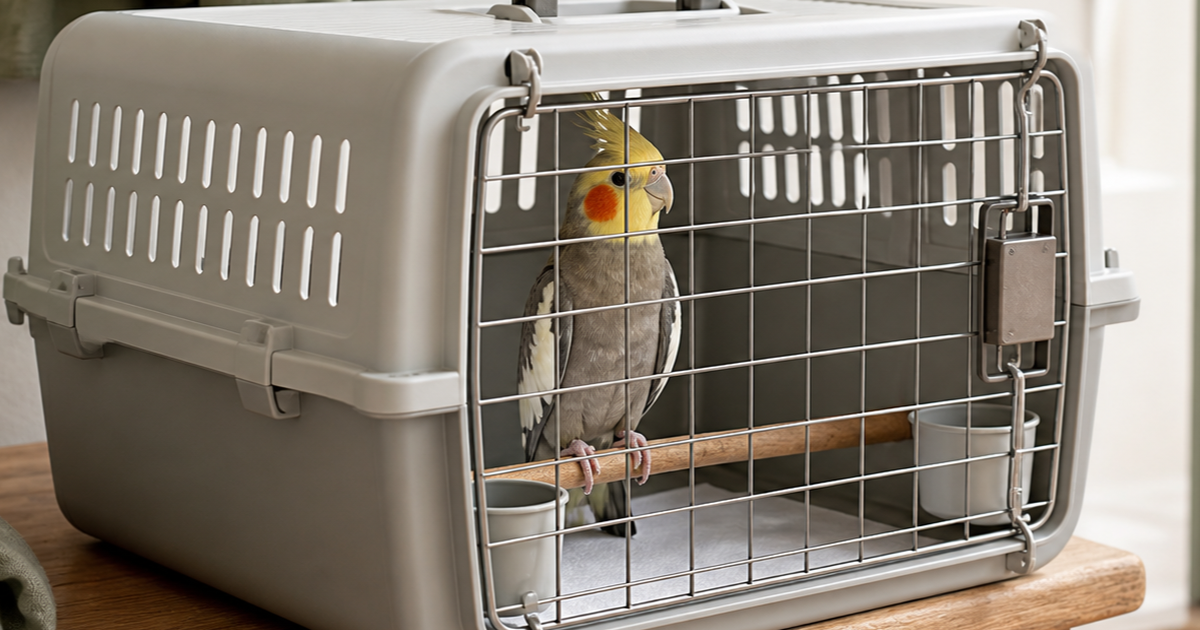
Bird travel carriers should be chosen by the bird's natural posture, the carrier's usable internal space, unobstructed airflow and its ability to prevent escape or injury under movement. The safest option is not automatically the largest or the most transparent. It is a rigid, stable enclosure that contains the bird securely, has no hazardous gaps or edges, stays level when carried and can be opened quickly in an emergency.
Measure the individual bird, inspect the exact carrier and run a dry test with an equivalent inert load before travel.
How to Compare Bird Travel Carriers
Use three pass-or-fail gates before considering price, color or storage convenience:
1. Fit: The bird can stand naturally, turn and make normal postural adjustments without the head, wings or tail contacting unsafe surfaces.
2. Airflow: Ventilation reaches the occupied area from more than one direction and remains open when the carrier is covered, handled or placed in the vehicle.
3. Containment: The body, door, seams, fasteners and openings withstand the bird's beak and the normal movement of travel.
A carrier that fails any gate should not be rescued by a shoulder strap, panoramic window or accessory tray. It must also match the species, health status, journey and operator rules.
Size the Usable Interior, Not the Product Label
Labels such as small, medium and large are not measurements. Record the carrier's internal length, width and height after the perch, cups, liner and door hardware are installed. Compare that usable space with the bird's posture and tail length.
The carrier should allow the bird to:
- stand without the crest, head or tail rubbing the roof or floor;
- turn and reposition normally;
- maintain balance during gentle movement;
- keep feathers away from door mechanisms and sharp edges;
- access the floor safely if it leaves the perch.
Too little space can damage feathers or restrict posture. Excessive empty space can increase movement during a sudden stop. The goal is controlled clearance, not flight space.
Species name alone is not enough. Birds of similar weight may need different proportions. Measure the individual and ask an avian veterinarian about modifications for a bird that is weak, injured or unable to perch.
Travel carrier versus destination cage
A travel carrier is for secure movement; a destination cage supports longer activity, feeding, enrichment and rest. Do not use an oversized vehicle carrier as a substitute. See the ShineePets bird cage size guide.
Evaluate Ventilation as a Complete Air Path
Count neither holes nor mesh panels in isolation. Air must be able to enter, cross the bird's occupied space and leave without vents being pressed against a seat, wall, cover or suitcase.
Check that:
- openings are distributed on at least two vertical surfaces;
- the bird cannot put its head, wing, toes or beak through a hazardous gap;
- ventilation remains clear when the carrier is in its intended travel position;
- an exterior cover reduces visual stimulation without sealing the openings;
- bowls, paper, bedding and labels cannot shift over vents;
- the carrier does not trap direct sunlight like a greenhouse;
- any external rim or stand-off prevents a flat adjacent object from blocking airflow.
For transport covered by U.S. Animal Welfare Act rules, the USDA APHIS checklist specifies openings on two vertical walls covering at least 16% of each wall, or openings on four walls covering at least 8% of each wall. It also calls for 0.75-inch (1.9-centimeter) exterior clearance unless a wall is at least 90% open. Read the official checklist. These regulated-commercial figures do not guarantee airline acceptance; operator and route rules may differ.
More ventilation is not automatically better if the openings weaken the shell, expose feathers to damage or create escape gaps. Clear acrylic areas can improve visibility, but they need sufficient shaded ventilation and careful temperature management. Never cover a carrier so completely that airflow is reduced.
Inspect Doors, Latches and Escape Points
Birds can push, lift, chew and manipulate hardware. Test the closed carrier before the bird enters.
Door and latch checks
- The main latch should engage positively rather than relying on friction.
- A secondary lock should prevent accidental opening without delaying emergency access.
- Hinges and pins should not lift out during normal handling.
- Sliding trays should lock and should not create a gap when partly displaced.
- Zippers, fabric windows and plastic clips must resist the beak strength of the species.
- Door spacing must not permit the head or limbs to protrude.
Body and handling checks
- Joined panels should not separate when the loaded carrier is lifted.
- Fasteners should be complete, tight and inaccessible to the bird.
- Interior surfaces should have no sharp wire ends, burrs or pinch points.
- The handle should keep the carrier level; support from underneath whenever possible.
- Emergency removal should be quick without dismantling multiple structural parts.
The APHIS checklist also requires regulated transport enclosures to contain the bird, withstand normal transport, prevent dangerous protrusion and allow quick emergency removal. It calls for nontoxic materials and no injurious interior edges. Review the criteria.
Avoid improvised twist ties, clips with sharp ends or elastic cords within reach of the bird. If a carrier needs temporary hardware to stay shut, replace or repair it before travel.
Choose Materials for the Bird and the Journey
| Construction | Useful qualities | Main risks to inspect | Best fit |
|---|---|---|---|
| Rigid plastic shell with metal door | Stable, easy to clean, good weather protection | Chewed seams, weak clips, blocked side vents, door spacing | Routine vehicle trips and many nervous birds |
| Metal travel cage | Strong airflow and visibility | Exposed wire ends, wide spacing, poor weather protection, rattling | Calm birds on controlled short trips |
| Acrylic-panel carrier | Clear view, debris containment and easy wipe-down | Heat buildup, glare, scratching and insufficient cross-ventilation | Climate-controlled travel after a ventilation check |
| Fabric or mesh carrier | Lightweight and collapsible | Chewing, claw entanglement, collapse and zipper escape | Only species and individuals that cannot damage the structure |
Material names are not safety evidence. Inspect any surface the bird can chew; reject strong odors, flaking finishes, corrosion, cracked acrylic and rough openings. Ask for material identification and care limits rather than relying on an unsupported “non-toxic” claim.
Set Up the Interior Without Creating Hazards
Use a low, stable perch of an appropriate diameter if the bird can perch normally. The perch should not rotate, slide or place the bird close to the roof. A higher perch creates a longer fall; a loose perch becomes a moving impact hazard.
For a debilitated bird or one with balance problems, an avian veterinarian may recommend a padded floor and no elevated perch. Do not improvise medical transport when the bird has breathing difficulty, trauma or cannot stand normally.
Keep the interior simple:
- fit a clean, absorbent, nonslip liner over a solid leak-resistant base;
- secure cups so they cannot swing or spill onto the bird;
- remove hanging toys, bells, chains and heavy accessories;
- keep loose fibers and frayed rope away from feet;
- use familiar food and a water system the bird already knows;
- confirm that every item leaves the ventilation path clear.
Positive training is part of safety. LafeberVet recommends a species-suitable carrier and gradual positive reinforcement so the animal willingly enters. See the training guidance. Reward calm exploration and rehearse short carries before the trip.
Perform a Pre-Travel Product Test
Complete these checks without the bird first:
1. Loaded carry test: Add an inert weight equal to the expected bird and accessories. Lift from the intended points and watch for tilting, flexing or panel separation.
2. Latch-cycle test: Open and close every door, tray and secondary lock repeatedly. Confirm that alignment and engagement remain consistent.
3. Gap inspection: Examine door edges, corners, cup openings and tray slots from the bird's side. Look for pinch points and protrusion risks.
4. Ventilation-position test: Place the carrier where it will travel and confirm that the seat, cover, luggage and restraint system leave vents open.
5. Cleaning test: Remove the liner and cups, wash according to instructions, dry fully and check for trapped water, corrosion or warped parts.
6. Route rehearsal: Carry and secure the empty carrier through each transfer point so doors are not first tested in a public area.
Then conduct short, calm practice sessions with the bird. Stop if the bird shows escalating fear, loss of balance or breathing changes. Never use travel day as the first full carrier trial.
Match the Carrier to Car and Air Travel
In a vehicle, keep the bird inside the closed carrier. Position it away from airbags, direct sun, heating vents and strong drafts. Use the manufacturer's restraint method or another stable placement that does not crush the shell or block ventilation. Never leave a bird in a parked vehicle.
For air travel, ask the airline for the current carrier dimensions, construction rules, booking process and species restrictions before purchasing. “Airline approved” is not a universal certification. Acceptance depends on the operator, aircraft, route and whether the bird travels in the cabin or cargo.
International travel may require permits, veterinary certificates, identification, inspections or quarantine. U.S. pet-bird import requirements vary by origin, disease status and transit history. Check the current APHIS page. Consult every relevant authority and operator directly.
Recognize When Travel Should Stop
Watch the bird before and throughout travel. Open-mouth breathing at rest, marked tail bobbing, loss of balance, inability to perch, severe weakness, collapse or injury require prompt veterinary attention. The Merck Veterinary Manual lists breathing difficulty, weakness, balance loss and sitting at the bottom of the cage among signs of illness in birds. Review the veterinary guidance.
If breathing becomes difficult, minimize handling, move the carrier away from heat or fumes and contact an avian veterinarian or emergency clinic immediately. Do not delay care to complete the journey.
Bird Travel Carrier Final Checklist
Before approving or using a carrier, confirm:
- internal dimensions suit the individual bird's posture and tail;
- the bird can turn and make normal postural adjustments;
- ventilation reaches the occupied area from multiple directions;
- covers, restraints and luggage cannot block the vents;
- openings prevent dangerous protrusion and escape;
- doors, trays, hinges and secondary locks remain secure under movement;
- materials are cleanable, intact and appropriate for the bird's beak strength;
- the perch, liner and cups are stable and do not create impact hazards;
- the loaded carrier stays level and can be opened quickly in an emergency;
- vehicle, airline and destination rules have been verified directly;
- the bird has been introduced gradually and is medically fit to travel.
The best bird carrier is the one that fits the individual bird, stays breathable in the real travel position and remains secure after repeated handling—not the model with the most windows or the boldest marketing claim.
*This article provides general product-selection and bird-care information. It does not replace advice from an avian veterinarian or the requirements of an airline or government authority.*
Sources and Further Reading
Frequently Asked Questions
How big should a bird travel carrier be?
It should let the individual bird stand naturally, turn and make normal postural adjustments without the head, wings or tail contacting hazardous surfaces. Measure usable internal space after fittings are installed.
Is a clear acrylic bird carrier safe?
It can be suitable when cross-ventilation is adequate and temperature is controlled. Clear panels may trap heat or glare, so inspect the complete airflow path and keep the carrier out of direct sun.
Should a bird travel carrier have a perch?
A healthy perching bird may benefit from a low, stable perch of suitable diameter. A weak, injured or poorly balanced bird may need a padded floor setup directed by an avian veterinarian.
Can two birds share one travel carrier?
Separate carriers are generally easier to manage safely. Only place birds together when they are compatible, there is sufficient space and the veterinarian and transport rules permit it.
What does airline approved mean for a bird carrier?
It is not a universal certification. The operating airline decides acceptance based on its current dimensions, construction, species, route and cabin-or-cargo rules, so verify before purchase.
About this article
ShineePets publishes practical, source-checked guidance for pet owners and pet-product professionals.
ShineePets is a commercial B2B pet-supply sourcing brand. Read our editorial standards and commercial disclosure.