Cat Care
Cat Carrier Types: Soft, Hard and Backpack Options
Quick answer
Compare soft, hard and backpack cat carriers by stability, ventilation, cleaning, escape resistance, vehicle use and feline comfort.
By ShineePets Editorial Team · Published · Updated
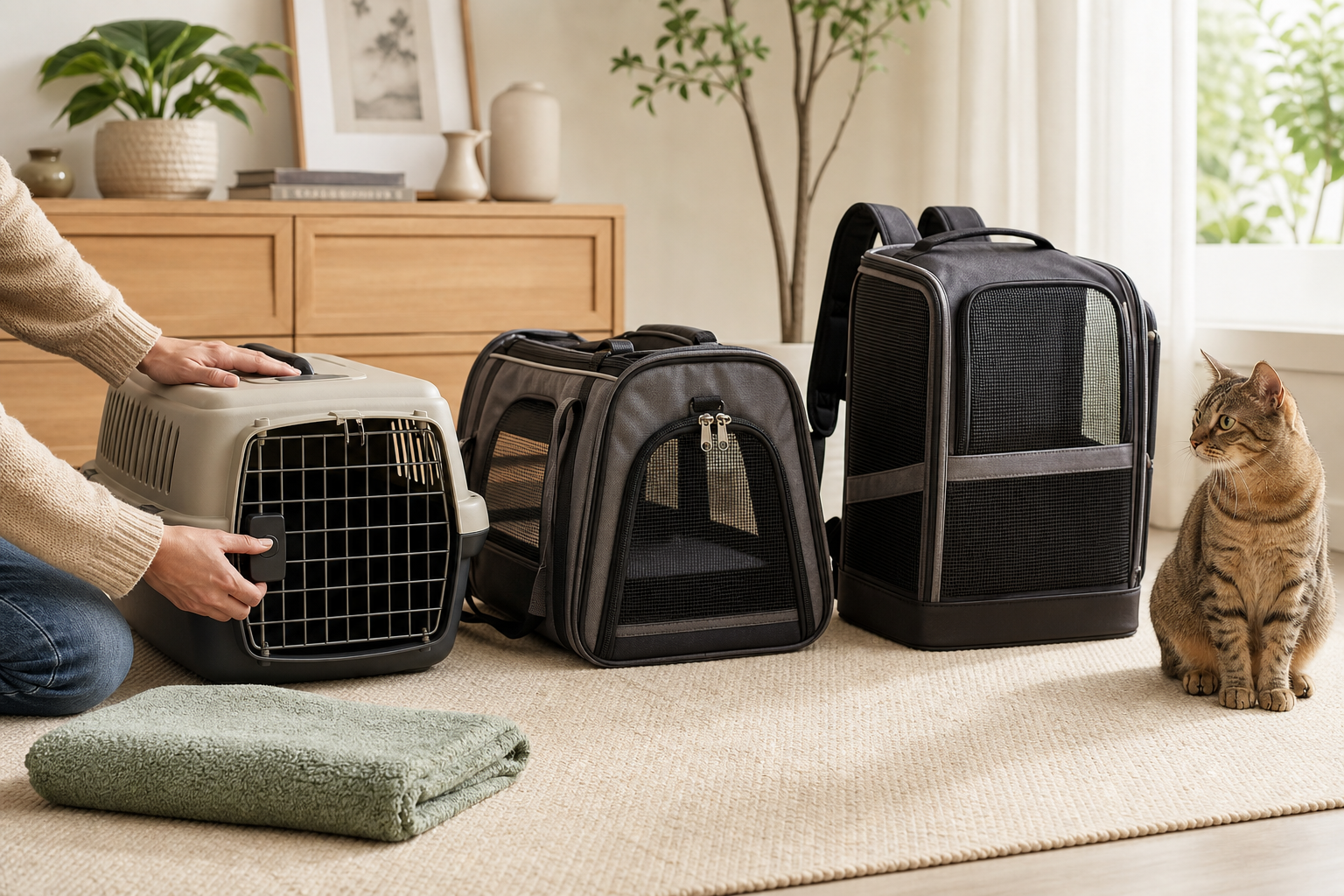
A cat carrier is more than a container for the occasional veterinary visit. It is safety equipment for routine care, moving home and emergencies, and it can become a familiar hiding place when introduced properly.
Soft-sided carriers, hard-shell carriers and backpack carriers each solve different handling problems. Their labels do not determine whether they are safe for a particular cat. Structure, internal space, ventilation, access, escape resistance, cleaning and transport method matter more than appearance.
Quick recommendation: For most routine veterinary trips, start with a sturdy hard-shell carrier that has a secure front door and a removable top or top opening. Consider a soft carrier only when it holds its shape and closes securely, and treat a backpack as a specialized option that must provide enough space, ventilation and stability for the individual cat.
The carrier should allow the cat to stand, turn around, sit and lie down naturally. It should also remain level when lifted and resist collapsing when the cat shifts position.
Seven Non-Negotiable Carrier Features
Before comparing styles, apply the same basic requirements to every carrier.
A suitable carrier should be:
- Secure: Doors, latches and zippers should resist pushing, pawing and accidental opening.
- Structurally stable: The base should remain flat and the walls should not fold onto the cat.
- Correctly sized: The cat must be able to stand, turn, reposition and lie down comfortably.
- Well ventilated: Air openings should be distributed across at least two sides without creating escape gaps.
- Easy to access: A front entrance supports voluntary training; a top opening or removable top helps with a reluctant or unwell cat.
- Easy to clean: Urine, vomit and feces should not remain trapped in seams, foam or inaccessible channels.
- Comfortable to carry: The loaded carrier should stay level when supported from underneath.
Check the manufacturer's maximum load, but do not choose by weight rating alone. A long, tall or broad cat may need more space than another cat of the same weight.
Hard-Shell Cat Carriers
Hard carriers are commonly made from molded plastic with a metal or rigid plastic door. Many have top and bottom sections held together by clips, bolts or screws.
Main advantages
- The walls and floor usually remain stable when the cat moves.
- Plastic surfaces are relatively easy to wash, rinse and dry.
- A removable top can let a nervous cat remain in the lower half during a veterinary examination.
- A rigid frame can protect the cat from light bumps and prevent other luggage from pressing inward.
- Secure front and top access can make loading and unloading easier.
- A solid lower section can contain small accidents better than open mesh.
International Cat Care and FelineVMA client guidance prefer sturdy plastic carriers for veterinary transport because they are stable, secure and easy to clean. A removable top is especially useful for cat-friendly handling.
Limitations
- Hard carriers can be bulky to store.
- A poorly assembled top can separate from the base.
- Cheap latches may bend, loosen or open unexpectedly.
- A large carrier becomes awkward when held only by one top handle.
- Ventilation can be insufficient if most surfaces are solid.
- Cracked plastic can develop sharp edges or structural weakness.
Inspect every fastener connecting the top and bottom. If the design uses removable clips, confirm that all clips are present and locked. For heavier cats, bolts or other secure hardware may provide more confidence than a few flexible side tabs.
Soft-Sided Cat Carriers
Soft carriers use fabric panels, mesh windows, zippers and a reinforced base. They can be lighter and easier to store than hard carriers.
Main advantages
- Lower carrier weight can make short hand-carried trips easier.
- Flexible dimensions may fit certain airline or train requirements.
- Broad mesh panels can provide good airflow when they remain unobstructed.
- Some cats may find the fabric interior quieter and visually sheltered.
- Removable washable pads can improve comfort and accident management.
Limitations
- Weak walls can collapse inward or sag around the cat.
- A flexible floor may tilt or fold when lifted.
- Claws and teeth can damage mesh, seams or zipper tape.
- Two zipper sliders can separate if they are not clipped together.
- Urine, vomit and odor can soak into seams, foam and fabric.
- Fabric can retain moisture after surface cleaning.
- Heavy items placed beside or above the carrier can compress the space.
A soft carrier should stand open on its own when empty. Press gently on the roof and sides, then lift it with a similar test weight inside. The floor should remain level and the openings should not distort.
Look for a rigid or semi-rigid base, reinforced corners, fine but durable mesh and zipper sliders that can be secured. Do not rely on a decorative hook, elastic loop or light luggage zipper as the only escape barrier.
Backpack Cat Carriers
A backpack places the carrier vertically against the person's back. It can free the hands and may help on stairs or short walking routes, but the upright shape and movement create important tradeoffs.
Potential advantages
- Weight can be distributed across two shoulder straps.
- The person's hands remain available for doors, tickets or another bag.
- A structured model may be convenient for a short walk when a handheld carrier is difficult to manage.
- Some cats may tolerate the close proximity to their caregiver.
Common concerns
- Many backpacks are too narrow for a cat to turn or lie naturally.
- The base may tilt with the wearer's posture.
- Each step can create repeated swinging or bouncing.
- Rounded transparent windows may heat quickly and provide limited ventilation.
- A cat may be exposed to visual stimulation without a place to hide.
- The wearer cannot easily see early distress or an opening zipper.
- Falls and collisions can directly affect the carrier.
- Tall designs may place a heavy cat in an unstable position.
Cats Protection and International Cat Care caution that many backpack-style carriers provide inadequate room and may feel unstable. A backpack should not be selected simply because it is easy for the person to carry.
If considering one, require a rigid frame, flat stable base, generous mesh ventilation, enough horizontal depth for the cat to reposition, secure zipper locks and supportive chest or waist straps. Test it indoors with weight before placing the cat inside. Reject designs that fold, tip or force the cat to remain upright.
Backpack rule: If the cat cannot turn around and lie in a natural position while the bag remains level, it is not an appropriate carrier for that cat.
Measure the Cat and the Usable Interior
Measure the cat while standing naturally:
1. Measure body length from the chest to the base of the tail.
2. Measure standing height from the floor to the top of the head or ears.
3. Note shoulder width and normal lying posture.
4. Compare these measurements with the carrier's internal usable space, not only the external dimensions.
5. Check the door opening as well as the main compartment.
6. Add the thickness of the intended towel or pad.
The carrier should be large enough for natural position changes but not so oversized that the cat slides from side to side during movement. A kitten's carrier may need replacement as the cat grows. Recheck adult cats after meaningful weight change or reduced mobility.
For a senior, arthritic or recovering cat, a wide top opening or fully removable roof can reduce difficult bending and handling.
Test Every Door, Latch and Zipper
A cat may push harder against a carrier when frightened than during a calm home inspection.
Before first use:
- Close every door and pull gently in multiple directions.
- Press outward near the latch from inside with your hand.
- Confirm that spring-loaded latches return fully.
- Check that metal doors sit inside their retaining slots.
- Move each zipper to the end and secure paired sliders.
- Inspect mesh where it joins the fabric.
- Remove or secure long internal tethers that could wrap around the cat.
- Check ventilation holes for sharp molding or claw-catching gaps.
Do not tether a cat by a collar inside the carrier. A short internal lead can create entanglement or neck pressure. If a manufacturer includes one, discuss safe use with a veterinarian and use a properly fitted cat harness only when specifically appropriate.
Compare Openings and Veterinary Access
A front door supports voluntary entry because the cat can walk straight into the carrier. Leave it open at home and reward exploration.
A top opening can help in an urgent situation, but lowering a struggling cat through a small hatch may still cause stress. A fully removable top is often the most versatile arrangement: the cat can be examined in the lower section without being pulled through a narrow doorway.
Choose openings that:
- Are large enough for the cat's body and limbs.
- Do not create pinch points when closing.
- Can be operated with one hand while the other stabilizes the carrier.
- Cannot be opened by the cat from inside.
- Remain attached securely after repeated cleaning.
Practise opening and closing the empty carrier before an appointment. Do not discover an unfamiliar latch while the cat is already anxious.
Ventilation Must Work in Real Conditions
Mesh or holes are useful only when air can reach them. A carrier pushed against luggage, covered by a heavy blanket or placed in direct sunlight may overheat despite having many openings.
Check that:
- At least two sides have unobstructed airflow.
- A privacy cover leaves ventilation panels open.
- Bedding does not block lower vents.
- The carrier is not placed in a closed vehicle boot.
- Heating or air-conditioning vents do not blow directly onto the cat.
- The backpack does not press all ventilation panels against the wearer's body.
Never leave a cat unattended in a parked vehicle. Temperature can become dangerous quickly even when the weather feels mild.
Open-mouth breathing, persistent panting, drooling, collapse, pale or blue gums, severe lethargy or loss of coordination requires urgent veterinary attention. Cats do not normally pant like dogs after routine carrier travel.
Secure the Carrier in a Vehicle
The Feline Veterinary Medical Association's 2025 position statement recommends placing the carrier on the vehicle floor behind the driver or front passenger seat. If using a seat belt, it advises doing so only with a carrier that has appropriate crash-test certification.
A carrier advertised as "car safe" is not automatically crash tested. Look for current independent certification for the exact model and size, and follow its installation instructions. The Center for Pet Safety maintains a current certified-products list.
During travel:
- Keep the cat inside the closed carrier.
- Place the carrier upright and prevent sliding or tipping.
- Do not place it in the front seat near an active airbag.
- Keep doors and windows closed before opening the carrier at the destination.
- Drive smoothly and reduce loud sound.
- Never balance a carrier on a passenger's lap as the primary restraint.
- Check the route and emergency veterinary options before a long trip.
Airline, rail and ferry rules differ. Confirm current dimensions, materials, ventilation and documentation directly with the carrier and transport provider before travel.
Carry From Underneath, Not by the Handle Alone
International Cat Care and AAHA advise supporting the carrier from below. A single top handle can make the carrier swing, tilt and feel unstable.
Use two arms, keep the base level and hold the carrier close to the body. Check that long shoulder straps cannot catch on doors or wrap around the carrier. When setting it down, choose a stable raised surface rather than a busy floor where dogs may approach.
For a backpack, tighten the shoulder and stabilizing straps before lifting, stand slowly and avoid running, cycling or sudden bending. If another person is available, ask them to watch the bag and the cat while walking.
Train the Carrier Before It Is Needed
Carrier acceptance matters as much as carrier construction. FelineVMA and AAHA recommend positive, choice-based training.
A gradual routine can include:
1. Leave the carrier open in a quiet room the cat already uses.
2. Place familiar bedding near it, then inside.
3. Reward looking at, approaching and entering the carrier.
4. Feed occasional treats inside without immediately closing the door.
5. Close the door briefly, reopen it and reward calm behavior.
6. Lift the carrier from underneath for one second, then set it down.
7. Progress to short walks around the room.
8. Practise a brief calm car session before a necessary journey.
Do not chase the cat around the home or use the carrier only before frightening events. Keep it accessible as furniture or a resting place when possible.
If the cat remains highly fearful, ask a veterinarian about an individualized travel plan well before the appointment. Do not give human medication or sedatives without veterinary instruction.
Use Familiar Bedding and a Light Cover
Line the base with an absorbent pad under a familiar washable towel or blanket. The surface should provide grip without taking away needed headroom.
A light familiar-smelling cover may reduce visual stimulation for some cats. Keep ventilation open and observe temperature. Some cats prefer partial visibility, so use the cat's behavior rather than covering every carrier automatically.
Avoid thick loose bedding that bunches around the face, blocks vents or makes the cat slide.
Give Each Cat a Separate Carrier
Even cats that live peacefully together may react differently under travel stress. Feline guidance recommends one cat per carrier.
Separate carriers:
- Prevent conflict in a confined space.
- Allow each cat to turn and lie comfortably.
- Make weight and carrying limits easier to manage.
- Let veterinary staff examine one cat without releasing another.
- Reduce the chance that one cat blocks ventilation or the exit.
Keep both carriers familiar at home and label records for each cat without displaying unnecessary personal information publicly.
Cleaning and Maintenance
After each trip, remove bedding and inspect for urine, vomit, feces, food and damage. Follow the manufacturer's instructions.
For hard carriers:
- Separate removable parts when permitted.
- Wash with mild pet-safe soap and water.
- Rinse latches, corners and ventilation holes.
- Dry every section before reassembly.
- Confirm all clips, bolts and doors are correctly replaced.
For soft carriers and backpacks:
- Remove the base insert and washable pad.
- Inspect foam, seams and zipper channels.
- Clean without leaving strong fragrance or chemical residue.
- Dry the inner layers completely to prevent mold.
- Replace the carrier if odor or contamination remains trapped.
Recheck the structure after cleaning. Fabric, plastic and hardware can weaken with age, sunlight, heat and repeated washing.
A Carrier Comparison Checklist
Choose a hard carrier when
- Stability and easy cleaning are top priorities.
- The cat needs front and top access.
- A removable roof would support veterinary examination.
- The carrier can be stored and transported despite its bulk.
- The fastening system is complete and secure.
Consider a soft carrier when
- Low carrier weight is important.
- The walls, corners and base remain structured.
- Mesh and zippers resist the cat's claws and pushing.
- The carrier can be cleaned and dried thoroughly.
- The exact model meets the transport provider's current rules.
Consider a backpack only when
- The cat can stand, turn and lie naturally inside.
- The base stays horizontal during movement.
- Large ventilation panels remain unobstructed.
- The frame does not collapse onto the cat.
- The backpack can be carried without bouncing or tilting.
- A safer handheld carrier is not practical for the specific route.
Final Pre-Trip Check
Before closing the door:
- Confirm the carrier matches the cat's current size and weight.
- Inspect all latches, seams, mesh and zippers.
- Add secure, absorbent and familiar bedding.
- Close windows, exterior doors and cat flaps.
- Make sure each cat has a separate carrier.
- Support the carrier from underneath.
- Secure it using the safest location and method for the vehicle and exact model.
- Keep ventilation open and temperature comfortable.
- Carry identification, veterinary details and essential supplies.
- Never open the carrier in an unsecured outdoor or vehicle area.
Key Takeaway
For most routine veterinary transport, a sturdy hard-shell carrier with a front entrance and removable top offers the strongest balance of stability, cleaning and access. A well-built soft carrier can work when it keeps its shape and closes securely. A backpack requires the most careful evaluation because internal space, posture, ventilation and movement are often compromised.
Choose for the cat, not for convenience alone. The best carrier is secure, stable, correctly sized, familiar and handled in a way that keeps the cat level and contained from home to destination.
Frequently Asked Questions
What size cat carrier should I choose?
Choose enough internal space for your cat to stand, turn around, sit and lie down naturally, including the bedding thickness. It should be snug enough to limit sliding but must not compress the cat's body or whiskers.
Are hard carriers better than soft carriers for cats?
Hard carriers are usually more stable, easier to clean and more likely to offer a removable top for veterinary access. A structured soft carrier can still work when its base stays level, the walls do not collapse and the mesh and zippers are escape-resistant.
Are backpack carriers safe for cats?
Some structured backpacks may suit short specific routes, but many are too narrow, unstable or poorly ventilated. Use one only if your cat can turn and lie naturally, the base remains level and broad airflow panels stay unobstructed.
Where should a cat carrier go in a car?
FelineVMA recommends the vehicle floor behind a front seat. Use a seat belt only with a carrier that has appropriate crash-test certification for that installation, and follow the exact manufacturer's instructions.
How can I help my cat accept a carrier?
Leave the carrier open in a familiar room, add comfortable bedding and reward voluntary exploration. Progress gradually to closing the door, lifting from underneath and taking short practice trips without chasing or forcing the cat.
Sources and References
- Feline Veterinary Medical Association - 2025 Transportation of Cats in Motor Vehicles Position Statement
- Feline Veterinary Medical Association - Positive Reinforcement Techniques and Carrier Training
- International Cat Care - Taking Your Cat to the Veterinary Clinic
- American Animal Hospital Association - Helping Your Cat Cope With Veterinary Visits
- Cats Protection - Choosing and Using a Cat Carrier
- Cats Protection - Choosing the Best Cat Carrier
- RSPCA - Taking Your Pet on Holiday
- Center for Pet Safety - CPS Certified Products
About this article
The ShineePets Editorial Team publishes practical, evidence-informed guidance for responsible pet care and safer everyday routines.
ShineePets is a commercial B2B pet-supply sourcing brand. Read our editorial standards and commercial disclosure.