Cat Care
Cat Litter Box Placement: A Room-by-Room Guide
Quick answer
A practical room-by-room guide to placing litter boxes for privacy, easy access, cleaner routines and lower conflict in single- and multi-cat homes.
By ShineePets Editorial Team · Published · Updated
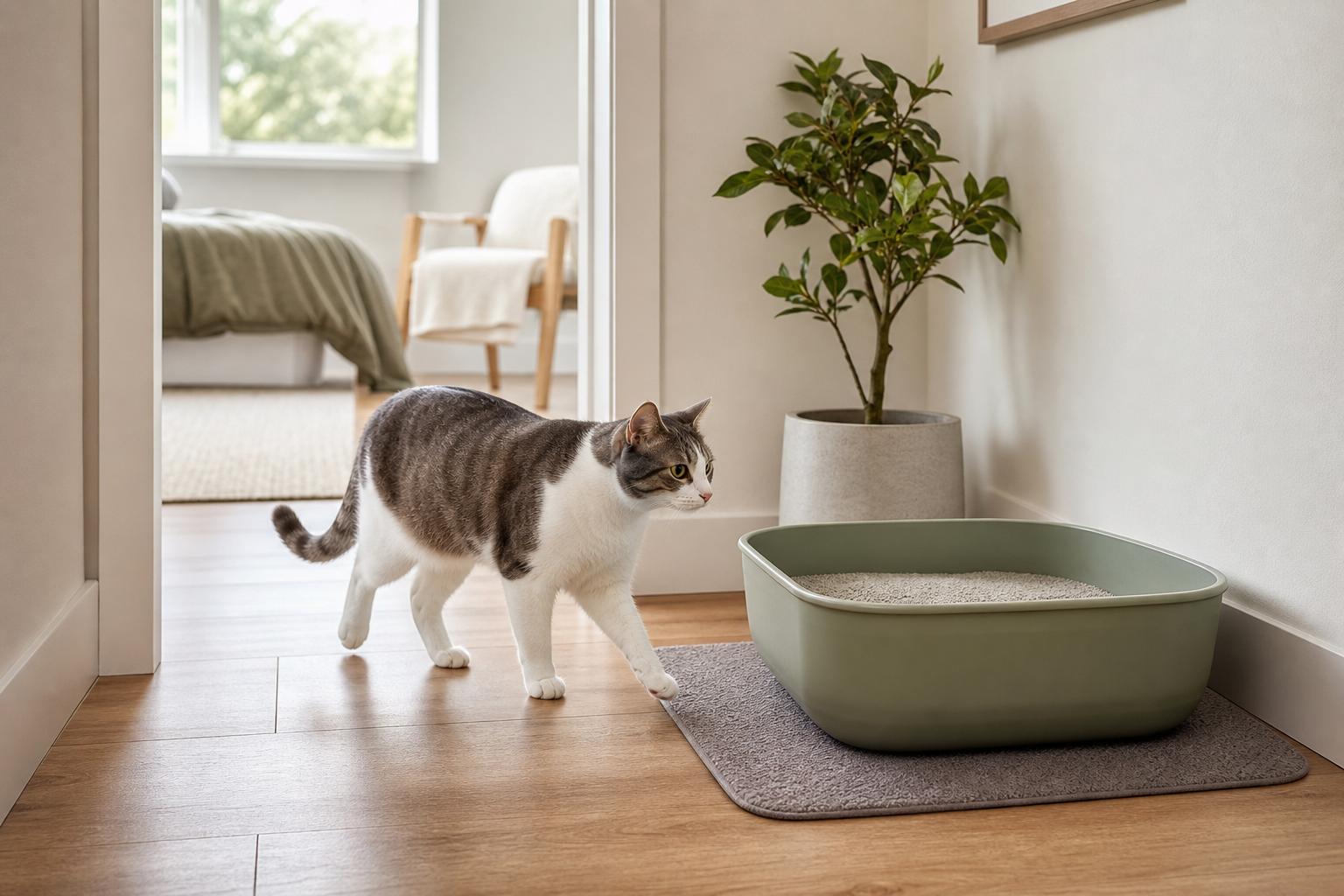
Where a litter box sits can matter as much as the box itself. A location that looks discreet to a person may feel noisy, trapped, distant, or socially risky to a cat. The best placement gives the cat easy access, a clear approach, enough privacy, and a safe way to leave.
This room-by-room guide helps you evaluate real homes rather than search for one perfect location.
Quick recommendation: Start with one box per cat plus one extra, place them in separate locations, and make sure at least one box is available on every level your cat regularly uses.
The six tests every litter box location should pass
Before judging a room, stand where the box would sit and check six conditions:
1. Access: Can the cat reach it at all times, including overnight?
2. Quiet: Is it away from sudden appliance noise, slamming doors, and heavy foot traffic?
3. Escape: Can the cat see the approach and leave without being blocked by another pet?
4. Separation: Is it away from food, water, and primary sleeping areas?
5. Comfort: Is the temperature stable, the floor level, and the space large enough to turn around?
6. Maintenance: Can a person scoop it daily without the box becoming forgotten?
The Ohio State University Indoor Pet Initiative advises placing boxes in quiet, private, easily accessible areas and away from appliances or air ducts that can suddenly startle a cat. The Feline Veterinary Medical Association also recommends distributing boxes in multiple locations rather than clustering them together.
Bathroom: often practical, but check the door
A bathroom can work well because the floor is easy to clean and the room may have low traffic. It becomes a poor choice when the door is frequently closed, showers create persistent dampness, or a loud exhaust fan starts suddenly.
Best bathroom setup:
- Keep the route open at all times with a doorstop or cat-safe access solution.
- Place the box away from the shower spray and toilet-cleaning chemicals.
- Leave enough open space around the box for entry, turning, and exit.
- Avoid squeezing it between the toilet and wall if the cat cannot comfortably move.
- Do not place a food or water station beside it.
A small guest bathroom may be suitable as one option, but it should not be the only box if guests can close the door.
Laundry or utility room: convenient for people, risky for cats
Laundry rooms are a common human choice because litter can be swept easily. For cats, the washer, dryer, boiler, ventilation fan, or vibrating floor can make the room unpredictable.
A utility room is acceptable only when:
- The box is several feet from noisy or hot equipment.
- The cat is not startled when a machine begins a cycle.
- Detergent, bleach, dryer sheets, cords, and cleaning chemicals are secured.
- The door remains open and the cat cannot be cornered.
- There is a second box in a quieter location.
If a cat leaves the room when an appliance starts, do not make that room the primary toileting location. Convenient cleaning is not a substitute for feline comfort.
Bedroom or spare room: quiet and reliable
A bedroom, guest room, or calm back room can be one of the best locations, especially for a kitten, a newly adopted cat, or a cat that needs a temporary safe room. The main risks are odor management, nighttime access, and placing the box too close to bedding or food.
Use a washable litter mat and position the box:
- Near the room edge rather than beside the bed
- Away from food and water bowls
- Outside a cramped closet
- Where the door cannot be shut accidentally
- Where the cat has a clear view of anyone entering
For a new cat, keeping essential resources in one quiet room can reduce the challenge of navigating an unfamiliar home. Even then, separate the litter box from feeding and resting areas as much as the room allows.
Living room: possible when the edge is calmer than the center
A living room may sound too public, but a low-traffic edge can work better than a remote basement. Choose a stable corner with an open sightline, not the center of family activity.
Avoid locations beside:
- Televisions and speakers
- Children's play zones
- Frequently moved chairs
- Dog beds or feeding stations
- Patio doors used throughout the day
- Robot vacuum docks
Furniture enclosures can hide a box from people, but they may also trap odor, limit turning space, or create a single entrance that another animal can guard. Treat an enclosure as a box-design choice, not proof of good placement.
Hallway: use an alcove, not a bottleneck
A wide hallway alcove can provide predictable access, but a narrow corridor can make a cat feel exposed. The box should not force people to step around it or let another cat block the only route.
A hallway location works best when it is:
- Outside the main walking line
- Away from the front door and doorbell activity
- Not beside a stair landing
- Visible enough that the cat can assess the area
- Wide enough for a comfortable approach and retreat
Do not place the box behind a door that swings toward it. A cat should never have to choose between entering the box and avoiding a moving door.
Home office: a strong option with predictable routines
A quiet home office can be suitable if the door stays open and the room does not contain sudden mechanical noise. Place the box away from rolling desk chairs, paper shredders, and cables.
Consider whether video calls, visitors, or work equipment change the room from calm to busy. If your cat regularly rests in the office, preserve distance between the box and its preferred sleeping spot.
Kitchen and dining area: usually avoid
Food preparation areas are generally poor litter-box locations. They create hygiene concerns for people and place toileting too close to food-related activity. Cats also prefer separation between key resources.
If a very small apartment leaves few options, look for a hallway edge, bathroom corner, ventilated entry alcove, or quiet living-room boundary before using the kitchen. Never place the box beside the cat's food or water.
Basement: never the only option
A dry, climate-controlled basement can hold an additional box, but it should rarely be the only one. Stairs, distance, darkness, dampness, storage hazards, and doors that close unexpectedly can all reduce access.
A basement box needs:
- Reliable lighting
- Comfortable temperature and humidity
- A clear, uncluttered route
- No exposed chemicals, traps, tools, or loose insulation
- Daily checking and scooping
- Another box on the main living level
Kittens, senior cats, and cats with mobility limitations may not reach a basement box in time.
Garage: generally unsuitable
Most garages are not appropriate primary litter-box locations. Temperature swings, vehicles, antifreeze, fuel, pesticides, sharp tools, automatic doors, and the risk of escape create avoidable hazards.
An attached, fully converted, climate-controlled room may be evaluated like any other indoor room, but an active vehicle garage should not be treated as normal living space for a cat.
Multi-story homes: provide a box on each used level
A cat should not have to climb a full flight of stairs every time it needs to eliminate. Place at least one box on each level the cat regularly occupies. For a senior cat, keep a low-entry box on the level where it spends the most time.
Do not put every box in one basement row. Cats may perceive adjacent boxes as one toileting station, and a single doorway can let another cat control access to all of them.
Multi-cat homes: distribute resources, not just boxes
The common starting rule is one litter box per cat plus one extra, but location matters as much as the count. Three boxes lined up in one room do not offer the same choice as three boxes in separate, accessible areas.
In a multi-cat home:
- Separate boxes across different rooms or levels.
- Avoid dead ends where one cat can trap another.
- Watch for staring, chasing, doorway blocking, or ambushing.
- Give each social group access to more than one route and toileting area.
- Keep at least one box in a quiet area that dogs and children do not enter.
The 2024 AAFP Intercat Tension Guidelines emphasize separated resources because subtle conflict can affect how safely a cat accesses food, water, resting places, and litter boxes.
Kittens, senior cats, and cats with limited mobility
Kittens need boxes they can find and enter easily. International Cat Care recommends offering more than one tray in separate locations and placing a tray on each floor in a multi-level home.
Senior cats and cats with pain or mobility changes benefit from:
- Low-entry sides
- Non-slip flooring around the box
- Short, level routes
- Night lighting
- A box near their main resting area, but not directly beside the bed
- More frequent cleaning if movement inside the box is difficult
A sudden change in litter-box use should not automatically be blamed on location or behavior. Urinary disease, constipation, pain, mobility problems, and other health conditions can contribute to house-soiling.
Small apartments: create distance without wasting space
In a studio or compact apartment, full room separation may be impossible. Use visual and functional separation instead:
- Put food and water at the opposite end of the room.
- Choose a low-traffic wall rather than the entry path.
- Use a mat to control tracking without trapping the box inside a tiny cabinet.
- Keep ventilation gentle and avoid strong air fresheners.
- Provide two separate box locations when possible, especially for more than one cat.
A location does not need to be invisible. It needs to remain clean, accessible, and acceptable to the cat.
Signs the placement is not working
Reassess the location if your cat:
- Hesitates at the doorway or scans repeatedly before entering
- Runs out immediately after eliminating
- Uses one box but consistently avoids another
- Toilets beside the box or in a quieter room
- Waits until people, dogs, or another cat leave
- Stops using a box after an appliance, renovation, or household change
First, add a box in the location the cat appears to prefer rather than removing every existing option. Keep the litter type consistent while testing placement so you change only one variable.
A 10-minute placement audit
Walk through your home with this checklist:
- [ ] Every cat can reach a box at all times.
- [ ] Every used floor has a box.
- [ ] Boxes are separated rather than grouped together.
- [ ] No box is beside food or water.
- [ ] No loud appliance starts beside a primary box.
- [ ] Another pet cannot guard the only entrance.
- [ ] Kittens and senior cats have a low-entry option.
- [ ] The temperature and lighting remain comfortable.
- [ ] Cleaning supplies and household hazards are secured.
- [ ] Each box is visible enough to be scooped at least daily.
When to contact a veterinarian
Contact a veterinarian promptly when a cat suddenly urinates or defecates outside the box, strains, vocalizes, passes small amounts frequently, has blood in urine or stool, becomes lethargic, or stops eating. Inability to pass urine can be an emergency, especially in male cats.
This guide supports environmental planning; it does not diagnose urinary, gastrointestinal, pain, or behavioral conditions.
For a broader daily routine, read A Practical Cat Care Routine: A Daily Checklist for Happy Indoor Cats. For warning signs that need attention, see Common Health Problems in Cats: Signs, Prevention and When to See a Vet.
Sources
Frequently Asked Questions
What is the best room for a cat litter box?
A quiet, easily accessible room with a clear approach and exit is usually best. A calm bathroom, spare room, home office, or low-traffic hallway alcove can work if the door stays open.
Can I put a litter box in the laundry room?
It can be an additional location, but washers, dryers, boilers and fans may startle a cat. Keep the box away from equipment and provide a quieter alternative.
How many litter boxes should a multi-cat home have?
A common starting rule is one box per cat plus one extra, placed in separate locations rather than lined up together.
Should a litter box be on every floor?
Yes, provide at least one box on every level the cat regularly uses, especially for kittens, senior cats and cats with mobility limitations.
When is house-soiling a medical concern?
A sudden change, straining, frequent small urinations, blood, pain, lethargy or inability to urinate requires prompt veterinary attention; inability to pass urine can be an emergency.
Sources and References
About this article
Evidence-led cat care and home-environment guidance from the ShineePets Editorial Team.
ShineePets is a commercial B2B pet-supply sourcing brand. Read our editorial standards and commercial disclosure.