Cat Care
Choosing Cat Toys by Hunting and Play Style
Quick answer
Observe whether your cat stalks, chases, bats or kicks, then choose toy movement and construction to match—with a safety check before use.
By ShineePets Editorial Team · Published
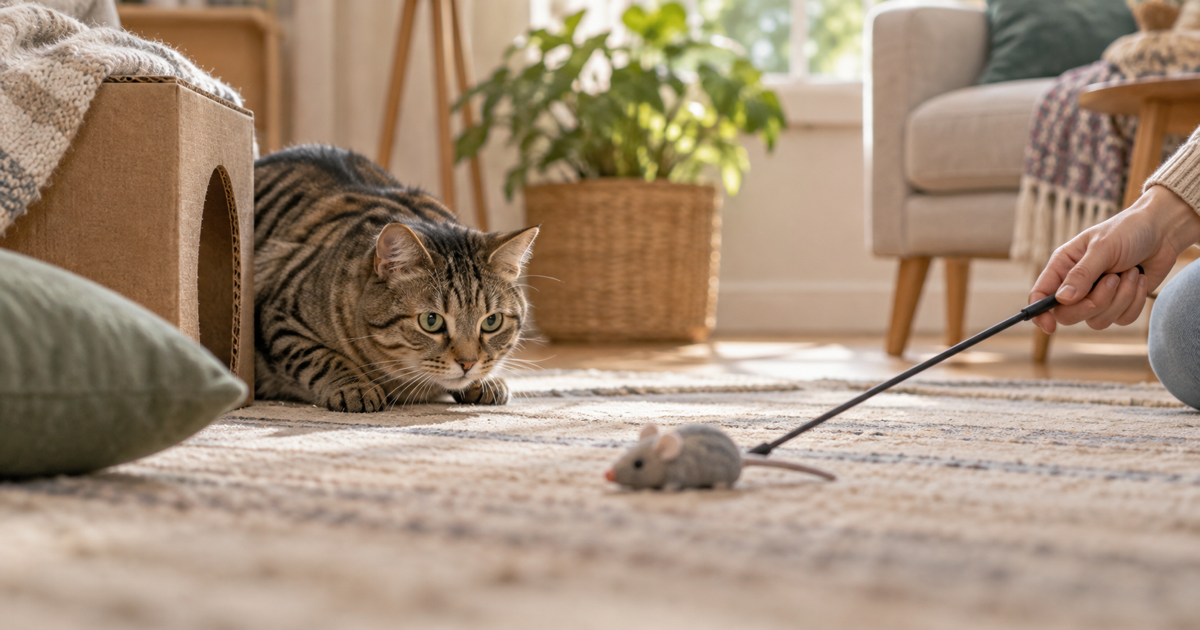
Choosing cat toys by play style starts with observing what your cat actually follows, stalks and catches. One cat may track a lure moving low along the floor; another watches something briefly flutter above a hiding place; a third prefers to grab and kick a soft object. Select the toy's movement, size and construction for that response, then test it in a calm, supervised setting. Do not equate a lack of dramatic jumping with disinterest, especially in an older cat. The goal is a safe opportunity to watch, pursue and sometimes capture—not a toy that moves fastest or looks most like prey to a human. The Ohio State Indoor Pet Initiative recommends observing which prey-like qualities a cat responds to before choosing toys.
This guide is about matching a toy to an individual cat, not setting a daily play schedule or ranking puzzle difficulty. If your cat's play has changed suddenly, consider health and comfort before shopping for a more exciting toy.
Choose Cat Toys by Play Style: Watch Before You Buy
The words *hunter*, *chaser* and *wrestler* are useful descriptions of play moments, not fixed personality labels. A cat may prefer floor-level pursuit one day and a soft kicking toy another. Watch for the action that happens before the catch: Do the eyes follow? Does the cat crouch behind cover, creep forward, bat from a seated position, sprint after a rolling object or carry it away? Note whether the cat voluntarily returns after a catch.
Start with two safe objects you already have rather than buying a large bundle. Compare one variable at a time—ground movement versus a small change in height, for example—while keeping the room and handler familiar. The Ohio State prey-preference exercise suggests comparing responses to bird-, mouse- and insect-like movement. Our practical extension is to record *how* your cat plays as well as which object it notices.
Try this short observation sequence:
1. Choose a quiet room with secure footing, no fragile items overhead and an easy place for the cat to retreat. Cornell's toy-safety guidance notes that the play environment matters as well as the toy.
2. Move a supervised wand lure slowly away along the floor, with pauses near cover. Give the cat time to watch, approach or pounce. Do not aim it at the face or force the cat from a hiding place.
3. After a catch, pause and offer a second movement pattern: a short, low flutter or a gently rolling, intact toy. Keep the object within the cat's comfortable reach.
4. Write down the useful signal: watched only, approached, stalked, chased, pawed, grabbed, carried or returned for another turn. If the cat avoids the area or seems distressed, stop; a failed trial is information, not a reason to push harder.
There is no need to turn this into a timed experiment. Repeat another day if the cat was sleepy, interrupted or newly settled in the home. A single "favorite" may reflect the room, speed or your handling as much as the object itself.
Match the Observed Action to a Toy Design
| What the cat chooses to do | Try first | How to present it | What to check before buying |
| --- | --- | --- | --- |
| Crouches, waits and pounces from cover | A supervised wand with an intact soft lure | Let it appear and disappear beside a box or low furniture, then allow a catch | Secure lure attachment; no loose strands or detachable eyes |
| Follows movement near the floor and gives chase | A larger, smooth ball or a ground-level fabric lure | Roll or draw it away in short, unpredictable paths, not into a wall | Too large to swallow; no cracks, loose bells or sharp edges |
| Tracks brief movement above the floor | A lightweight, securely attached wand lure | Flutter briefly at a comfortable height and bring it down for a catch | Strong joints and no feathers or strings that can separate |
| Grabs with front paws and kicks | A long, soft kicker toy | Offer it at floor level after the cat captures it; let the cat hold it | Durable seams and stuffing that stays enclosed |
| Bats from a seated or lying position | A light, easily reached toy or low-moving wand | Bring movement into the cat's view without demanding a leap | Size, easy grip and no parts that can break off |
These are starting points, not a breed chart or a guarantee. A toy's material name does not establish that it is suitable: inspect the finished construction and watch how this cat uses it. Cats Protection describes stalking, chasing, pouncing and batting as useful play opportunities; Cornell cautions against small pieces or strand-like parts that can detach and be swallowed.
Movement Matters as Much as the Object
The same wand can be exciting or ignored depending on how it moves. A lure dragged in a straight line at high speed may never give the cat a chance to assess or intercept it. Try moving it away, pausing near cover and changing direction after the cat looks toward it. A brief flutter can suit a cat that tracks movement above the floor, but high repeated jumps are not necessary to make play useful.
Make the "prey" catchable. Pause long enough for a paw or mouth to make contact, then let the cat hold it briefly before offering another turn. Both Cats Protection and the Feline Veterinary Medical Association's environmental-needs guidance stress the value of intermittent capture rather than endless pursuit. Keep hands and feet out of the game; use the toy to create distance instead of teaching a kitten to bite skin.
Watch the cat, not just the toy. Focused tracking, voluntary approach and returning after a pause suggest the presentation may be working. A cat that turns away may prefer another movement or may simply be finished. If ears flatten, the cat freezes, hisses or repeatedly retreats, stop and give space. The Feline Veterinary Medical Association advises positive, predictable interaction tailored to the individual cat and describes avoidance and defensive body language as signs of distress.
Apply a Safety Gate to Every Play Style
A toy can match a hunting preference and still be a poor purchase. Before its first use and after each active session, check:
- Size and shape: Can this cat put the whole object in its mouth or lodge it where it cannot be retrieved? Choose a larger option if uncertain.
- Attachments: Tug gently on the lure, eyes, bells and sewn-on pieces before offering it. Retire the toy if an attachment loosens.
- Strings and elastic: Use wand toys only with direct supervision; store them beyond reach afterward. Avoid loose yarn, ribbon or similar household substitutes.
- Surface and seams: Feel for exposed wire, sharp plastic, rough edges or stuffing coming through a seam. Replace rather than patch a toy in a way that leaves a new loose part.
- Cleaning: Follow the product's care directions, dry it fully and discard a toy that cannot be cleaned or dried after soiling.
Cornell's feline toy guidance warns particularly about detachable feathers and string-like parts; Cats Protection advises not leaving cats alone with toys that could be shredded, eaten or tangled. No unattended-access label should override what you observe this particular cat doing to a toy. If a part is missing and swallowing is possible, stop play and contact a veterinarian promptly.
Adjust the Match for Age, Mobility and the Household
Kittens may investigate many moving objects, but their smaller mouths make loose parts especially concerning. Use toys that keep teeth and claws away from hands; supervise until you know the kitten's chewing and tearing habits. An adult cat may switch between quick chase and patient ambush. Provide the style it chooses, not a supposed age-based toy category.
For a senior cat or one with reduced mobility, bring the target to the cat's comfortable level. Watching, reaching or a gentle paw tap can be meaningful play; do not require repeated jumping to prove interest. FelineVMA's chronic-pain guidance notes that some cats may watch a wand rather than pounce, and that reduced play can also be a sign of discomfort.
In a multi-cat home, observe each cat separately first. A fast or assertive cat can intercept every lure before a quieter cat has a chance to show a preference. Offer space and separate opportunities rather than assuming one shared toy reveals what both cats enjoy. This is a practical choice test, not a diagnosis of social behavior.
When a New Toy Is Not the Answer
If a cat that usually plays suddenly stops, avoids movement, limps or seems unusually withdrawn, arrange a veterinary assessment. The change may reflect pain or illness rather than boredom or a failed toy. FelineVMA includes reduced play and stiffness among signs to discuss with a veterinarian. Stop play immediately and seek emergency veterinary care for labored or open-mouth breathing; Cornell's feline respiratory guidance explains that breathing difficulty needs prompt treatment.
For a healthy cat, buy conservatively: one safe ground-level toy, one supervised lure or one intact kicker may tell you more than a large assorted pack. Keep the style that produces voluntary engagement, and change one feature if it does not. For help turning that choice into a sustainable activity pattern, read ShineePets' indoor cat play routine guide. For construction and supervision checks, see our pet toy safety guide.
*This article is general pet-care information and does not replace veterinary diagnosis or individual advice.*
Sources and Further Reading
- Identifying Prey Preference — Ohio State University Indoor Pet Initiative
- Cats and Play — Cats Protection
- Safe Toys and Gifts — Cornell Feline Health Center
- Understanding the Needs of Your Cat and Their Behavior — Feline Veterinary Medical Association
- Setting Up the Environment for Success — Feline Veterinary Medical Association
- Treating Chronic Pain with NSAIDs — Feline Veterinary Medical Association
- Dyspnea (Difficulty Breathing) — Cornell Feline Health Center
For retailers, distributors and pet brands
Building a cat-product assortment?
Explore cat trees, scratchers, toys, grooming and feeding products, with B2B sourcing and customization support.
Explore Wholesale Cat Products Discuss OEM/ODMFrequently Asked Questions
Does watching a toy without pouncing count as interest?
Yes. A cat may track a toy with its eyes or bat gently, especially when older or less mobile. Offer a low, easy-to-reach movement; if play has suddenly declined, ask a veterinarian.
Does a cat need only one prey-style toy?
No. Preferences can vary by day, movement and setting. Start with a small selection and note which safe presentations invite voluntary stalking, chasing or catching.
Can I leave a feather wand out when I am away?
No. Wand cords and detachable feathers can be tangled, chewed or swallowed. Supervise play, inspect the lure and store the wand out of reach afterward.
Can the same wand toy suit ground and air play?
Often yes, if its lure and attachment remain intact. Move it along the floor for ground pursuit or briefly above the floor for tracking, then give the cat a chance to catch it.
Sources and References
- Identifying Prey Preference — Ohio State University Indoor Pet Initiative
- Cats and Play — Cats Protection
- Safe Toys and Gifts — Cornell Feline Health Center
- Understanding the Needs of Your Cat and Their Behavior — Feline Veterinary Medical Association
- Setting Up the Environment for Success — Feline Veterinary Medical Association
- Treating Chronic Pain with NSAIDs — Feline Veterinary Medical Association
- Dyspnea (Difficulty Breathing) — Cornell Feline Health Center
Continue Reading
Indoor Cat Play: Building a Balanced Daily Routine
Build a balanced indoor cat play routine with short hunting games, safe solo activities, toy rotation, rest, and age-appropriate adjustments.
Pet Toy Safety: Materials, Size and Supervision
A practical guide to choosing safer pet toy materials and sizes, supervising first use, inspecting damage and responding to swallowed pieces.