Cat Care
Indoor Cat Play: Building a Balanced Daily Routine
Quick answer
Build a balanced indoor cat play routine with short hunting games, safe solo activities, toy rotation, rest, and age-appropriate adjustments.
By ShineePets Editorial Team · Published · Updated
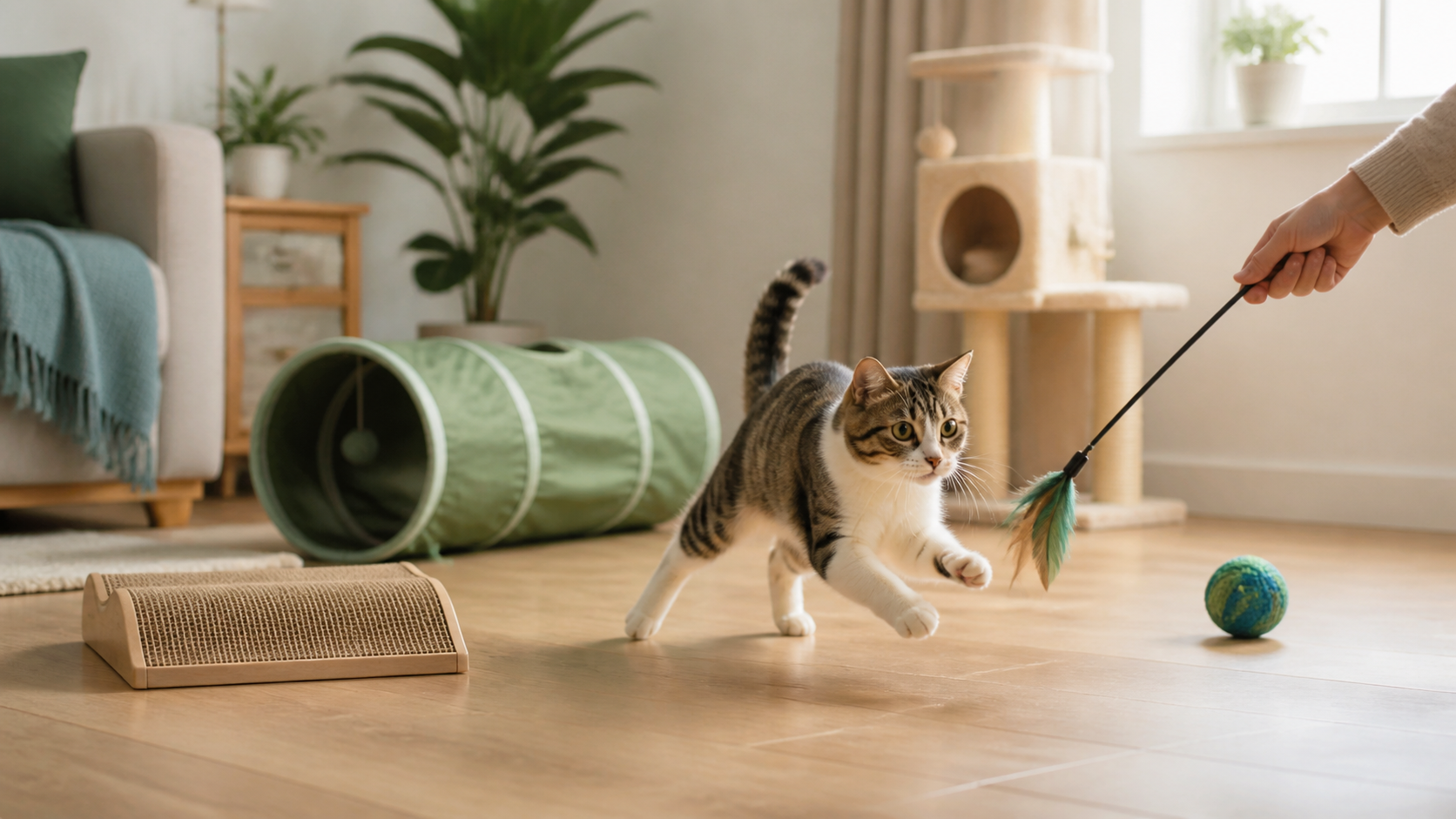
Indoor cats need more than a pile of toys left on the floor. A balanced play routine combines short interactive hunting games, safe independent activities, climbing and scratching opportunities, predictable quiet periods, and enough choice for the individual cat. The goal is not constant entertainment. It is a repeatable daily rhythm that lets a cat stalk, chase, pounce, catch, explore, and then settle.
Key Takeaways
- Schedule at least two interactive play opportunities each day, then add shorter sessions when your cat asks for them or has extra energy.
- Keep most games brief and successful. Several focused sessions are usually easier to sustain than one exhausting workout.
- Move toys like prey, allow regular catches, and finish before the cat becomes frustrated or overstimulated.
- Balance owner-led play with puzzle feeding, scratching, climbing, hiding, observation, and uninterrupted rest.
- Adjust the routine for age, mobility, health, confidence, and multi-cat relationships rather than using one fixed timetable for every cat.
A good play routine is predictable enough to feel safe, varied enough to stay interesting, and flexible enough to follow the cat’s signals.
Why Indoor Cats Need Planned Play
An indoor home protects cats from many outdoor risks, but it also removes much of the searching, climbing, chasing, and decision-making that would otherwise fill their day. Food arrives in a bowl, rooms rarely change, and prey does not cross the living room on schedule.
The Feline Veterinary Medical Association identifies opportunities for play and predatory behavior as one of the essential pillars of a healthy feline environment. Indoor cats also need safe places, separated resources, predictable positive social contact, vertical space, and respect for their sensory world.
Play supports this larger environment by giving the cat an appropriate outlet for normal behavior. It can add movement, strengthen the caregiver-cat relationship, and redirect stalking or pouncing away from hands, ankles, and other pets. It cannot compensate for pain, conflict, an unsuitable litter setup, or a lack of secure resting places, so it should be one part of the daily routine rather than the entire plan.
What “Balanced” Means in Practice
A balanced routine includes five different elements:
1. Interactive hunting play: A person controls a wand, lure, ball, or other toy that moves like prey.
2. Independent play: The cat can safely bat, carry, kick, explore, or solve a simple food puzzle without direct help.
3. Environmental movement: Climbing, scratching, walking between resources, and moving through tunnels add low-pressure activity.
4. Choice and recovery: The cat can stop, hide, observe, groom, or sleep without being chased into another game.
5. Variation: Toys and routes change gradually while the basic daily rhythm stays familiar.
Balance does not mean equal minutes for every activity. A confident young cat may want many fast play bursts. A cautious adult may prefer stalking from behind a tunnel. A senior may enjoy slower ground-level games with long pauses. The routine is successful when the cat participates willingly and returns to a calm baseline afterward.
How Often and How Long Should Cats Play?
There is no universal number of minutes that suits every cat. Current FelineVMA caregiver guidance recommends routine object play at least twice daily, with short bursts of a few minutes to simulate hunting. Cats Protection notes that very short games—even one or two minutes—can be useful, and that younger cats often seek more sessions than older cats.
A practical starting point for a healthy adult indoor cat is:
- two planned interactive sessions each day;
- about 5–10 minutes available for each session, while allowing the cat to finish sooner;
- one or two optional micro-sessions of 1–3 minutes;
- independent enrichment available at selected times, not every toy left out permanently.
Treat these as starting ranges, not targets to force. Stop earlier if the cat walks away, hides, becomes tense, pants, or loses coordination. Some cats prefer several 60-second chases separated by long stalking pauses. What matters is engaged behavior, not a stopwatch.
A Sample Daily Play Routine
The best schedule fits the household, but placing active games around natural transition points makes the routine easier to remember.
Morning: a short hunting game
After the household wakes, offer 3–7 minutes with a wand or lure. Begin with slow movement near cover, allow the cat to stalk, then add short bursts across the floor. Let the cat catch the toy several times.
End with a final catch and a calm transition. If it fits the feeding plan, part of the cat’s measured breakfast can follow the game or be offered in a food puzzle. Do not add extra calories simply because food enrichment is used.
Midday: independent exploration
When the cat is alone or the household is busy, provide one or two safe options:
- a sturdy treat ball or puzzle feeder using part of the daily food allowance;
- a cardboard box with more than one easy exit;
- a tunnel positioned so the cat cannot become trapped by another pet;
- a durable ball or kicker toy with no loose pieces;
- access to a stable perch and a safe window view.
Rotate the choice instead of presenting everything every day. Novelty is more effective when it appears in small, manageable doses.
Evening: the main interactive session
Many cats become active when people return home or during evening transition periods. Use 5–10 minutes for the most energetic game of the day. Combine floor-level stalking, a few short chases, and pauses behind furniture or a tunnel.
Avoid repeatedly making the cat leap straight upward or twist in the air. Keep the route predictable enough to prevent collisions, especially on smooth floors or around furniture.
Before bed: a calm finish
If the cat regularly races through the home at night, add a brief, lower-intensity session before the household settles. Use slow stalking, a soft kicker toy, scent exploration, or a few easy food-puzzle actions. Finish with quiet rather than continuing until the cat is highly aroused.
Build Each Interactive Session Like a Hunt
Randomly waving a toy in the cat’s face is less engaging than creating a simple hunting sequence.
1. Search: Hide the lure partly behind a chair, tunnel, or paper bag with its handles removed.
2. Stalk: Move slowly and pause. Give the cat time to lower its body, watch, and plan.
3. Chase: Add a short movement away from the cat, not directly toward the face.
4. Pounce: Let the cat close the distance.
5. Catch: Stop the toy and allow the cat to hold, bite, or bunny-kick it safely.
6. Reset: Wait a moment, then begin another short sequence.
7. Finish: Offer one clear final catch and put the interactive toy away after the cat releases it.
Cats should catch the “prey” regularly. FelineVMA guidance specifically notes that intermittent capture helps prevent frustration. A successful game is not one in which the person keeps winning.
Choose Toys by Function, Not Quantity
Different toys support different parts of the routine.
Wand and lure toys
These create distance between teeth, claws, and human hands while allowing realistic movement. Use them only with supervision and store them securely after play so strings, feathers, or elastic cannot be chewed or swallowed.
Balls and small carry toys
Lightweight balls and toy mice can support chasing and carrying. They should be too large to swallow, free from detachable eyes or bells, and checked regularly for damage.
Kicker toys
Longer soft toys give cats an appropriate object to grip and kick. Choose durable seams and remove the toy if stuffing or internal material becomes exposed.
Puzzle feeders
Food puzzles add searching and problem-solving. Start easy so food is visible and obtainable, then increase difficulty gradually. Use measured food from the normal daily allowance and provide a standard feeding option if the cat cannot or will not use the puzzle.
Scratching and climbing areas
Scratching posts, horizontal scratchers, shelves, and cat trees are not toys in the narrow sense, but they make the daily activity pattern more complete. Place stable resources near areas the cat already uses rather than hiding them in an unused room.
Rotate Toys Without Making the Home Unpredictable
Leaving every toy available can reduce interest and make damage harder to notice. Divide safe toys into small groups and rotate them every few days or weekly. Keep a few familiar favorites while introducing one changed element at a time.
A simple rotation might look like this:
- Days 1–2: feather-style wand, soft ball, cardboard box
- Days 3–4: fabric lure, kicker toy, easy food puzzle
- Days 5–7: ribbon-free wand, track ball, tunnel
Rotation should not involve moving all of the cat’s essential resources. Food, water, litter, safe resting areas, and core scratching locations should remain dependable.
Read the Cat’s Body Language During Play
Engaged play often includes forward-facing ears, focused eyes, stalking, brief tail movement, pouncing, catching, and voluntary re-engagement. The cat may pause frequently; a pause is part of the hunt, not necessarily loss of interest.
Slow down or stop when you see:
- ears flattening or rotating sharply sideways;
- repeated hard tail lashing;
- skin rippling, sudden grooming, or agitated vocalization;
- biting directed at the person rather than the toy;
- frantic movement without pauses or control;
- the cat trying to leave, hide, or guard the toy;
- open-mouth breathing or panting.
Do not punish the cat for becoming overexcited. Freeze the toy, create space, and allow recovery. Next time, shorten the session or reduce speed and jumping.
Adjust the Routine by Life Stage and Ability
Kittens and young cats
Young cats often need many brief sessions. Use toys that keep hands and feet out of the game, teach gentle transitions, and inspect small parts closely. Provide safe climbing challenges that match developing coordination.
Adult cats
Adult routines can combine two planned sessions with optional micro-sessions. Watch for preferences: some cats love aerial movement, while others engage only when the toy stays on the floor and disappears behind cover.
Senior cats and cats with limited mobility
Keep games on nonslip surfaces and within comfortable reach. Drag toys slowly, use wide turns, add pauses, and place puzzles or scratchers near resting areas. A senior cat may show interest through watching, pawing, or one short pounce rather than a long chase.
A sudden decline in play, reluctance to jump, stiffness, hiding, irritability, or a change in appetite can be associated with pain or illness. Arrange a veterinary assessment rather than assuming the cat is simply bored or old.
Plan Play Carefully in Multi-Cat Homes
Cats living together do not automatically want to share one game. One confident cat may block the lure, while another watches from a doorway and never gets a turn.
For a more balanced routine:
- schedule individual sessions in separate spaces when possible;
- provide more than one play, resting, scratching, food, water, and toileting location;
- avoid sweeping one toy through both cats if it creates chasing or guarding;
- give shy cats routes with cover and more time to stalk;
- stop if one cat corners, fixates on, or redirects aggression toward another.
Parallel play can work when cats are relaxed, but each cat should still have control, escape routes, and access to resources without passing a social competitor.
Common Play Mistakes to Avoid
- Using hands or feet as prey: This teaches the cat that human skin is an acceptable target.
- Moving the toy at the cat’s face: Prey generally moves away or hides; constant face-level motion can be irritating.
- Never allowing a catch: Endless pursuit may cause frustration.
- Forcing a long workout: Fatigue is not the measure of a successful session.
- Relying only on a laser: If a light game is used, never aim near eyes and finish with a physical toy the cat can capture. A catchable toy is a better foundation for the routine.
- Leaving strings or damaged toys unattended: Store wand toys, ribbons, elastic, and loose components after use.
- Adding food without adjusting portions: Puzzle feeding should usually use food already included in the daily plan.
- Ignoring conflict in multi-cat homes: Watching from a distance may reflect exclusion, not satisfaction.
A Seven-Day Routine Builder
Use one week to learn what your cat actually prefers.
Days 1–2: observe
Offer two short sessions at different times. Note whether the cat prefers floor movement, hiding toys, jumping, carrying, or kicking.
Days 3–4: shape the schedule
Repeat the two most successful time slots. Add one safe independent activity during a naturally alert period.
Days 5–6: add variety
Change the toy or route, but keep the session time familiar. Reduce intensity if the cat becomes agitated or stops participating.
Day 7: review
Ask:
- Did the cat approach voluntarily?
- Which movement produced stalking and catching?
- Did the cat settle comfortably afterward?
- Was one cat excluded in a multi-cat home?
- Did any toy show wear or create a safety concern?
- Can the household realistically repeat this schedule?
Keep what worked and change only one variable the following week.
Final Recommendation
Start with two short interactive sessions—one near the beginning of the day and one in the evening—plus a rotating independent activity. Build each game around search, stalk, chase, pounce, and catch. Keep essential resources stable, respect rest, and adjust intensity to the cat in front of you.
The most effective routine is not the busiest one. It is the routine your cat chooses to join and your household can repeat safely every day.
Frequently Asked Questions
How many times a day should I play with my indoor cat?
Start with at least two interactive opportunities each day. Many cats prefer additional one-to-three-minute sessions, especially when young or naturally active.
How long should each cat play session last?
A practical starting window is five to ten minutes, but follow the cat rather than the clock. Shorter sessions are useful when the cat engages, catches the toy and then chooses to stop.
What is the best way to end a play session?
Slow the toy, allow one clear final catch, wait for the cat to release it, and transition to a calm activity. Store wand and string toys securely afterward.
Can indoor cats play safely by themselves?
Yes, with durable balls, kicker toys, simple food puzzles, scratchers and stable climbing areas. Remove damaged items and never leave strings, elastic or detachable pieces unattended.
Why has my cat suddenly stopped playing?
A sudden change can be linked to pain, illness, fear or household stress. Note other changes such as hiding, stiffness, appetite loss or irritability and arrange veterinary advice.
Sources and References
- Feline Veterinary Medical Association — Your Cat's Environmental Needs
- Feline Veterinary Medical Association — Indoor Cats Position Statement
- Feline Veterinary Medical Association — Training Techniques for Undesirable Behaviors
- Cats Protection — Cats and Play
- Cats Protection — Guide to Indoor Cats
- RSPCA — Keeping Cats Indoors
About this article
The ShineePets Editorial Team creates practical, source-based guides for pet owners, retailers, and product buyers.
ShineePets is a commercial B2B pet-supply sourcing brand. Read our editorial standards and commercial disclosure.