Dog Care
Choosing Dog Toys by Size and Chewing Strength
Quick answer
Choose dog toys using mouth fit and observed chewing strength, then test the first session and retire damaged toys before they become hazards.
By ShineePets Editorial Team · Published
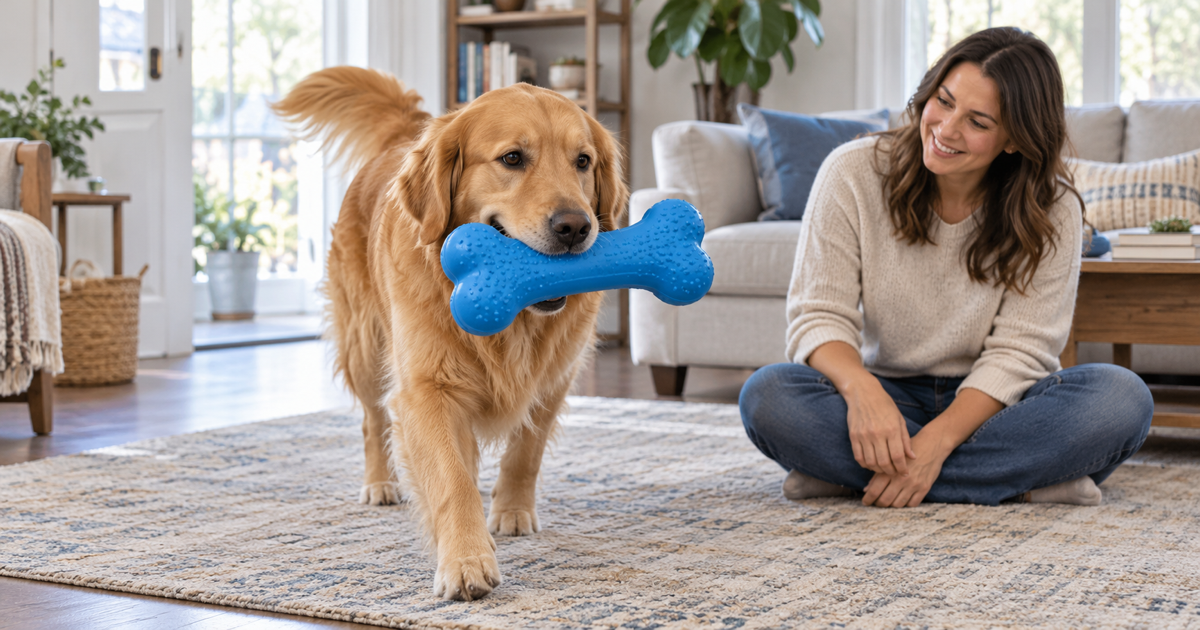
Choosing dog toys by size and chewing strength means checking two things separately: can this dog put the whole toy into its mouth or swallow a broken piece, and what happens when it actually bites the toy? Start with a product intended for the dog's size, then check its shape against the dog's mouth. Match construction to the dog's observed behavior—not a breed stereotype or a promise of “indestructibility.” A toy also needs enough give to protect teeth. Supervise its first use, inspect it afterward and retire it when its size or structure changes. The ASPCA recommends choosing for the individual dog's size and chewing habits and contacting a veterinarian if a chunk is swallowed.
This guide covers non-edible toys. Discuss edible chews and dental products with your veterinarian.
Choose Dog Toys by Size and Chewing Strength: Two Separate Checks
“Small dog” and “strong chewer” are not mutually exclusive. A compact dog may strip fabric seams quickly; a large dog may only carry a soft toy. Write down the dog's actual mouth fit and play pattern before choosing a size or material. Product weight ranges are a starting point, not a guarantee that the shape fits your dog's head and jaw. AAHA's size guidance advises that chews generally be bigger than the snout and slightly wider than the mouth.
| What you observe | First toy to consider | Critical check during play |
|---|---|---|
| Gentle carrier or light chewer | Appropriately sized soft toy for supervised carrying, or a flexible rubber toy | Seams, stuffing and attached features stay intact. |
| Moderate chewer who grips and gnaws | Appropriately sized, slightly yielding rubber toy designed for repeated use | No deep cuts, loose pieces or hard tooth-on-toy impact. |
| Strong chewer who quickly tears or consumes parts | Larger, simpler flexible toy with no removable details; use only under close observation first | Stop immediately if pieces tear off or the dog attempts to gulp the toy. |
| Dog with a sore mouth or reduced chewing comfort | Ask a veterinarian about a gentler option before offering a new chew toy | Do not try to solve sudden reluctance to chew with a tougher product. |
These are observed behaviors, not measured bite-force scores. A “power chewer” label cannot override size or dental checks. A toy may be too hard for teeth even if the dog cannot damage it. The American Animal Hospital Association asks owners to consider chew style, size, hardness and durability together.
Make the Mouth-Fit Decision Before Comparing Materials
Stand beside the dog and compare the full toy—not just its retail photo—with the dog's muzzle. It should not fit wholly inside the mouth or slide toward the back of the throat. Assess narrow ends, handles and compressible sections too: a toy that appears large on the shelf may become much smaller when squeezed or worn. VCA's chew-toy guide warns against toys that easily fit entirely in the mouth.
Use this store or online-cart checklist:
1. Read the manufacturer's dog-size and intended-use information. Record the toy's actual dimensions rather than choosing by “small,” “medium” or “large” alone.
2. Compare its widest usable section with your dog's mouth and snout. If the dog is between sizes, the toy compresses substantially, or the dog tends to gulp objects, favor the larger suitable option; check that it remains easy to manipulate.
3. Reject a shape with a narrow neck, dangling piece, exposed squeaker or attachment that could be torn off and swallowed.
4. Recheck the fit as puppies grow and when a product wears down. In a multi-dog home, keep toys selected for a smaller dog away from larger housemates.
Do not size up without limit. If a toy is heavy or awkward, choose a different shape rather than the largest size. Cornell's veterinary guidance advises avoiding easily swallowed toys and supervising play.
Match Construction to What Your Dog Actually Does
Observe one short play session with an existing suitable toy. Does the dog carry it, mouth it intermittently, hold it between its paws and gnaw, pick at a seam, or remove chunks within minutes? Does it try to swallow fragments? This observation is more informative than breed or body weight alone. ASPCA's position statement distinguishes slower chewing from rapid consumption and urges active observation.
For a dog that carries or fetches, a soft toy can be a supervised play object, but check stitching, appliqués, tags and any internal squeaker. It is a poor chew choice if the dog opens seams or eats stuffing. For a dog that gnaws steadily, a flexible rubber toy with a simple shape may be easier to inspect than a complex design with multiple joins. For a dog that destroys toys quickly, prioritize a larger, simple toy that yields slightly yet does not shed pieces under that dog's use. If every tested option breaks, stop trialing harder and harder objects and ask a veterinarian about alternatives.
Tug and fetch toys are activity-specific. A tug toy may be suitable during an interactive session but not as an unattended chew. A ball must be large enough for the individual dog, and a dog that compulsively gnaws on an abrasive ball surface may need another fetch option. VCA notes that obsessive chewing of a tennis-ball surface can wear teeth over time.
Food-dispensing toys add an extra check: the opening and cavity should be cleanable, the toy must not release pieces, and any food should fit the dog's normal diet. VCA's enrichment guidance recommends supervising initial use and cleaning and drying activity toys after use. If several dogs share a home, separate them for valuable food toys if guarding or competition occurs.
Strength Is Not Hardness: Protect the Teeth
A toy that outlasts vigorous chewing is not automatically suitable. Very hard materials can damage or fracture teeth; brittle products can also produce sharp fragments. As a practical screening step, press a thumbnail into a proposed chew toy and check whether a longer toy has some bend. If neither yields at all, it may be too hard. This is a screening rule, not a certification of safety. AAHA and VCA both recommend checking give and warn about dental damage from very hard chews.
Avoid treating bones, antlers, hooves, rocks or very hard manufactured chews as the default answer for a strong chewer. A stronger jaw does not make teeth immune to fractures. Cornell's dental-care guidance cautions that hard objects can wear or fracture teeth and recommends asking a veterinarian for individual advice.
If the dog suddenly stops using a toy, chews only on one side, drops food, drools, has mouth bleeding or shows facial swelling, stop offering new chew challenges and contact a veterinarian. Do not assume the dog needs a different flavor or tougher material. Cornell lists eating difficulty, bleeding, swelling and drooling among signs that warrant veterinary contact.
Run a Supervised First-Use Test
The label is only the first filter. Try a new toy under close observation. Inspect it before and after play.
- Fit: Can the whole toy or a compressed portion slip behind the front teeth? Does a handle or opening catch the jaw or tongue?
- Behavior: Does the dog lick, carry or gnaw predictably, or try to strip and swallow parts?
- Damage: Are there new cuts, punctures, loose seams, exposed squeakers, frayed fibers or missing chunks?
- Comfort: Is there coughing, gagging, unusually forceful biting, blood on the toy or a sudden refusal to continue?
If the dog targets a weak point, end the session. A strong-chewer toy that loses chunks in the first trial is the wrong match for this dog, even if its package claims durability. VCA says a product is not recommended for a pet that chews off pieces, and advises monitoring toys at least initially. “Supervised once” does not mean the toy is safe to leave unattended forever; wear and behavior can change.
Inspect, Clean and Retire Toys on Purpose
Check high-stress points before each chewing session: molded seams, thin necks, fabric stitching, rope ends and the area around a food-dispensing opening. After play, look for pieces on the floor and compare the toy with its previous condition. Retire a toy when it becomes small enough to swallow, sheds chunks, develops deep cuts or sharp edges, exposes stuffing or a squeaker, or has frayed fibers the dog can ingest. Do not keep a damaged toy in circulation merely because it was expensive. VCA's guide specifically identifies broken rubber, frayed rope and exposed stuffing as retirement signals.
Follow the maker's cleaning instructions. Wash food-contact cavities thoroughly and let them dry before storage. If a toy cannot be cleaned adequately after food use, reconsider that design. Store limited-session toys where the dog cannot retrieve them without supervision. For a dog that consistently eats non-food material, speak with the veterinarian about an individualized prevention plan rather than relying on a supposedly indestructible toy.
If a Piece Is Swallowed or the Dog Looks Unwell
Difficulty breathing, choking or collapse requires immediate emergency veterinary help. If a toy piece is missing and may have been swallowed, contact a veterinarian promptly even if the dog initially appears normal. Do not wait for vomiting to prove that an obstruction exists, and do not induce vomiting unless a veterinary professional directs you to. Vomiting, loss of appetite, abdominal pain and lethargy are among signs of possible gastrointestinal obstruction; Cornell's canine foreign-body guidance describes this as an emergency requiring prompt assessment.
This article offers general toy-selection information and does not replace veterinary diagnosis or treatment.
The Buying Decision in One Pass
Choose the smallest *suitable* product that remains too large to enter the back of this dog's mouth, while still being easy for the dog to use. Match its construction to observed chewing, then reject anything too hard for teeth or too easy to fragment. Supervise a first trial, inspect after use and revise the choice when the dog grows, changes chewing habits or shows oral discomfort. For broader cross-species hazards, see our pet toy safety guide; for a dog that chews household items, see our guide to understanding destructive chewing.
Sources and Further Reading
- Position Statement on Dog Chews/Treats — ASPCA
- Don't Chew On This! — American Animal Hospital Association
- How to Choose the Best Chew Toy for Your Dog — VCA Animal Hospitals
- Behavior Management: Enrichment and Activity Toys — VCA Animal Hospitals
- Gastrointestinal Foreign Body Obstruction in Dogs — Cornell University College of Veterinary Medicine
- Dental Disease and Home Dental Care — Cornell University College of Veterinary Medicine
For retailers, distributors and pet brands
Building a dog-product assortment?
Explore dog toys, grooming, feeding, beds and travel products, with B2B sourcing and customization support.
Explore Wholesale Dog Products Discuss OEM/ODMFrequently Asked Questions
Is a heavy dog automatically a strong chewer?
No. Body weight does not tell you whether the dog gently carries a toy or tears it apart. Observe actual play, then check both mouth fit and construction.
Should I always buy the hardest toy for a power chewer?
No. Very hard objects can damage teeth. Look for enough give, choose a suitable size, and stop using any toy that sheds chunks under your dog's chewing.
Can a puppy keep the same toy size as it grows?
Recheck frequently. A toy that was appropriately sized may become too small for the growing mouth; replace it before it can be swallowed or lodge in the throat.
When should a rubber chew toy be replaced?
Retire it if it has deep cuts, missing pieces, sharp edges, a damaged opening, or a size or shape that now permits swallowing. Inspect before and after chewing sessions.
Sources and References
- Position Statement on Dog Chews/Treats — ASPCA
- Don't Chew On This! — American Animal Hospital Association
- How to Choose the Best Chew Toy for Your Dog — VCA Animal Hospitals
- Behavior Management: Enrichment and Activity Toys — VCA Animal Hospitals
- Gastrointestinal Foreign Body Obstruction in Dogs — Cornell University College of Veterinary Medicine
- Dental Disease and Home Dental Care — Cornell University College of Veterinary Medicine
Continue Reading
Pet Toy Safety: Materials, Size and Supervision
A practical guide to choosing safer pet toy materials and sizes, supervising first use, inspecting damage and responding to swallowed pieces.
Why Dogs Chew Household Items and What Helps
Learn what your dog's chewing pattern may mean, how to prevent access, offer safer alternatives, teach an exchange, and recognize urgent ingestion risks.