Small Pet Care
Free-Roam Rabbit Setup: Flooring, Barriers and Safety
Quick answer
Prepare a rabbit-friendly room with continuous floor grip, fitted barriers and cable protection, then use practical checks before opening extra space.
By ShineePets Editorial Team · Published · Updated
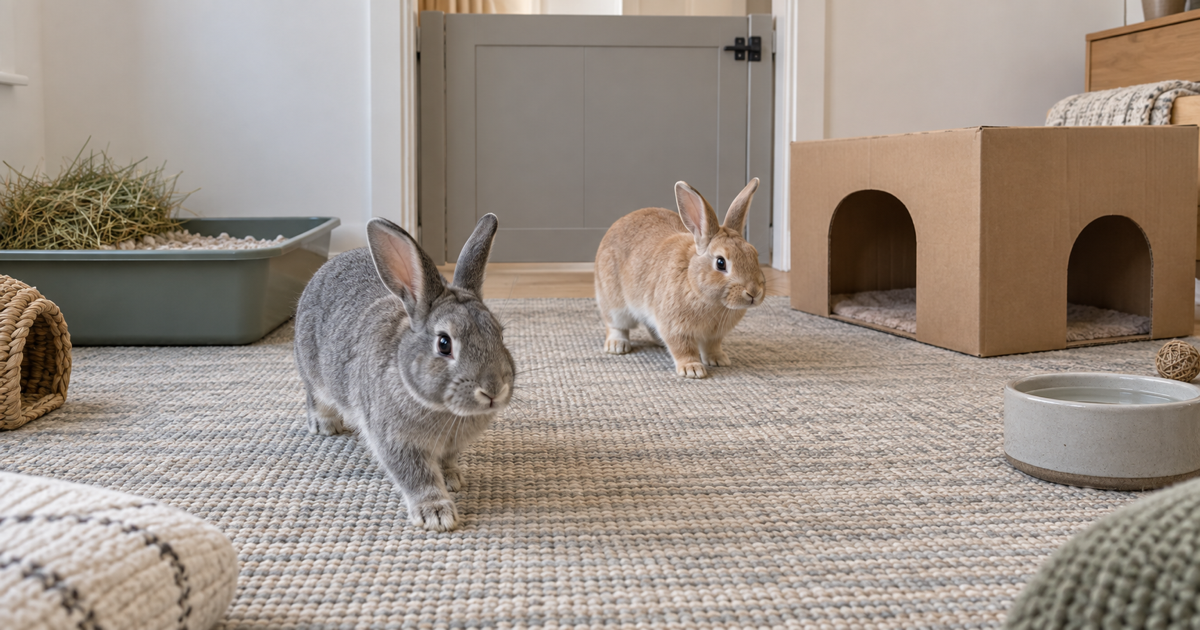
A free-roam rabbit setup starts with a room you can inspect and control: continuous floor grip, secure boundaries, inaccessible electrical cables and a clear route back to familiar resources. Opening every door is not the starting point. Prepare one suitable area, check it at rabbit level and observe how your rabbits actually use it before extending access.
This guide is a room-conversion checklist for owners of an established, compatible rabbit pair. It explains how to assess floor edges, doorway barriers and everyday household changes—not how to introduce unfamiliar rabbits. For the broader housing foundation, start with our rabbit housing guide.
Plan the Free-Roam Rabbit Setup Before Buying Equipment
Separate the permanent living area from additional rooms opened under supervision. RWAF recommends a continuously available, single-block footprint of at least 3 m by 2 m, with 1 m of height, for two average-sized rabbits. Upper levels do not replace that footprint. Its guidance also says free-ranging should be supervised. These are minimum housing recommendations, not proof that a 1 m barrier will prevent escape. RWAF space guidance
Sketch the room and mark four things: the permanent home area, optional exploration routes, household traffic and excluded hazards. Include the space occupied by doors when open and chairs when pulled out. A layout that works only when furniture is perfectly arranged needs revision.
Keep the first shopping list functional: floor coverage, doorway control, protected services and familiar resources. Measure these locations before choosing products. Buying several accessories without mapping their placement can leave less useful running space.
Check Floor Grip Along the Whole Route
RSPCA recommends solid, non-slip flooring and warns that shiny laminate or tiles can be slippery. A small comfortable mat beside an expanse of slick flooring does not address the entire route. RSPCA indoor housing guidance
Use the following as a practical inspection framework, not a certification that any material is suitable for every rabbit:
| Surface option | What to inspect before use | Reason to change the arrangement |
| --- | --- | --- |
| Existing carpet | Edges, loose fibres, previous damage and access beneath furniture | Your rabbit pulls fibres or repeatedly targets an edge |
| Washable low-pile rug or runner | Whether it lies flat, stays in place and covers turns as well as straight paths | It slides, bunches or exposes a slippery landing point |
| Removable mat over hard flooring | Accessible corners, backing, seams and drying instructions | Corners lift, backing becomes accessible or dampness remains underneath |
| Bare hard floor | Grip during ordinary voluntary movement | Your rabbit slips, hesitates or avoids crossing it |
For a hands-on check, walk the planned route yourself first. Press and move each covering gently to identify obvious sliding. Then let the rabbits explore voluntarily while you watch turns, doorway crossings and entry to their litter area. Do not chase them to test traction.
Look beyond the centre of a rug. Inspect the join between two coverings, the edge under a door and the corner beside a favourite resting place. Photograph the finished layout so you can restore the same coverage after washing.
RWAF notes that carpets may be chewed; suitability depends on the rabbits using them. If chewing exposes fibres or backing, prevent further access and reassess the surface. Do not treat a washable label or a soft feel as evidence that ingestion is acceptable. RWAF indoor housing guidance
Inspect Barriers as an Installed System
A gate is only one part of the boundary. Inspect its connection to the wall, the floor beneath it, its latch and objects positioned nearby. RWAF warns that rabbits can squeeze through small gaps and that some puppy-pen bars can trap a head or leg. A product marketed for another animal is not automatically appropriate. RWAF indoor housing guidance
Before opening the room, work through this checklist:
- Fit: Measure the actual opening at the installation points, not just the nominal doorway width. Follow the mounting instructions.
- Bottom edge: Examine the full length, including uneven flooring and changes created when a rug is removed.
- Connections: Check corners and joints between panels, not just the middle of each panel.
- Latch: Confirm it engages after each closure and that every household member knows how to use it.
- Nearby furniture: Review boxes, chairs and shelves that might provide access over or around the boundary.
- Household access: Check that people can enter without leaving the boundary open or moving equipment unpredictably.
Never push a rabbit toward an opening to see whether it fits. If suitability is uncertain, keep that area unavailable and seek a better-fitted solution. Recheck the installation whenever furniture or floor coverings move; yesterday's arrangement is not evidence about today's.
Audit Cables from Socket to Appliance
RSPCA advises covering electrical wires or keeping them out of reach and blocking access to hazards such as the oven. Apply that advice to the entire cable route, including the part hidden behind furniture. RSPCA indoor housing guidance
Start at each socket and follow every lead to its device. Include chargers, lamps, extension leads and cables normally brought into the room temporarily. Ask where the lead sits when the device is used, moved or unplugged—not only when the room looks tidy.
Use physical exclusion and appropriately installed cable protection rather than assuming a sleeve is chew-proof. Pay particular attention to uncovered ends and junctions. If protection cannot be maintained, exclude the appliance or the area from the rabbits' access.
Add a simple household rule: a new device triggers a new cable check. A visitor's phone charger should not silently invalidate the setup. Keep the room plan somewhere useful, such as beside the cleaning supplies, rather than relying on one person's memory.
Make Furniture and Door Use Predictable
RSPCA's indoor guidance highlights household hazards and warns that plants can shed leaves or petals into rabbit-accessible areas. Moving a pot onto a shelf may therefore leave a route of exposure. Remove or isolate uncertain items before granting access. RSPCA indoor housing guidance
For the room handover, agree on these practical operating rules:
1. Locate both rabbits before moving furniture or operating a recliner or sofa bed. If moving mechanisms cannot be reliably excluded, keep that furniture outside the accessible area.
2. Check behind a door before opening it and restore the boundary immediately after passing through.
3. Store bags, cleaning equipment and delivery packaging outside the running route.
4. Keep an agreed, clear route for returning the rabbits to their permanent area before visitors or maintenance work begin.
These are household workflow suggestions, not a substitute for observation. An arrangement that depends on remembering several awkward exceptions is a good candidate for simpler physical separation.
Open Extra Space in Stages
Set up the permanent area first, then open one additional prepared zone while you supervise. Keep familiar resources accessible rather than moving everything into the new room at once. For litter-station details, see our rabbit litter-training guide.
Offer somewhere to retreat and room to explore without filling every gap with toys. RSPCA recommends enrichment that supports natural behaviour, preserves movement space and is monitored when introduced. RSPCA enrichment guidance
Use a short observation record before expanding again:
- Can both rabbits cross the prepared route without obvious slipping?
- Do coverings and barriers remain where you installed them?
- Can you see and reach the inspection points without dismantling furniture?
- Has chewing revealed a material or gap that needs a different solution?
- Can everyone in the household operate the setup consistently?
A failed check means closing the optional zone and correcting the problem, not shrinking the permanent living space below the rabbits' needs. There is no universal number of successful sessions that certifies a room as safe.
Reset the Room After Cleaning—and Notice Health Changes
Before reopening an area, check that coverings are dry and flat, barriers are secure and cables have not been displaced. Follow cleaning-product instructions, including rinsing and drying where required. Keep rabbits away during cleaning and restore their familiar layout before access resumes.
Do not assume a rabbit that becomes quiet after a room change is merely settling in. PDSA advises immediate veterinary contact when a rabbit eats less or stops eating; fewer or smaller droppings, lethargy and unusual hiding can accompany illness. Do not wait overnight or try home treatment without veterinary advice. PDSA reduced-appetite guidance
This is everyday housing guidance, not a diagnosis or a substitute for advice from a rabbit-experienced veterinarian.
Sources and Further Reading
Frequently Asked Questions
Can rabbits free-roam in a rented apartment?
Possibly, if you can provide suitable permanent living space and effective protection without breaching your tenancy terms. Check permission for fixings and whether removable equipment remains secure in the actual room.
Does good litter training mean a rabbit can have the whole house?
No. Litter habits do not demonstrate safe flooring, secure boundaries or protected cables. Assess each additional room separately and supervise access outside the permanent secure area.
Should I buy floor coverings before choosing a gate?
Map both together. A covering can change the clearance beneath a gate or prevent a door from closing, so test the complete installed arrangement before opening the area.
What should a pet sitter check before letting rabbits explore?
Show them the permanent area, permitted rooms, latch operation and location of both rabbits. Leave a short reopening checklist and your veterinary contact details; do not introduce new rooms during your absence.
How can I tell whether a room still needs work?
Repeatedly moving equipment, chasing rabbits away from the same gap or relying on temporary obstacles means the layout needs revision. Keep the optional room closed until you have a dependable arrangement.
Sources and References
About this article
ShineePets publishes practical, source-checked guidance for pet owners and pet-product professionals.
ShineePets is a commercial B2B pet-supply sourcing brand. Read our editorial standards and commercial disclosure.