Small Pet Care
Rabbit Housing Basics: Space, Flooring and Enrichment
Quick answer
A practical welfare-first guide to planning rabbit space, safe flooring, hiding areas, feeding zones and everyday enrichment at home.
By ShineePets Editorial Team · Published · Updated
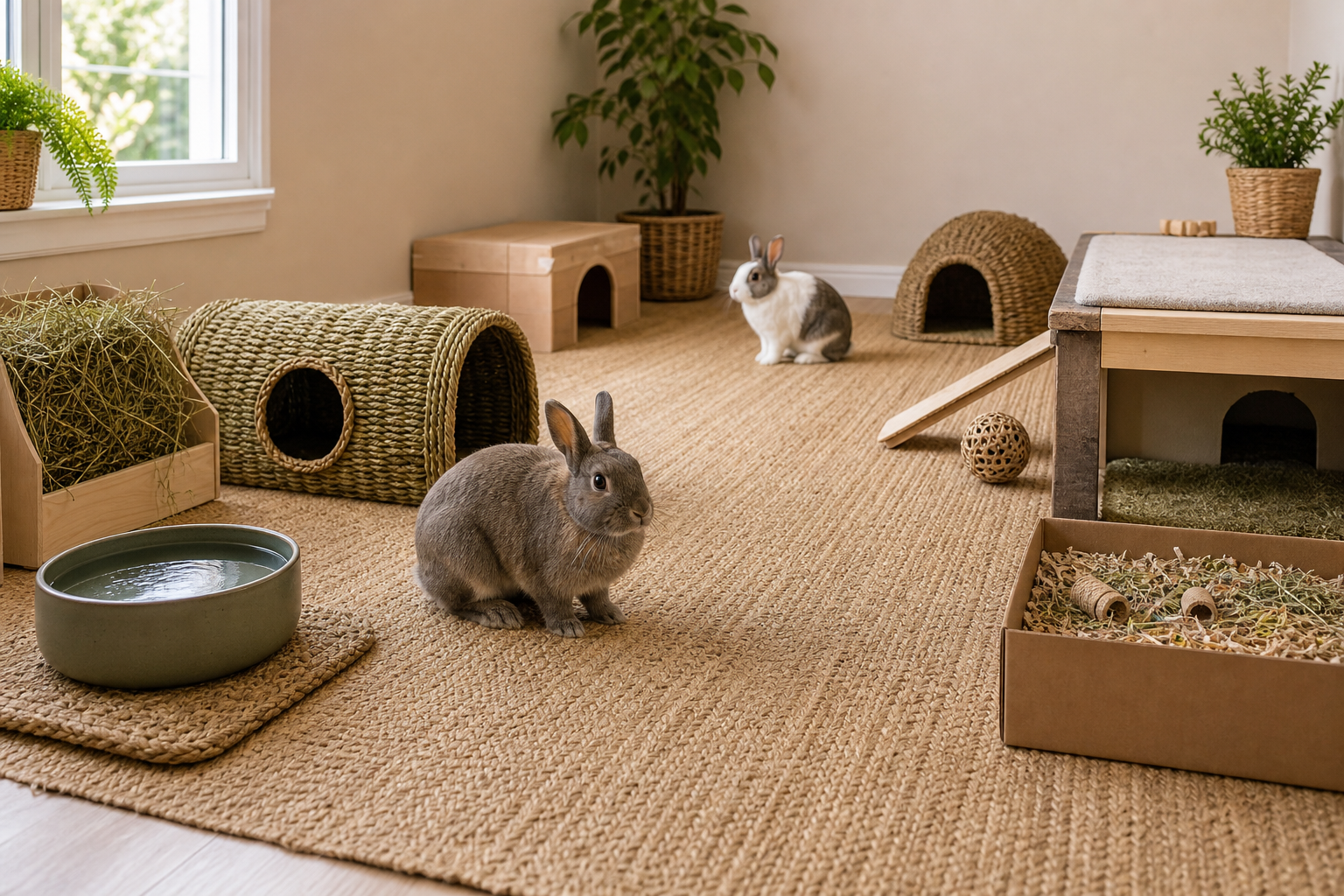
A rabbit home is not simply a place to contain an animal. It is the environment in which a rabbit must be able to run, rest, forage, hide, investigate and interact with a compatible companion. Good housing therefore starts with usable space and safe movement, then adds comfort, choice and enrichment.
Quick recommendation: Design the home around a large, continuously accessible floor area first. Add shelters, platforms and toys without turning the remaining exercise space into an obstacle course.
This guide explains the core decisions for indoor and outdoor rabbit housing. It is educational guidance, not a substitute for advice from a rabbit-experienced veterinarian or local animal-welfare authority.
Start With Usable Space, Not the Size of a Hutch
Rabbits move through powerful hops, short runs, jumps and sudden changes of direction. They also need enough height to stand upright without their ears touching the roof and enough length to lie fully stretched.
The RSPCA's rabbit housing guidance recommends that the total living area for two medium-sized rabbits should be at least 3 metres by 2 metres and 1 metre high, including both shelter and exercise space. The Rabbit Welfare Association & Fund recommends a single, connected area of the same dimensions for two average-sized rabbits, accessible at all times.
These are welfare recommendations rather than a universal legal standard. A rabbit's body size, mobility, health, group composition and local climate may justify more space. Importantly, platforms, shelves and tunnels add variety but do not replace the base floor footprint.
A useful space check asks whether every rabbit can:
- complete several consecutive hops without hitting furniture;
- run and turn without slipping;
- stand fully upright;
- lie flat with legs extended;
- move away from a companion when it wants privacy;
- reach food, water, hay and a toilet area without being blocked;
- use shelter and exercise areas during its most active periods.
A small sleeping shelter can form one part of a larger setup, but it should not be the rabbit's entire home. Continuous access is better than relying on a short, owner-scheduled exercise session.
Divide the Home Into Practical Zones
A clear layout helps rabbits make choices and helps owners clean without disrupting the entire environment. The zones can overlap, but each should remain easy to reach.
1. Open exercise zone
Keep the longest route as open as possible. This is where rabbits can run, hop and perform normal energetic movements. Avoid placing every tunnel, bowl and toy along the same path.
2. Rest and shelter zone
Provide a dry, quiet area protected from household traffic, strong sunlight, wind and temperature extremes. Each rabbit should be able to rest without being crowded.
3. Hiding zone
Hides reduce stress by giving rabbits control over when they are visible. As a practical rule, provide at least one hide per rabbit plus an extra option. Hides with two entrances reduce the risk that one rabbit traps another inside.
4. Hay, toilet and water zone
Rabbits often eat hay while using a litter tray, so placing clean hay beside or above a large toilet tray can support an orderly routine. Keep hay dry and available at all times. A heavy, stable water bowl should be refreshed daily and positioned where it cannot easily be tipped or contaminated.
5. Enrichment zone
Use part of the enclosure for digging, foraging, chewing and exploration. Rotate selected items rather than filling every open surface at once.
Choose Solid, Dry and Non-Slip Flooring
Flooring affects confidence, movement and foot comfort. The RSPCA advises a solid, non-slip floor and warns that wire flooring can injure rabbit feet. Smooth laminate, polished wood and glossy tile may also be slippery and stressful when used without traction.
A practical indoor floor may use layers:
1. A waterproof, easy-to-clean base where the property needs protection.
2. A secure non-slip top surface that lies flat and does not bunch under running feet.
3. Absorbent litter only in the toilet area, rather than loose material across every walking route.
4. A soft, dry resting surface in the shelter zone.
No single material is automatically suitable for every rabbit. Watch for chewing, pulled threads, exposed foam, sharp edges and damp patches. Remove materials that are being swallowed or that cannot be kept dry. Fabric products require supervision because ingestion can cause serious problems.
For outdoor housing, the surface must also resist predators and escape attempts. A secure perimeter may need to extend below ground, while the rabbit's walking surface should remain solid, dry and comfortable. Exposed wire mesh should not be used as the standing floor.
Build Hiding Places That Offer Choice
A cardboard box can be useful, but a good hide is more than a dark object. It should be large enough for the rabbit to enter and turn comfortably, stable enough not to collapse unexpectedly and easy to inspect.
Use a mixture of:
- enclosed boxes with two rabbit-sized openings;
- tunnels with a clear entrance and exit;
- a covered section connected to the main exercise area;
- visual screens that create privacy without blocking ventilation;
- low, stable platforms that provide a lookout and sheltered space below.
Platforms must be stable, non-slip and low enough for safe access, with adequate headroom above. Ramps should have traction and a gentle angle. If a rabbit hesitates, slips or jumps down awkwardly, redesign the access rather than assuming it will adapt.
Add Enrichment Without Removing Running Room
Enrichment should support natural behaviour: exploring, foraging, chewing, digging and social interaction. It does not need to be expensive or complicated.
Good options include:
- hay stuffed into plain cardboard tubes or boxes;
- scattered portions of the rabbit's normal food ration for foraging;
- untreated cardboard for tearing and investigating;
- a dig box filled with a rabbit-safe material;
- stable tunnels with more than one opening;
- safe untreated branches or chew items recommended for rabbits;
- raised lookout points with non-slip surfaces;
- periodic changes in box position, scent and route.
Introduce unfamiliar items gradually and preserve an easy retreat route. Provide enough high-value resources for all rabbits so enrichment does not create competition. The RSPCA's enrichment guidance also recommends rotating activities while avoiding so much clutter that normal movement becomes difficult.
Hay-based foraging is especially useful because it combines normal feeding with investigation. Treats should not become the main enrichment tool, and any food used in puzzles should be counted as part of the rabbit's daily diet.
Plan for Compatible Companionship and Shared Resources
Rabbits are social animals. Human attention does not reproduce all the communication and companionship available from a compatible rabbit. Bonding should be managed carefully, with suitable introductions and veterinary advice on neutering and health where appropriate.
In a shared home, duplicate important resources:
- more than one water point when space allows;
- several hay access points;
- multiple hides and resting places;
- wide routes that do not create dead ends;
- enough litter and feeding space to avoid guarding.
Observe the relationship. A rabbit that is repeatedly displaced from food, blocked from shelter or chased in a confined route may not have meaningful access to the resources that appear to be present.
Rabbit-Proof an Indoor Space
Free-roam or room-based housing still needs boundaries and risk control. Before allowing access, check the environment from floor level.
Secure or remove:
- electrical cables and chargers;
- toxic houseplants;
- cleaning chemicals and medicines;
- narrow furniture gaps where a rabbit could become trapped;
- unstable objects that can fall;
- foam, paint, carpet edges or plastics that are being chewed;
- open doors, balconies and unsafe stairways;
- heating appliances, fireplaces and hot pipes.
Keep the housing in a calm, well-ventilated area away from constant noise. Rabbits should not be housed in a garage used by vehicles because fumes can be dangerous.
Protect Outdoor Rabbits From Weather and Predators
Outdoor accommodation must be secure on every side, including the roof and ground boundary. Locks should resist predators rather than relying on a simple sliding latch. The sheltered area should stay dry in driving rain and remain ventilated without exposing rabbits to a constant draught.
Provide shade throughout the day and remember that the sun's position changes. During hot, cold or severe weather, reassess whether the location remains safe. Elevating a weatherproof shelter can help keep it dry, but ramps and entrances must remain easy and non-slip.
Check the enclosure daily for digging, rust, loose fasteners, wet bedding and gnaw damage. Predator-proofing and temperature management are ongoing tasks, not one-time installation steps.
Use a Simple Cleaning Routine
Cleaning should protect hygiene without making the environment feel completely unfamiliar every day.
Daily
- refresh water and check that the bowl or bottle works;
- remove wet or heavily soiled litter;
- replenish fresh hay;
- check flooring for dampness, damage and loose threads;
- inspect tunnels, boxes, ramps and fasteners;
- observe appetite, droppings, movement and social access.
Regular deep clean
- move rabbits to a secure temporary area;
- clean and dry toilet trays, bowls and affected surfaces;
- replace damaged or contaminated materials;
- retain a small amount of clean familiar nesting or scent material where appropriate;
- return the layout to a predictable arrangement before adding novelty.
Avoid strong fragrances and leave all cleaned surfaces fully dry before rabbits return.
Let Rabbit Behaviour Test the Design
The best housing audit is not only a tape measure. Watch how the rabbits use the space.
Positive signs include relaxed stretching, confident hopping, upright observation, foraging, resting in different locations and energetic movements such as running and binkies. A rabbit should be able to choose between social contact and privacy.
Warning signs can include repeated bar biting, route pacing, persistent hiding, reluctance to cross a slippery surface, competition at resources or sore-looking feet. Reduced eating, fewer droppings, unusual lethargy, breathing difficulty, wounds or a sudden movement change require prompt veterinary advice. Housing changes cannot diagnose or treat illness.
Rabbit Housing Setup Checklist
Before considering the setup complete, confirm:
- [ ] The main exercise footprint is large, connected and continuously accessible.
- [ ] Every rabbit can run, turn, stretch and stand upright.
- [ ] Flooring is solid, dry and non-slip, with no exposed wire standing surface.
- [ ] There is one hide per rabbit plus an additional option.
- [ ] Hides and tunnels have safe exits and do not create traps.
- [ ] Hay and fresh water are always accessible.
- [ ] Shared resources are duplicated to reduce competition.
- [ ] Enrichment supports foraging, chewing, digging and exploration.
- [ ] Toys and furniture do not block the running route.
- [ ] Indoor cables, plants and chemicals are secured.
- [ ] Outdoor areas are weatherproof, predator-resistant and checked daily.
- [ ] The layout can be cleaned and inspected without dismantling the whole home.
The Practical Standard
Good rabbit housing gives rabbits space, traction, shelter, choice and something meaningful to do. Start with the open footprint, then place resources around normal movement rather than squeezing movement around equipment.
A beautiful enclosure is not automatically a suitable one. The useful question is whether the rabbits can express normal behaviour safely at any time, not whether the setup looks complete in a photograph.
Frequently Asked Questions
How much space do two rabbits need?
The RSPCA and Rabbit Welfare Association & Fund recommend a connected living area of at least 3 metres by 2 metres and 1 metre high for two medium or average-sized rabbits. This includes shelter and exercise space and should be continuously accessible. Individual rabbits may need more space.
Can rabbits live on wire or mesh flooring?
Exposed wire or mesh should not be the standing floor because it can injure rabbit feet. Use a solid, dry, non-slip surface and inspect it regularly for dampness, damage or materials the rabbit may swallow.
What flooring works for indoor rabbits?
A secure non-slip surface over an easy-to-clean base can work well. Smooth tile, polished wood and laminate usually need added traction. The top layer should lie flat, stay dry and be removed if the rabbit chews or ingests it.
How many hiding places should rabbits have?
Provide at least one hiding place per rabbit plus an extra option. Hides and tunnels should be stable, appropriately sized and ideally have more than one opening so one rabbit cannot trap another.
What enrichment do rabbits need every day?
Rabbits benefit from opportunities to forage, chew, dig, explore, use tunnels and interact with a compatible companion. Keep hay available, rotate safe activities and preserve enough uncluttered floor space for running.
Sources and References
About this article
Practical, evidence-informed pet care guidance from the ShineePets Editorial Team.
ShineePets is a commercial B2B pet-supply sourcing brand. Read our editorial standards and commercial disclosure.