Small Pet Care
Guinea Pig Hay Guide: Storage, Racks and Daily Access
Quick answer
A practical guide to choosing quality guinea pig hay, storing it safely, designing low-risk racks and maintaining uninterrupted daily access.
By ShineePets Editorial Team · Published · Updated
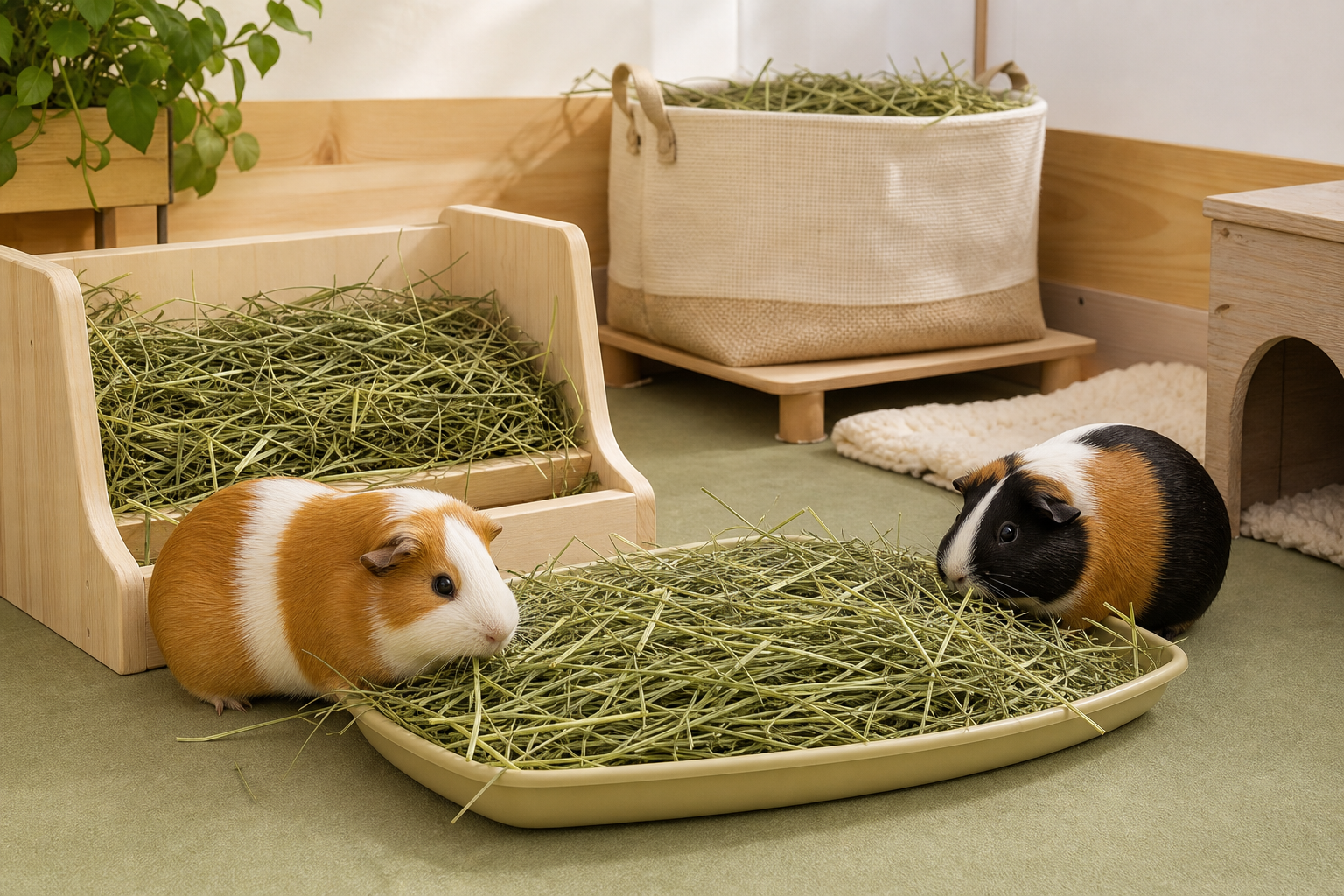
Guinea pigs are built to graze. For a healthy adult, good-quality grass hay is not an occasional treat or a decorative cage accessory; it is the foundation of the daily feeding system. The practical goal is simple: keep clean, appealing hay within easy reach at every hour, while storing the reserve supply so that it stays dry, ventilated and free from contamination.
Quick recommendation: Keep abundant clean grass hay available at all times through at least two easy-access points. A rack should protect hay from soiling without forcing a guinea pig to stretch, climb or push its head through a risky opening.
This guide explains how to choose feeding hay, organize storage, assess a rack and build a routine that makes interrupted access less likely. It is general husbandry information, not a substitute for advice from an experienced exotic-animal veterinarian.
Why Constant Hay Access Matters
Guinea pigs naturally eat small amounts repeatedly across the day and night. Merck Veterinary Manual, the RSPCA, PDSA and UC Davis all recommend continuous access to good-quality grass hay for adult guinea pigs. Hay supplies the long fiber needed for normal digestive activity, and its abrasive texture supports the natural wear of continuously growing teeth.
That means owners should think about hay as daily infrastructure, not as a measured side dish. A rack that is empty for hours, a bag that has become damp or a feeding point that one confident guinea pig controls can all interrupt the intended routine.
A practical setup should achieve four things:
- Hay remains available before, during and after normal feeding times.
- Every guinea pig can reach it with all four feet in a stable position.
- Wet, dirty or spoiled hay can be identified and removed promptly.
- The reserve supply stays dry and fresh between refills.
Pellets and vegetables have roles in a balanced diet, including an appropriate vitamin C source, but they do not replace the need for unrestricted grass hay.
Choose Hay for the Guinea Pig's Life Stage
For most healthy adult guinea pigs, suitable grass hays include timothy, orchard, meadow and oat hay. Texture and aroma vary by harvest, so a guinea pig may accept one grass hay more readily than another. The important features are quality, cleanliness and continued access rather than loyalty to a single named variety.
Alfalfa is a legume hay, not a grass hay. It is richer in protein and calcium and is generally used for growing guinea pigs under about six months old and for pregnant or lactating animals. It is not the default main hay for a healthy adult. Life-stage feeding decisions should be discussed with a veterinarian, especially when a guinea pig has a history of urinary, dental, digestive or weight problems.
Change hay gradually. A sudden switch in smell, texture or taste can reduce intake. Mix increasing amounts of the new hay into the familiar supply over several days, monitor eating and droppings, and avoid changing several foods at once.
A Five-Sense Quality Check
Examine every new package and recheck it during storage. Good feeding hay is usually dry, fibrous and fresh-smelling, with a green to greenish-brown appearance depending on the crop and harvest. Color alone is not enough, but strongly yellowed, stale-smelling or degraded hay deserves closer inspection.
Use this checklist before placing hay in the enclosure:
- Touch: The hay should feel dry, not clammy, warm, sticky or compressed into damp clumps.
- Smell: Look for a clean, grassy or mildly sweet smell. Reject musty, sour, fermented or chemical odors.
- Sight: Check for visible mold, webbing, insects, animal droppings, soil, plastic, string and other foreign material.
- Dust: A small amount of chaff is normal, but a dense dust cloud, powdery coating or irritating debris is not.
- Structure: Offer a useful mix of stems and softer leaves. Remove unusually sharp foreign pieces that could injure an eye or mouth.
Never feed lawnmower clippings. Cut grass packed by a mower can heat and ferment rapidly and may also contain contamination that is difficult to assess.
Discard rule: Do not try to rescue moldy or musty hay by airing it out. Contamination can extend beyond the visible patch, so removing only the obvious spot does not make the remaining hay reliably safe.
Store Hay Cool, Dry and Ventilated
Storage protects both nutritional usefulness and appetite appeal. UC Davis advises keeping timothy hay in a cool, dark location away from light. In a home, that usually means a dry, shaded area with stable conditions and enough airflow around the container.
A sound storage location is:
- Away from bathrooms, laundry humidity, leaking pipes and condensation-prone windows.
- Raised off concrete or other floors that may transfer moisture.
- Protected from direct sunlight and excessive heat.
- Separate from cleaning products, fragrances, paint, fuels and pesticides.
- Inaccessible to insects, wild rodents, dogs and cats.
- Easy to inspect without moving a large, tightly packed bale.
Breathable original packaging, a clean canvas hay bag, a paper sack or a ventilated container can work when the room itself is dry. Do not compress damp hay into an airtight plastic box. Trapped moisture and heat can encourage spoilage even when the outside of the container looks clean.
Avoid buying more than the household can use while it remains fresh. Mark the delivery or opening date, use older sound hay first and inspect a handful from the middle as well as the top. If a storage area has flooded, leaked or developed condensation, treat exposed hay as suspect rather than waiting for obvious mold.
Racks Should Improve Cleanliness, Not Restrict Eating
A hay rack can lift some hay above a wet floor and reduce waste. It is useful only when access remains natural and safe. Guinea pigs should not need to stand upright, climb a wall, balance on a toilet tray or force the head through a narrow opening to reach the main supply.
A safer rack is generally:
- Low enough for comfortable feeding with a stable stance.
- Securely attached or heavy enough not to tip.
- Open enough that strands pull out without trapping the head, neck or feet.
- Free from sharp wire ends, splinters, loose loops and detachable small parts.
- Positioned where another guinea pig cannot block the only entrance or exit.
- Easy to empty, wash and dry completely.
Avoid closed wire balls and narrow mesh designs that invite a guinea pig to climb, insert a limb or push too far into an opening. Inspect any fabric feeder for frayed seams and loose threads. A product described as a hay rack is not automatically safe for every body size.
An open-front holder combined with a wide floor-level tray is often more practical than relying on one rack. The holder keeps a portion clean, while the tray or loose pile permits easy browsing and natural foraging. Blue Cross also describes shallow hay-filled forage trays as a simple enrichment option.
Build Redundancy Into Daily Access
The best-looking feeder still fails if it becomes empty, blocked or wet. Redundancy prevents a single problem from removing all access.
For one guinea pig, offer more than one accessible portion when possible. For a bonded pair or group, provide multiple separated hay stations with enough width for simultaneous eating. Place them so that a more assertive animal cannot guard every station from one position.
Good placement principles include:
- Keep a large main supply at floor level or at a low open feeder.
- Put a second supply in another part of the enclosure.
- Preserve more than one route to and from each feeding point.
- Refill before the final handful disappears.
- Add extra access during cleaning, travel preparation or temporary enclosure changes.
Some hay will be sat on, scattered or used as nesting material. That behavior is normal. Waste is reduced through sensible tray design and frequent refreshment, not by rationing the only hay source.
Separate Feeding Hay From Wet Bedding
Hay on the floor is not automatically unsafe, but hay soaked with urine or water should not remain in the feeding area. Use a shallow washable tray, clean litter area or dry forage zone so that the owner can distinguish fresh feeding hay from contaminated material.
At least once daily:
1. Check every station for remaining clean hay.
2. Remove wet, visibly dirty or stale material.
3. Add fresh hay before access becomes limited.
4. Confirm that water has not leaked into the feeding area.
5. Watch each guinea pig approach and eat.
Wash hard trays and racks as needed with a pet-safe cleaning method, rinse thoroughly and let them dry completely before refilling. Do not place fresh hay into a still-damp container.
Watch the Guinea Pig, Not Just the Rack
A full rack does not prove that a guinea pig is eating enough. Hay may be unappealing, difficult to pull through, physically inaccessible or avoided because another guinea pig is guarding it.
Observe actual behavior and output. Useful routine indicators include:
- Repeated voluntary visits to hay during both active and quiet periods.
- Normal chewing without dropping food or prolonged hesitation.
- A stable pattern of droppings for that individual.
- Regular body-weight monitoring on the same scale.
- Normal energy, posture and social behavior.
Reduced appetite, reduced or unusually small droppings, lethargy, a wet chin, difficulty chewing, weight loss or obvious abdominal discomfort needs prompt veterinary attention. Do not wait for a hay delivery or assume that changing the rack will solve a medical problem. Guinea pigs can deteriorate quickly when food intake falls.
Daily and Weekly Hay Checklist
Every morning and evening
- Confirm that fresh grass hay is available at every station.
- Check for wet patches, moldy odor, heavy dust and foreign material.
- Verify that each guinea pig can eat without being displaced.
- Remove soiled hay and refill before a station becomes empty.
- Check bottles and bowls for leaks near the hay.
- Observe appetite and droppings.
Once a week
- Empty and inspect the rack, tray and surrounding corners.
- Check bars, seams, fasteners and openings for trapping hazards.
- Clean and fully dry washable feeding equipment.
- Inspect the reserve hay from more than one part of the container.
- Review the storage area for humidity, pests, sunlight or chemical exposure.
- Record body weight and investigate an unexplained change.
When opening a new package
- Compare smell, texture and dust with the previous batch.
- Confirm that the hay is dry throughout.
- Introduce a noticeably different hay gradually.
- Keep package information until the batch has been accepted.
- Discard any supply with mold, mustiness or unexplained heat.
A Practical Setup for Most Homes
A reliable everyday arrangement does not need to be complicated. Start with a large, dry floor-level forage tray or loose pile, add a secure low open-front holder, and keep a second feeding point for backup. Store the reserve hay in a cool, shaded and ventilated place off the floor.
The system should be easy for the guinea pigs to use and easy for the owner to inspect. If a rack saves hay but creates stretching, climbing, crowding or long empty periods, it is solving the wrong problem.
Owners planning a first small-pet home may also find the broader first-time pet selection guide useful for thinking about daily care capacity, space and long-term responsibility.
Key Takeaway
The most important hay rule is continuous, safe access to clean grass hay. Choose an adult-appropriate hay, reject damp or moldy material, store the reserve supply with ventilation, and use feeding points that do not trap or exclude the animal. Then verify the system every day by watching each guinea pig eat.
A rack is a cleanliness tool, not a rationing tool. The correct setup is the one that keeps hay abundant, dry, reachable and safe.
Frequently Asked Questions
How much hay should a guinea pig have each day?
Guinea pigs should have unlimited access to fresh, good-quality grass hay at all times. Refill before access points become empty and provide enough separate stations that every guinea pig can eat without being displaced.
What type of hay is best for an adult guinea pig?
Timothy, orchard, meadow and other suitable grass hays can form the main hay supply for healthy adults. Alfalfa is richer in calcium and protein and is generally reserved for growing, pregnant or lactating guinea pigs under veterinary guidance.
Is a hay rack better than a loose hay pile?
A safe low rack can keep some hay clean and dry, while a loose pile or shallow forage tray supports natural browsing and easy access. Many homes use both. The rack must not create head, limb, climbing or trapping risks.
How should guinea pig hay be stored?
Store hay in a cool, dry, shaded and ventilated place off the floor and away from leaks, humidity, chemicals and direct sunlight. Keep airflow around it and never seal damp hay into an airtight container.
When should hay be thrown away?
Discard hay that is damp, moldy, musty, unusually hot, heavily dusty, pest-contaminated or mixed with foreign material. Do not try to rescue moldy hay by airing it out, because unsafe contamination may extend beyond visible spots.
Sources and References
About this article
The ShineePets Editorial Team publishes practical, evidence-informed guidance for responsible pet care and safer everyday routines.
ShineePets is a commercial B2B pet-supply sourcing brand. Read our editorial standards and commercial disclosure.