Product Sourcing
How Pet Product Durability Testing Protects Buyers
Quick answer
Learn how tensile, abrasion, fatigue, impact, wash and transit testing help pet-product buyers compare suppliers and prevent predictable failures.
By ShineePets Editorial Team · Published · Updated
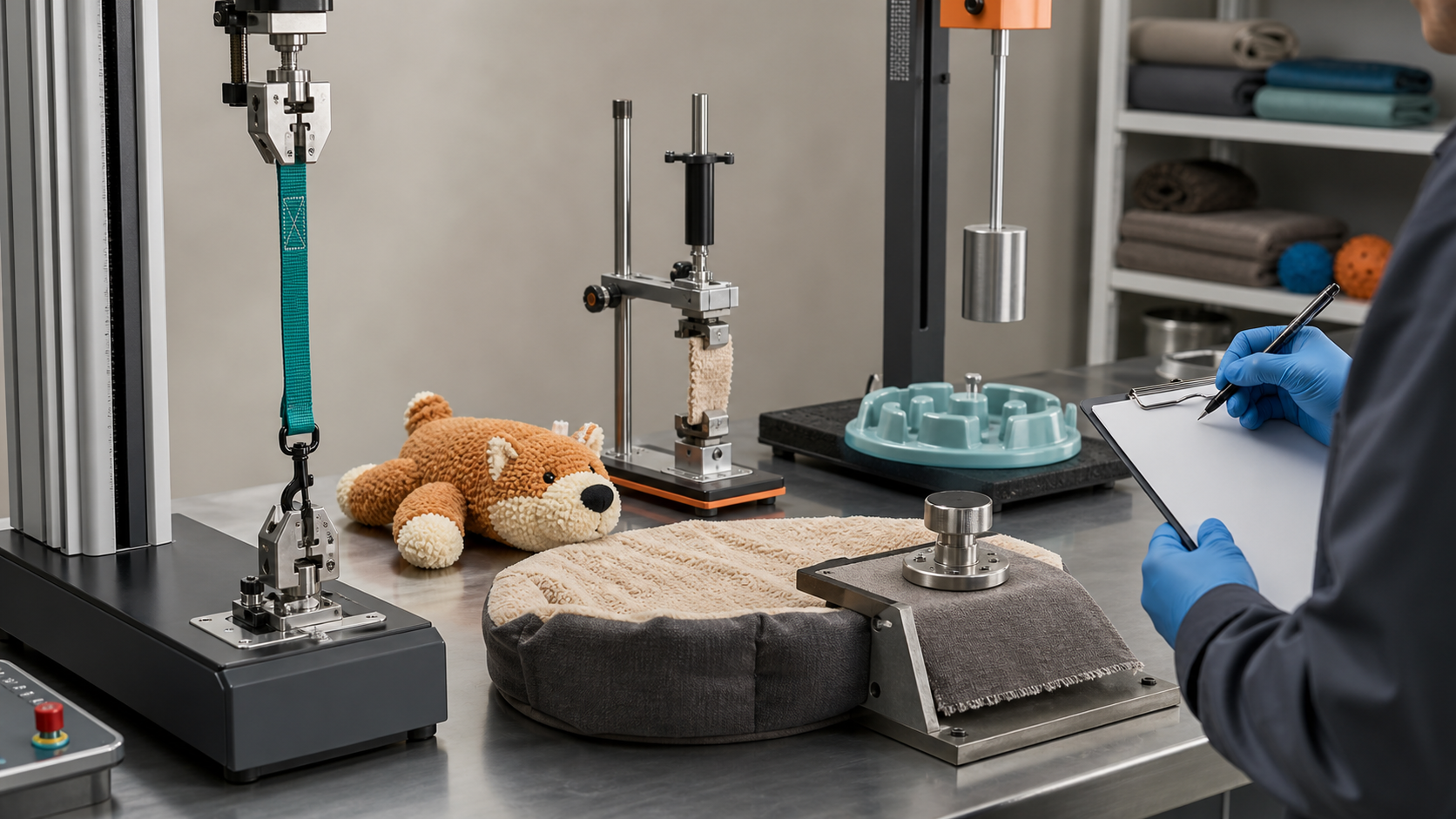
Durability testing turns a product promise into a repeatable question: what happens when the same leash is pulled hundreds of times, a bed cover is rubbed and washed, a feeder is dropped, or a package is vibrated through parcel delivery? For pet-product buyers, the answer affects returns, replacement costs, customer trust and the likelihood that normal wear develops into a functional failure.
This guide explains how pet product durability testing protects buyers, which tests fit common product categories, and what evidence a retailer, distributor or private-label brand should request before approving an order. It is a purchasing framework, not a universal test standard. The correct methods, loads, cycles and pass criteria must be chosen for the product, its materials, the intended animal, the destination market and reasonably foreseeable use.
What Durability Testing Actually Measures
Durability is the ability of a product to retain its intended function and acceptable condition through a defined period or number of use cycles. A useful test does not merely ask whether a sample can survive one unusually high load. It asks how the complete product changes under relevant stresses.
Those stresses may include pulling, bending, twisting, scratching, chewing, abrasion, washing, moisture, sunlight, temperature change, impact, repeated loading and transportation. The important word is relevant. A test designed for woven fabric does not automatically validate a buckle, and a strong component does not guarantee a strong finished assembly.
A durability result should therefore identify:
- the exact sample and production stage;
- the referenced standard or written internal method;
- conditioning, equipment and test setup;
- load, speed, height, duration or cycle count;
- sample quantity and lot information;
- measurable pass and fail criteria;
- individual results, not only an average;
- failure mode and failure location; and
- report date, laboratory identity and product photographs.
Without these details, "durability tested" is a marketing phrase rather than decision-ready evidence.
How Testing Protects Buyers
It Finds Weak Links Before a Large Order
Pet products are systems. A leash may use strong webbing but a weak stitch pattern. A carrier frame may pass a static load test while its door latch loosens after repeated opening. A bed fabric may resist abrasion while the zipper slider fails after washing. Testing assemblies and interfaces exposes these weak links before inventory reaches customers.
Early discovery gives the buyer options: change the specification, reinforce a seam, select different hardware, modify packaging or reject the design. After production and shipment, the same change becomes slower and more expensive.
It Makes Supplier Comparisons More Objective
Two factories may quote products that look identical in a sample photo. Their material grades, sewing consistency, molding control and hardware performance can still differ. A shared test plan allows the buyer to compare results against the same method and threshold instead of relying on adjectives such as heavy-duty, premium or long-lasting.
It Reduces Avoidable Returns and Complaints
Durability testing cannot eliminate every failure, because animal behavior and household conditions vary. It can reduce predictable failures caused by inadequate materials, weak joints, unsuitable constructions or packaging damage. Fewer early failures can mean fewer refunds, replacement shipments, negative reviews and customer-service cases.
It Protects the Approved Product Specification
Testing is also a change-control tool. A passing pre-production sample establishes a reference, but production may later use a different fabric weight, resin, thread, fastener or foam. Lot inspections and periodic verification help confirm that the shipped product still matches the approved construction.
It Improves Buyer-Supplier Decisions
A failed test is useful when it identifies a specific weakness. Buyers can distinguish a correctable design issue from random variation or poor process control. That evidence supports a clearer corrective-action request and a more rational decision to approve, rework, retest or cancel.
Start With the Real Use Case
Testing begins with a product risk assessment, not a laboratory menu. Define the intended species, animal size range, product function, expected environment and misuse that can reasonably be anticipated. A cat scratcher, dog tether, soft carrier and ceramic bowl need different stress models.
Ask four questions:
1. What loads or actions occur during correct daily use?
2. Which components keep the product functional?
3. How could wear make the product unusable or cause a critical failure?
4. What evidence would show that the design maintains an adequate margin?
The answers become test requirements. For a leash, critical points may include webbing, stitching, swivel, snap hook and handle. For a pet bed, the cover, seams, zipper, liner and foam recovery may matter. For a feeder, consider impact resistance, warping, base stability and repeated dishwasher or hand-wash exposure where claimed.
The Main Types of Pet Product Durability Tests
Tensile and Breaking-Strength Tests
Tensile testing applies a controlled pulling force and records extension, peak force or failure. It is relevant to webbing, fabric panels, leads, collars, harness straps and certain attachment assemblies.
ASTM D5034 covers grab testing for the breaking strength and elongation of many woven and nonwoven fabrics. ISO 13934-1 describes a strip method for maximum force and elongation of textile fabrics. These methods provide disciplined ways to compare material, but finished-product testing is still needed because seams, hardware and geometry change how forces travel through an assembly.
Buyers should ask whether a result refers to raw fabric, a sewn component or the complete product. They should also confirm units, test direction, conditioning, clamp configuration, test speed and sample count. A single highest result is less informative than all specimen results and their failure modes.
Seam, Stitch and Joint Strength
Stitches concentrate load around needle holes and thread paths. Seam strength depends on fabric construction, thread, stitch type, stitch density, seam allowance, reinforcement and workmanship. The strongest fabric can still fail where it is assembled.
A practical plan tests critical production seams in the direction and geometry that reflect use. Record whether failure occurred in the thread, fabric, seam slippage or another component. Also inspect variation between samples. One unusually weak seam may reveal inconsistent sewing or missed reinforcement.
For molded or rigid products, the equivalent weak points are welds, hinges, snap fits, screws, adhesive bonds and connections between dissimilar materials. Test the joint, not only the material coupon.
Abrasion and Surface-Wear Tests
Abrasion testing measures change caused by repeated rubbing. It is useful for beds, carriers, harness linings, apparel, mats and other textile surfaces. ISO 12947-2 specifies a Martindale method for determining specimen breakdown in many textile fabrics, while coated surfaces may require a different method.
The buyer should define the endpoint: yarn break, hole formation, coating loss, unacceptable appearance change, mass loss or another measurable criterion. A cycle count has little meaning without the method, abrasive material, pressure and endpoint.
Laboratory abrasion is comparative. Real pets add claws, dirt, moisture, hair, cleaning products and irregular movement, so field-use evaluation remains valuable.
Repeated-Load and Fatigue Tests
Some products pass a one-time proof load but weaken after repeated use. Cyclic tests repeatedly apply a representative force or motion. Examples include loading a raised bed frame, flexing a carrier handle, opening a crate latch, rotating a leash swivel or compressing bed foam.
The protocol should define the load profile, number of cycles, speed, rest interval and post-test inspection. Buyers should look for permanent deformation, loosened fasteners, cracked parts, loss of function, unusual noise and change in dimensions-not merely whether the sample stayed in one piece.
Static overload and cyclic endurance answer different questions. A good plan may use both: one checks short-term margin, while the other checks accumulated wear.
Impact and Drop Tests
Bowls, feeders, carrier shells, litter accessories, toy components and packaged products may be dropped during use or handling. Impact tests should reflect realistic orientations and surfaces. Edge, corner and closure impacts can reveal weaknesses that a flat drop misses.
Define the sample condition, drop height, number of drops, orientation, impact surface and acceptance criteria. Inspect for cracks, sharp edges, detached parts, leakage, door or latch function and hidden damage. Repeating the test after temperature conditioning may be appropriate when polymers become more brittle in cold conditions, but the conditions must match the intended market.
Hardware and Closure Cycling
Buckles, zippers, snaps, hooks, swivels, latches and hook-and-loop closures often determine the useful life of a product. ASTM D2061 includes multiple strength evaluations for zippers and notes that no single zipper test establishes suitability for every end use.
Combine component strength with realistic opening-and-closing cycles. After cycling, check engagement, retention, slider movement, deformation, corrosion and unintended release. Hardware should also be evaluated as installed because webbing thickness, stitch placement and surrounding panels affect performance.
Wash, Moisture and Cleaning Resistance
If a label says a bed cover is machine washable or a bowl is dishwasher compatible, testing should follow the stated care conditions. Define detergent, temperature, cycle, drying method and number of repetitions. Measure shrinkage, color change, delamination, seam distortion, odor retention, corrosion and continued operation of closures.
Moisture testing can also expose swelling, adhesive failure, coating damage or rust. Buyers should ensure that the protocol covers the complete product configuration and not an unrealistically gentle laboratory condition.
Weathering and Environmental Exposure
Outdoor products may face ultraviolet light, rain, dust, salt, heat and freezing temperatures. Accelerated weathering can compare materials and identify obvious weaknesses, but it does not translate automatically into a guaranteed number of outdoor years.
The claim should match the evidence. "Tested for 500 hours under a specified accelerated weathering method" is more transparent than "lasts five years outdoors" unless a defensible correlation supports that lifespan.
Packaging and Distribution Tests
A durable product can still reach the buyer damaged. ASTM D4169 provides a framework for evaluating shipping units through sequences representing distribution stresses. ISTA 3A is a general simulation procedure for packaged products shipped through parcel systems and includes package types such as standard, small, flat and elongated.
Choose the route that resembles the actual supply chain: factory handling, ocean freight, warehouse stacking, courier networks or direct-to-consumer parcel delivery. Test the final retail and shipping configuration, including inserts, closures and accessories. Afterward, inspect both packaging and product function.
A Practical Test Plan by Product Category
Leashes, Collars and Harnesses
Review webbing tensile performance, seam or bartack strength, hardware pull strength, buckle release force, swivel cycling, corrosion resistance and finished-assembly proof loading. Test each size where geometry or materials change. A result for the largest size should not automatically be applied to every size.
Pet Beds and Textile Accessories
Consider cover abrasion, seam strength, zipper performance, wash cycles, dimensional stability, liner integrity, foam compression and recovery, and repeated loading of elevated frames. Specify how appearance and function will be graded after testing.
Toys
Map the likely play pattern: fetching, tugging, scratching, chewing or batting. Evaluate seam and attachment strength, repeated flexing, impact and the tendency for components to detach. No test can make a toy indestructible. Instructions, supervision guidance, sizing and replacement criteria must remain consistent with the design.
Carriers, Crates and Gates
Test doors, latches, handles, anchor points, hinges, frames and panels under static and repeated loads. Add impact, tip or transport simulation where relevant. Inspect escape-critical openings and latch function after every conditioning sequence.
Bowls, Feeders and Litter Accessories
Use impact, tip stability, dishwasher or cleaning cycles, dimensional checks and repeated operation of moving parts. For powered feeders or fountains, mechanical durability should be coordinated with the other product requirements for the destination market rather than treated as a substitute for them.
How Buyers Should Write Pass/Fail Criteria
"No damage" is rarely precise enough. Criteria should be observable and agreed before testing. Examples include:
- no breakage, separation or unintended opening;
- no sharp edge or accessible detached component after the test;
- load-bearing function retained;
- deformation within a stated dimensional limit;
- seam slippage below a defined value;
- zipper or latch operating through the full travel;
- no leakage under the specified condition;
- appearance grade meeting an agreed reference; and
- packaging protecting the product without functional damage.
Set thresholds from risk assessment, product design, comparable field data, applicable regulations, retailer requirements and recognized methods. Do not copy a competitor's number without knowing its setup or product geometry.
Why Sample Selection Matters
A beautiful development sample may be handmade by the most experienced technician. Production testing should use units made with normal tools, workers, materials and process controls. Record the purchase order, batch, color, size, manufacturing date and critical component lots.
Sample quantity should reflect the decision and risk. One unit may be enough for an early engineering comparison, but it cannot show production variation. Critical validation generally needs multiple specimens and clear rules for retesting. Buyers should avoid a policy where failed units are silently replaced until one passes.
How to Read a Durability Test Report
First confirm identity. The model, dimensions, materials, color, supplier and photographs should match the item being purchased. Then check the method and revision, deviations, equipment, calibration information, conditioning and dates.
Next read the raw or individual results. An average can hide one early failure. Compare the reported units and threshold carefully. Review photographs of the setup and failed areas, then check whether the conclusion matches the data.
Finally, evaluate scope. A report on fabric abrasion does not cover seam strength, material specifications, labeling or finished-product function. Testing answers the question it was designed to answer-no more.
Common Red Flags
Be cautious when a supplier provides:
- a report for a similar but different model;
- no photographs or incomplete sample description;
- only "pass" with no method or acceptance criteria;
- an obsolete or unsuitable test method;
- a result for raw material presented as finished-product approval;
- a report belonging to another factory or brand;
- test dates that predate a material or design change;
- an implausibly broad "all sizes and colors" conclusion;
- only the best specimen result; or
- a durability claim that cannot be traced to measured evidence.
Verify the laboratory and report directly when the risk or order value justifies it. Independent testing is useful, but buyers still need a correct specification and representative samples.
Durability Testing Has a Defined Scope
Durability results address the mechanical or environmental questions in the test plan. They do not automatically cover material composition, labeling, powered-product requirements or every rule in a destination market. A product can perform well in repeated-use testing while another part of the specification still needs separate verification.
Buyers should identify all market and retailer requirements independently and avoid presenting a voluntary durability result as approval by a regulator or standards organization. The report should name exactly what was evaluated and what remains outside its scope.
Build Testing Into the Purchase Process
The strongest program connects testing to commercial decisions:
1. Define intended use and foreseeable stress.
2. Create a critical-component and failure-mode list.
3. Select relevant standard or validated internal methods.
4. Agree on samples, conditions, thresholds and reporting.
5. Test engineering and pre-production samples.
6. Correct failures and repeat the affected sequence.
7. Freeze the approved bill of materials and workmanship standard.
8. Verify production lots through inspection and selected tests.
9. Monitor returns, complaints and field failures by batch.
10. Revalidate after material, supplier, tooling or design changes.
This creates a feedback loop. Laboratory results inform specifications; production data confirms consistency; field experience improves the next test plan.
Questions to Ask a Supplier or Laboratory
Before approving a report, ask:
- Why was this method selected for this product?
- Is the method current, and were any deviations made?
- Does the sample represent normal mass production?
- Which sizes, colors and component variants are covered?
- What are the pass/fail criteria and their basis?
- How many specimens were tested, and what were all results?
- Where did each failure begin?
- Was function checked after conditioning or cycling?
- Can the report number and laboratory be verified?
- What triggers periodic or change-based retesting?
Clear answers are a sign that testing is part of quality control rather than a document collected after the fact.
Final Buyer Checklist
Before relying on a durability claim, confirm that the evidence matches the exact product, normal use and actual sales configuration. Check that the test stresses the weakest interfaces as well as the main material, uses repeatable conditions, reports every specimen and applies objective acceptance criteria.
Durability testing protects buyers best when it happens before production approval and continues after launch. It cannot promise that a pet product will never fail. It can reveal predictable weaknesses, make supplier comparisons fairer, protect the approved specification and turn customer feedback into measurable improvements.
Discuss Your Sourcing Project with Our B2B Team
Planning a pet-product range, private-label project, or supplier brief? Share your target market, product category, MOQ expectations, sample requirements, and timeline with the ShineePets B2B team through our 24/7 WhatsApp Business contact page.
Explore our OEM and private-label support, dog product sourcing options, and cat product sourcing options before preparing your brief.
Frequently Asked Questions
What is pet product durability testing?
It is controlled testing that measures how a pet product, component or package retains function and condition under defined stresses such as pulling, abrasion, repeated loading, impact, washing or transportation.
Does a strong raw material guarantee a durable finished product?
No. Seams, joints, hardware, geometry and workmanship can become the weakest point. Buyers should combine relevant material tests with tests of critical components and the complete production assembly.
How many samples should be tested?
The number depends on product risk, production variability and the decision being made. One engineering sample may support an early comparison, but production validation normally needs multiple representative specimens and predetermined retest rules.
Does durability testing cover every product requirement?
No. Durability testing evaluates retained function and resistance to wear under the stated method. Material, labeling, powered-product and destination-market requirements must be identified and verified separately.
What should buyers check in a durability test report?
Confirm the exact product identity, current method, sample quantity, setup, conditioning, individual results, acceptance criteria, failure modes, photographs, laboratory identity and whether the tested units represent normal production.
Sources and References
- ASTM International - D5034-21(2025) Breaking Strength and Elongation of Textile Fabrics
- ISO - ISO 13934-1:2013 Tensile Properties of Fabrics
- ISO - ISO 12947-2:2016 Abrasion Resistance of Fabrics
- ASTM International - D2061-07(2021) Strength Tests for Zippers
- ASTM International - D4169-23e1 Performance Testing of Shipping Containers and Systems
- ISTA - Test Procedure 3A Overview
About this article
Independent pet-industry guidance from the ShineePets Editorial Team for pet owners, retailers, distributors and sourcing professionals.
ShineePets is a commercial B2B pet-supply sourcing brand. Read our editorial standards and commercial disclosure.