Cat Care
How to Choose a Scratching Post Your Cat Will Use
Quick answer
A practical guide to matching scratching-post height, stability, direction, material and placement to the habits your cat already shows at home.
By ShineePets Editorial Team · Published · Updated
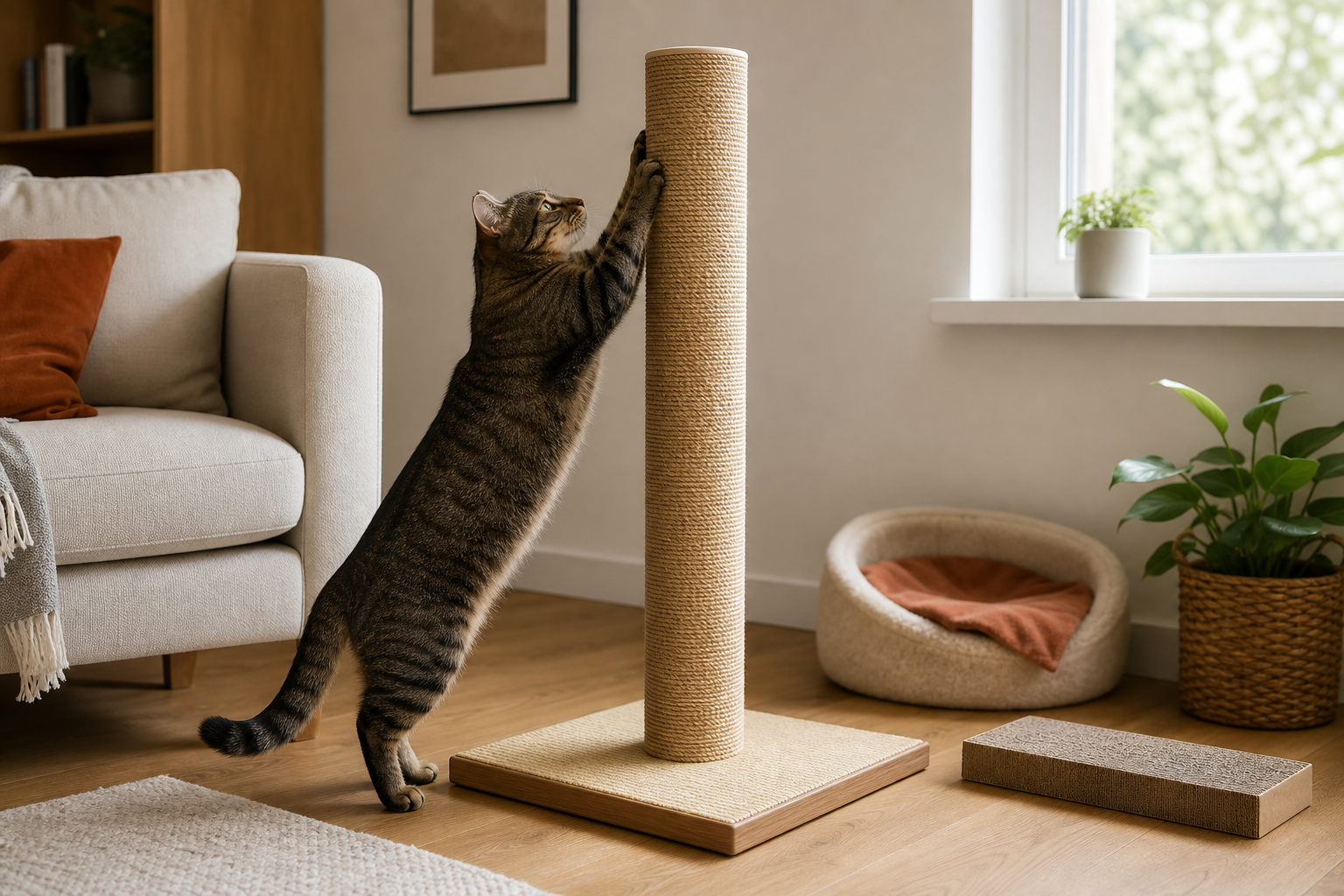
A scratching post succeeds when it matches the cat, not when it looks impressive in a product photo. Cats differ in where they scratch, which direction they prefer, how far they stretch and which textures give their claws the right resistance.
Quick recommendation: Watch the surfaces your cat already chooses. Match their orientation, texture and location first, then make sure the replacement is tall enough and stable enough for a confident full-body scratch.
Scratching is normal feline behavior. The goal is not to stop it, but to provide better places for it. This guide explains how to evaluate scratching posts and how to introduce one without forcing the cat.
Why Cats Need Scratching Areas
Cats scratch for several reasons. The movement helps them stretch, the surface helps remove loose outer claw sheaths and the marks communicate information through both visible scratches and scent from glands around the paws.
The AAFP and ISFM Feline Environmental Needs Guidelines identify scratching areas as key environmental resources. The guidance recommends providing choices in separate locations, especially in multi-cat homes.
A cat that scratches a sofa is not being spiteful. The sofa may simply provide the height, stability, texture and socially important location that the available post does not.
Treat the existing scratch mark as information. It tells you what the cat currently finds functional.
Start by Observing Direction
The first buying decision is orientation.
Vertical scratchers
A cat that scratches sofa arms, door frames, walls or upright furniture is showing a vertical preference. Look for a tall rigid post or a securely mounted vertical panel.
Horizontal scratchers
A cat that scratches carpet, rugs, stair treads or flat furniture may prefer a horizontal pad. A traditional upright post may remain unused because it asks for a different movement.
Angled scratchers
Some cats prefer a sloped surface that lets them lean forward while keeping all four paws supported. Angled scratchers can also be easier for cats with reduced mobility.
Do not assume one orientation will satisfy every cat in the household. Providing both vertical and horizontal options is often a more efficient first test than repeatedly buying different versions of the same design.
Choose Enough Usable Height
For a vertical post, “height” should mean the continuous scratchable distance, not the total product height including a platform, toy or decorative top.
The cat should be able to:
- stand with hind paws securely supported;
- extend the front legs high;
- lengthen the spine through a full stretch;
- drag the claws downward without reaching the base immediately;
- repeat the movement without the post shifting.
Cats Protection advises that a post should be tall enough for a full stretch and gives about 60 cm as a reference for an average adult cat. Larger and longer-bodied cats may need substantially more. Measure your own cat's stretched reach and choose with extra usable length rather than buying to a generic age label.
A post can be visually tall but functionally short if the upper section is not scratchable or the lower section is blocked by a bed or platform.
Stability Is a Non-Negotiable Feature
Cats put meaningful body weight and pulling force into a vertical scratch. A post that rocks during the first attempt may lose the cat's trust.
Check stability in three directions:
1. Side-to-side movement: Push near the top. The base should resist rocking.
2. Forward pull: Apply pressure in the direction the cat will pull. The post should not tip.
3. Twist: Rotate the column gently. Connections should not loosen or creak.
A freestanding post generally needs a wide, heavy base and a rigid connection between base and column. A wall-mounted scratcher needs suitable hardware and installation into a structure that can safely carry repeated pulling force.
Avoid relying on a base hidden under thin fabric if you cannot judge its size or weight. If a tall post is unusually light, test it carefully before expecting the cat to use it.
Match the Surface to the Cat
There is no single material that every cat prefers. Research on designated scratching objects shows variation among cats and study results, which is why observation is more useful than a universal material ranking.
Sisal fabric
Woven sisal can provide a broad, consistent resistance. A continuous fabric panel also avoids the horizontal gaps that develop when rope separates.
Sisal rope
Rope gives pronounced ridges and is widely available. Inspect the wrapping direction, fastening and tension. Loose coils can expose glue, staples or the column beneath.
Corrugated cardboard
Cardboard offers a shreddable surface and is common in horizontal, angled and curved scratchers. Some cats strongly prefer it. It wears faster and creates debris, so check replacement availability and the integrity of the holder.
Carpet or fabric
A cat that targets upholstered furniture may respond to a similar texture. However, offering carpet that closely resembles household carpet can make the boundary between permitted and protected surfaces less obvious. Use a clearly defined scratching object and consistent placement.
Wood or bark-like surfaces
Some cats enjoy firm natural textures that let the claws hook into the surface. Wood must be untreated, smooth where it should be handled and free from splinters, sharp edges or unsafe coatings.
A pilot study of owner-reported scratching behavior found that designated posts were used more often than pads in that sample, but material, angle and length did not independently explain use. Other studies have reported different preferences. The practical conclusion is to test the individual cat rather than buying a material based on popularity alone.
Look at Texture Direction
The direction of a weave or rope can affect the movement.
For a vertical scratch, Cats Protection recommends a vertical weave that supports a downward claw motion. If rope creates thick horizontal ridges, some cats may enjoy the resistance while others may dislike catching their claws between coils.
Run your hand over the surface. It should feel firm enough to resist but should not contain:
- exposed wire or staples;
- sharp glue ridges;
- broken fibers forming loops;
- splinters;
- gaps large enough to trap a claw;
- loose sections that peel away under light pulling.
Check the top and bottom edges, not only the center display area.
Placement Can Matter More Than Material
A perfect post in an unused corner may be irrelevant to the cat. Scratching has a communication function, so cats often choose visible or meaningful locations.
Useful starting locations include:
- directly beside a sofa arm or object already being scratched;
- near a sleeping area, because cats often stretch and scratch after waking;
- along a frequently traveled route;
- near an entry, window or boundary where the cat encounters other scents;
- in the room where the household spends time;
- near, but not blocking, a favored perch or resting place.
Do not place every cat resource in one cluster. The AAFP and ISFM guidance recommends separating key resources such as feeding, drinking, toileting, resting and scratching areas.
Once the cat uses the post reliably, it can be moved gradually if necessary. Large moves made too quickly can remove the location value that made the post successful.
Multi-Cat Homes Need Distributed Options
One large post is not automatically enough for several cats. A confident cat can control access simply by resting nearby or intercepting another cat's route.
Provide scratching choices:
- in more than one room;
- in locations with more than one approach and exit;
- near the resting areas used by different cats;
- in both vertical and horizontal forms where preferences differ;
- away from narrow corners where one cat can trap another.
Count social groups, not just cats. Cats that share a home may not consider themselves part of the same group and may need physically separated resources.
Consider Age, Size and Mobility
Kittens may experiment with several surfaces and orientations. Their first post should still be stable; a small wobbling product does not become appropriate simply because the cat is young.
Large cats need more usable height, a thicker column and a broader base. Measure rather than relying on breed labels.
Older cats may shift toward horizontal or angled scratchers that require less upward reach. The 2023 AAFP/IAAHPC feline hospice and palliative care guidelines note that scratching remains important when possible, but resources may need adaptation for impaired mobility.
For a cat with arthritis, pain, weakness, balance changes or a sudden reduction in scratching, ask a veterinarian about comfort and accessibility. A different scratcher can support movement, but it cannot diagnose the cause of a behavior change.
Inspect the Construction
A useful buying inspection takes less than a minute.
Column
- rigid rather than hollow and flexible;
- securely attached at both ends;
- thick enough not to bend under pulling force;
- fully covered through the intended scratch zone.
Base
- broad enough to resist tipping;
- heavy or securely mountable;
- flat on the floor without rocking;
- protected by non-slip material when needed;
- free from protruding fasteners underneath.
Surface
- tightly attached;
- no sharp seams or exposed staples;
- no long loose loops;
- replaceable or repairable when worn;
- appropriate for the cat's preferred orientation.
Overall design
- no dangling elastic or string that requires unsupervised access;
- no narrow gaps that could trap a paw, claw or collar;
- no unstable top-heavy platform;
- no chemical odor that persists after airing;
- care instructions and material information are available.
Do Not Confuse a Cat Tree With a Good Scratching Post
Some cat trees include excellent scratch zones. Others use short columns interrupted by platforms, hammocks or beds.
Evaluate the scratchable section separately:
- Can the cat fully stretch?
- Is the surface accessible from a stable stance?
- Does the structure stay still under a downward pull?
- Is the scratch area in a location the cat values?
- Can worn material be repaired or replaced?
Our related guide, How to Choose the Right Cat Tree for Indoor Cats, explains how to assess the larger climbing and resting structure. A cat tree and a dedicated post can serve different needs.
How to Introduce the New Post
A good introduction makes the correct choice easy.
Step 1: Place it at the evidence
Put the post directly beside the surface the cat currently scratches. Do not begin by hiding it where it looks tidy.
Step 2: Make it stable
Test it on the actual floor. Add a suitable non-slip layer or secure the mount before the cat's first serious attempt.
Step 3: Create voluntary interest
Use a wand toy around the base or reward calm investigation. Catnip may help cats that respond to it, but it is optional and does not fix poor height or instability.
Step 4: Protect the old target temporarily
Cover the specific furniture area with a safe, securely attached material that is less satisfying to scratch while the preferred alternative is immediately beside it. Check that covers do not create loose adhesive, strings or chewing hazards.
Step 5: Reward use
Offer quiet praise, play or a small appropriate reward after the cat chooses the post. Keep the response calm and consistent.
Step 6: Move only after success
If the post must change location, move it a short distance at a time while monitoring use.
Never lift the cat's paws and drag them across the post. Cats Protection warns that this can be off-putting. Do not shout, spray water or punish scratching; punishment can add fear without providing a better outlet for normal behavior.
Why a Cat May Ignore a New Post
If the post remains unused, audit the mismatch.
- It is too short for a full stretch.
- It wobbles or rotates.
- The surface does not match the cat's preference.
- The post is vertical but the cat scratches horizontally.
- The location has little social or territorial value.
- Another cat controls the route.
- The cat had a frightening first interaction with it.
- The surface has a strong unfamiliar odor.
- Pain or reduced mobility makes the posture uncomfortable.
Change one variable at a time. Moving the same unsuitable post around the home will not solve a height or texture problem.
When to Replace or Repair It
Visible wear can make a scratcher more attractive because it carries the cat's scent and claw marks. Replacement should therefore be based on safety and function, not appearance alone.
Repair or replace when:
- the post becomes unstable;
- rope slides and exposes fasteners or glue;
- fabric creates loops that can catch claws;
- cardboard collapses and no longer resists scratching;
- the base cracks, warps or develops sharp edges;
- the column loosens;
- the surface is contaminated and cannot be cleaned safely.
When introducing a replacement, place it beside the familiar scratcher before removing the old one. Transferring a small amount of familiar scent through contact with the old item may make the transition easier, provided both surfaces are clean and safe.
A Two-Week Scratch-Post Test
Use a simple observation log instead of deciding after one day.
Record:
1. where the post is placed;
2. orientation and material;
3. whether it moves during use;
4. how often the cat approaches it;
5. whether the cat completes a full scratch sequence;
6. which furniture or carpet areas are still used;
7. what happens after waking, play and social interactions;
8. whether another cat affects access.
A cat may investigate immediately but scratch later. The useful signal is repeated voluntary use, not one interaction created by treats.
Scratching Post Buying Checklist
- [ ] The orientation matches the cat's current scratching behavior.
- [ ] The usable scratch area allows a full-body stretch.
- [ ] The base remains stable when the top is pushed and pulled.
- [ ] The surface matches a texture the cat already chooses.
- [ ] The weave or rope supports the preferred claw movement.
- [ ] There are no exposed staples, sharp seams or trapping loops.
- [ ] The post fits beside an existing scratch target or resting area.
- [ ] Multiple cats have distributed scratching options.
- [ ] The design is accessible for the cat's age and mobility.
- [ ] Worn components can be inspected, repaired or replaced.
- [ ] The post does not depend on dangling strings for attraction.
- [ ] The cat can approach and leave without being blocked.
The Practical Conclusion
The best scratching post is not a universal model. It is the one that gives a particular cat the right direction, satisfying resistance, full stretch, reliable stability and meaningful location.
Observe first, buy second and let voluntary use be the final test. When a post works, preserve its location and familiar scent long enough for it to become part of the cat's normal territory.
Frequently Asked Questions
How tall should a cat scratching post be?
It should provide enough continuous scratchable height for your cat to stand on the hind paws, extend the front legs and lengthen the body fully without reaching the top. Measure your own cat because larger cats need more than generic minimums.
Is sisal or cardboard better for cats?
Neither material is best for every cat. Match the texture and orientation your cat already chooses. Sisal is common on vertical posts, while corrugated cardboard is widely used for horizontal and angled scratchers.
Where should I put a scratching post?
Start directly beside a surface the cat already scratches or near a favored sleeping area, route or territorial boundary. Once the cat uses it reliably, move it only gradually if necessary.
Why does my cat ignore the scratching post?
Common reasons include insufficient height, wobbling, the wrong orientation or texture, an irrelevant location, competition from another cat or discomfort with the required posture.
Should I place my cat's paws on the scratching post?
No. Forcing the paws onto the surface can make the cat avoid it. Encourage voluntary investigation with placement, play and rewards, and never punish normal scratching behavior.
Sources and References
- AAFP and ISFM - Feline Environmental Needs Guidelines
- Cats Protection - Cats and scratching
- Cats Protection - Behaviour focus: Scratching
- Journal of Feline Medicine and Surgery - Survey of cat owners on scratching objects
- Animals - Unwanted scratching behavior in cats
- Journal of Feline Medicine and Surgery - Environmental enrichment for indoor cats
- AAFP and IAAHPC - Feline hospice and palliative care guidelines
About this article
Evidence-informed cat care and product guidance from the ShineePets Editorial Team.
ShineePets is a commercial B2B pet-supply sourcing brand. Read our editorial standards and commercial disclosure.