Pet Care
Pet Brush Types and the Coats They Suit Best
Quick answer
Match rubber, bristle, pin, slicker, comb and undercoat tools to short, long, curly, silky, double and delicate pet coats.
By ShineePets Editorial Team · Published · Updated
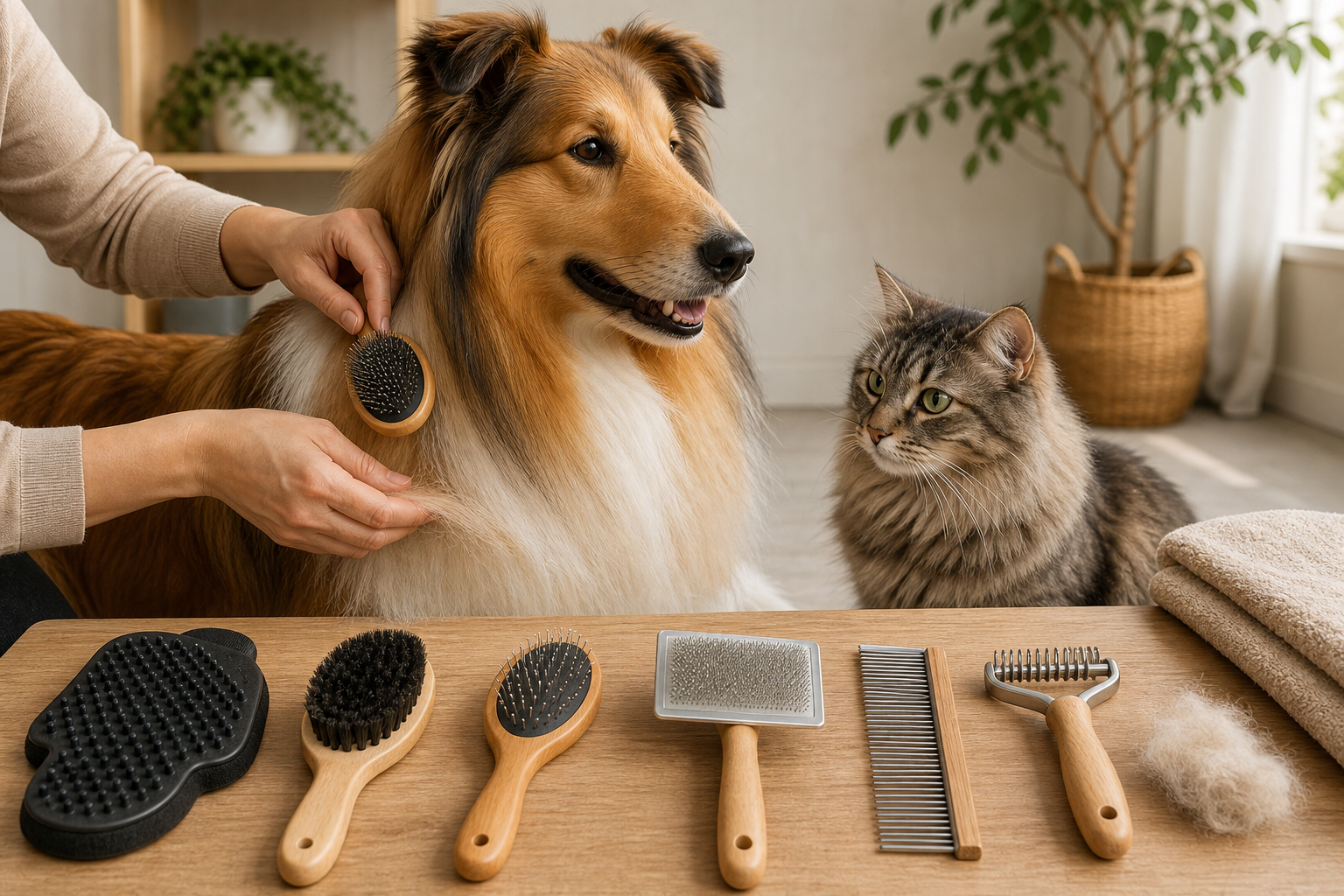
The right brush should move through a pet's coat with minimal pulling while removing the type of hair, debris or small tangle it was designed to handle. A tool that works well on a short smooth coat may barely reach a dense undercoat, while an aggressive shedding blade can damage a fine or sparse coat when used too often.
Quick recommendation: Identify the coat's length, texture, density and undercoat before choosing a brush. Start with the gentlest effective tool, use light pressure in the direction of hair growth, and finish with a comb check where the coat is long enough to hide tangles.
This guide compares common grooming brushes for dogs, cats and selected small pets. It covers routine coat maintenance, not medical treatment or severe mat removal. Skin disease, painful mats, unexplained hair loss or a sudden coat change needs veterinary assessment.
Start With the Coat, Not the Breed Label
Breed descriptions can provide clues, but the individual coat is what the brush touches. Mixed-breed pets may combine several textures, and the coat can change with age, hormones, clipping, health and season.
Assess four features:
- Length: Short, medium or long.
- Texture: Smooth, silky, wiry, curly or wool-like.
- Density: Sparse, moderate or very dense.
- Layers: Single coat or a topcoat with a softer undercoat.
Part the hair in several areas and look down to the skin. Check the neck, chest, behind the ears, armpits, groin, backs of the legs and tail base. These friction zones can need a different tool from the flatter coat along the back.
A dog may have a short double coat, a cat may have medium hair with a dense seasonal undercoat, and a rabbit may have delicate skin beneath a thick coat. One household rarely needs one universal brush.
Rubber Curry Brushes and Grooming Mitts
Rubber tools use short flexible nubs to loosen surface hair and debris. Some are handheld blocks; others fit over the hand as a mitt.
Best suited to
- Short, smooth-coated dogs.
- Short-haired cats that tolerate gentle stroking motions.
- Pets that are learning to accept grooming.
- Surface shedding and massage rather than deep detangling.
Strengths
- Flexible nubs are generally gentle on close coats.
- The hand-like motion can feel familiar to a nervous pet.
- Loose hair collects at the surface for removal.
- Some models can be used during bathing when the manufacturer permits it.
- A mitt can follow body contours without long pins contacting skin.
Limits
Rubber nubs do not reach through long, curly or dense double coats effectively. Vigorous circular rubbing can twist long hair and create tangles. Stop if the skin becomes pink, the pet flinches or friction builds heat.
For rabbits, PDSA notes that a soft bristle or rubber brush may remove loose hair gently, but every tool still requires care because rabbit skin is delicate.
Bristle Brushes
Bristle brushes contain natural or synthetic fibers arranged in clusters. Stiffer, shorter bristles reach a little more firmly; softer, longer bristles provide a lighter finish.
Best suited to
- Short, smooth coats.
- Short silky coats.
- Sparse undercoats.
- Finishing medium or long coats after tangles are removed.
- Distributing natural oils and lifting surface dust.
Strengths
- Removes loose surface hair and dander.
- Smooths the topcoat and improves the finished appearance.
- Offers a low-intensity introduction to grooming.
- Works well after a rubber curry on many short coats.
Limits
A bristle brush is not a reliable detangler for a dense or matted coat. If it glides only over the surface, loose undercoat may remain packed below. Choose bristle firmness for the pet's skin sensitivity and coat density; a stiff brush can scratch a thin coat.
Pin Brushes
A pin brush resembles a human hairbrush, with widely spaced metal pins set into a cushioned base. Good designs have smooth, polished ends without rough seams.
Best suited to
- Long, flowing or silky dog coats.
- Long-haired cats after larger tangles have been addressed.
- Wire coats as part of a breed-specific routine.
- Fluffing and finishing hair without compressing it.
- Daily maintenance when the coat is already in good condition.
Strengths
- Long pins can move through coat length with less surface drag.
- Spacing helps separate long strands.
- The cushioned base can reduce force when the user applies a light hand.
- Useful for final smoothing after combing.
Limits
A pin brush may pass over tight tangles or packed undercoat without removing them. Rounded tips are not a license to press into skin. Replace a brush when tips are missing, pins are bent or the cushion splits.
Slicker Brushes
A slicker has many fine wire pins, usually bent at an angle. It can remove loose hair and separate small tangles when used correctly.
Best suited to
- Medium and long coats.
- Curly or wool-like coats.
- Some wire coats.
- Feathering on legs, chest and tail.
- Loose undercoat near the surface.
- Preventing small tangles from becoming mats.
VCA identifies slickers as useful for curly, non-shedding coats, while AKC guidance also includes medium, long and wire coats.
Use with care
Slicker pins can irritate skin when the user presses hard, repeatedly scrapes one area or uses a tool with rough tips. Test the brush lightly on the inside of your forearm before using it on the pet. You should feel the pins without a sharp scratching sensation.
Use short controlled strokes and work in sections. The brush should lift hair, not rake skin. If the pet flinches, turns toward the brush, tenses or develops redness, stop and reassess the tool and technique.
Metal Combs and Wide-Tooth Combs
A comb is often the best verification tool after brushing. Teeth may be wide, medium, fine or arranged in alternating lengths.
Best suited to
- Medium and long dog or cat coats.
- Silky coats that develop small knots.
- Checking whether a slicker or pin brush reached the base.
- Working through minor tangles from the ends upward.
- Areas such as behind ears and feathering when handled gently.
A wide-tooth comb reduces resistance at the first pass. A medium or fine comb can follow only after the wider teeth move through freely.
The comb check
After brushing a section, pass a suitable comb from near the skin to the hair ends without forcing it. If the comb stops, the coat is not fully detangled even if the surface looks smooth.
Hold the hair close to the skin before addressing a small tangle so the comb does not pull directly on the body. Start at the end of the hair and move gradually toward the root.
Undercoat Rakes
An undercoat rake has one or two rows of longer metal teeth designed to reach beneath guard hairs and lift loose undercoat.
Best suited to
- Double-coated dogs.
- Dense seasonal shedding.
- Medium or long coats with a clearly defined undercoat.
- Selected double-coated cats when a veterinarian or groomer confirms the tool.
Choose tooth length carefully
The teeth should reach the undercoat without scraping skin. Teeth that are too short skim the surface; teeth that are too long can contact the body harshly.
Move in the direction of coat growth using light, short passes. Do not repeatedly work one spot after loose hair stops coming away. An undercoat rake is not a tool for cutting through a solid mat.
De-Shedding Tools and Shedding Blades
De-shedding tools may use closely spaced metal edges to capture loose undercoat. Shedding blades can have a toothed metal loop or straight edge.
Best suited to
- Heavy seasonal shedding in an appropriate double coat.
- Limited, deliberate sessions rather than automatic daily use.
- Pets whose coat and skin have been assessed for the exact tool.
Important limits
Some tools can cut or abrade healthy topcoat when pressure, angle or frequency is wrong. They are usually a poor first choice for fine single coats, sparse coats, fragile skin, curly coats that require preserved length, or pets with existing irritation.
Do not measure success by the largest pile of fur. Stop when the tool no longer moves easily, the coat looks thinned, guard hairs break or the skin becomes visible. Ask a professional groomer to demonstrate before using a bladed tool on a valuable or unfamiliar coat.
De-Matting Combs and Mat Splitters
De-matting tools have sharp or semi-sharp edges intended to divide small tangles. Their risk is higher than an ordinary brush or comb.
Appropriate use
- A very small, loose tangle that is clearly separated from the skin.
- A cooperative pet with no pain or inflammation.
- A user who understands blade direction and hand placement.
When not to use them
- The mat is tight against the skin.
- Several mats join into a sheet.
- Skin cannot be seen or felt safely.
- The area is wet, red, odorous, swollen or painful.
- The mat involves the ear edge, armpit, groin, tail or other thin skin.
- The pet struggles, bites, pants or freezes.
RSPCA and VCA guidance warn against cutting mats with scissors because pet skin can be drawn up into the mat and cut easily. Severe or widespread matting should be handled by a veterinarian or experienced professional groomer. Sedation may sometimes be the least painful veterinary option.
Flea Combs
A flea comb has very fine, closely spaced teeth. It is a detection and finishing tool, not a substitute for routine coat brushing or parasite treatment.
Best suited to
- Checking for fleas and flea dirt.
- Fine facial areas when the pet tolerates it.
- Removing small surface debris after brushing.
Keep a bowl of soapy water nearby only for captured fleas, not for application to the pet. A flea comb cannot control an infestation by itself. Ask a veterinarian for a species-appropriate parasite plan, especially for rabbits and cats, because some dog products are dangerous to other species.
Match the Brush to Common Coat Groups
Short, Smooth Coats
Examples include close dog coats and many short-haired cats.
Start with:
- Rubber curry brush or grooming mitt.
- Soft or medium bristle brush.
- Fine flea comb for inspection when needed.
Use slow strokes in the direction of growth. A short coat offers little protection from hard pins, so a slicker or rake may contact skin too aggressively.
Short Double Coats
These coats have short guard hairs over a dense softer layer.
Start with:
- Rubber curry for surface hair.
- Suitable bristle brush.
- Correct-length undercoat rake during shedding.
- De-shedding tool only when appropriate and used sparingly.
Part the coat to confirm that loose undercoat is being lifted without cutting the topcoat.
Medium and Long Double Coats
These coats can hide packed undercoat and tangles beneath a smooth surface.
Start with:
- Pin brush for length and finishing.
- Slicker for section work.
- Long-tooth or offset metal comb.
- Undercoat rake matched to coat depth.
Work in layers rather than brushing only the top. Lift a small line of hair, brush the section beneath and continue systematically.
Long, Silky Single Coats
Fine long hair tends to knot where the body moves.
Start with:
- Pin brush.
- Wide-tooth comb.
- Medium-tooth comb for the final check.
- Light bristle brush for finishing.
Support the coat near the skin and detangle the ends first. Pay close attention behind ears, under collars, in armpits and around leg feathering.
Curly or Wool-Like Coats
These coats can trap loose hair instead of shedding it onto furniture, allowing mats to form near the skin.
Start with:
- Soft or coat-appropriate slicker.
- Long metal comb.
- Professional grooming schedule appropriate to coat growth.
A fluffy surface does not prove that the base is tangle-free. Use the comb check throughout the body. Bathing before complete detangling can tighten existing knots.
Wire Coats
Wire coats vary by breed and grooming goal.
Start with:
- Pin brush.
- Medium and fine combs.
- Slicker for selected finishing.
- Professional advice before hand stripping or clipping.
Hand stripping changes the coat by removing mature hairs and should be taught by an experienced groomer. Routine brushing guidance cannot replace a breed-specific stripping plan.
Rabbit and Other Delicate Small-Pet Coats
Rabbit skin can tear easily. Use species-appropriate tools such as a soft bristle brush, rubber brush or carefully selected wide-tooth comb. Brush in the direction of growth and keep sessions short.
Blue Cross recommends at least weekly brushing for short-coated rabbits and daily care for long-haired rabbits, with more frequent grooming during moulting. Angora-type coats need specialist guidance.
Do not use dog de-shedding blades or sharp de-matting tools on a rabbit without veterinary or rabbit-grooming instruction. Do not cut rabbit mats yourself; seek a veterinarian or experienced professional.
Guinea pigs and other small mammals have different coat structures and handling needs. Ask an exotic-animal veterinarian for a tool and frequency suited to the species and individual.
Use a Low-Pull Brushing Technique
Prepare
- Choose a quiet, non-slip surface.
- Let the pet inspect the tool.
- Begin with a familiar area such as the shoulder.
- Keep treats or another appropriate reward available.
- Check the brush for bent pins, residue and sharp edges.
Brush
1. Separate a small section of coat.
2. Hold longer hair near the skin when needed.
3. Use light strokes in the direction of growth.
4. Begin at the hair ends when a minor tangle is present.
5. Move gradually toward the base.
6. Check progress with a comb where appropriate.
7. Stop before the pet becomes restless.
Observe
Relaxed posture, voluntary approach and normal breathing support continued grooming. Tail swishing, skin twitching, ears held back, lip licking, growling, hissing, freezing or repeated attempts to leave mean the session should pause.
Never punish resistance. Pain, fear and poor tool choice can all cause avoidance.
How Often Should You Brush?
Frequency depends on the coat and the individual, not a universal calendar.
General patterns include:
- Short smooth coats: usually weekly, with extra sessions during shedding.
- Medium coats: several times a week depending on density and friction areas.
- Long, silky or curly coats: often daily or near-daily maintenance.
- Double coats: regular care, increasing during seasonal shedding.
- Long-haired cats: commonly daily to prevent knots.
- Short-haired cats: at least weekly can help monitor coat and remove loose hair.
- Long-haired rabbits: daily.
- Short-haired rabbits: at least weekly and more often during moulting.
Use shorter sessions more often rather than one long, forceful session.
Clean and Maintain Grooming Tools
Hair, oil, dander and moisture collect around pins and teeth.
After grooming:
- Remove trapped hair without bending pins.
- Wash only as the manufacturer directs.
- Disinfect tools appropriately when infection or parasites are suspected, following veterinary advice.
- Dry metal completely to prevent corrosion.
- Store brushes with teeth protected.
- Replace cracked handles, loose pads, bent teeth and missing pin tips.
- Do not share tools between animals with unexplained skin problems.
A dirty or damaged brush can irritate skin and reintroduce debris.
When Brushing Should Stop
Stop home grooming and seek veterinary or professional help when you find:
- Tight or widespread mats.
- Red, broken, bleeding or moist skin.
- Pus, odor, scabs or painful swelling.
- Sudden bald areas or excessive hair loss.
- Heavy dandruff, intense itching or visible parasites.
- A lump that the brush catches.
- A foreign object embedded in skin.
- A dramatic change in coat texture or self-grooming.
- Pain, aggression or panic during gentle handling.
Older, arthritic, overweight or unwell pets may groom themselves less and need additional support, but a sudden decline can indicate pain or disease.
Brush Selection Checklist
Before buying or using a brush, ask:
- What are the coat's length, texture, density and layers?
- Does the tool reach the target hair without scraping skin?
- Are all pins and teeth smooth and intact?
- Is the head size appropriate for the pet and body area?
- Can I use it with light pressure?
- Does the tool remove loose hair or merely skim the surface?
- Is a comb needed to verify the result?
- Does the pet remain comfortable?
- Can the tool be cleaned and dried?
- Do I need a groomer to demonstrate it first?
Key Takeaway
Rubber and bristle tools suit many short coats. Pin brushes and metal combs support long or silky coats. Slickers can maintain medium, long and curly coats when used lightly. Undercoat rakes and de-shedding tools belong only on appropriate double coats and require restraint in pressure and frequency.
The best brush is the gentlest tool that reaches the coat layer you need to maintain. Match the tool to the individual coat, work in small sections, check the skin and stop before grooming becomes painful.
Frequently Asked Questions
What brush is best for a short-haired pet?
A rubber curry brush, grooming mitt or suitable bristle brush usually works well for short smooth coats. Use light strokes because short hair provides less protection from hard pins contacting the skin.
What brush should I use for a double coat?
A correctly sized undercoat rake can lift loose undercoat, while a pin brush, slicker or comb may maintain the outer layers depending on coat length. Choose tooth length carefully and avoid repeated passes that thin or break healthy topcoat.
Are slicker brushes safe for cats and dogs?
Slickers can suit medium, long and curly coats when the pins are smooth and the user applies light pressure. Stop if the skin reddens, the pet flinches or the brush repeatedly catches.
Can I cut a mat out with scissors?
No. Mats can pull skin up close to the blades, making accidental cuts likely. Tight, painful or widespread mats should be removed by a veterinarian or experienced professional groomer using an appropriate method.
How do I know when brushing is complete?
On medium or long coats, a suitable comb should pass from near the skin to the hair ends without force. Check friction areas such as behind the ears, armpits, groin, legs and tail rather than judging only the smooth surface.
Sources and References
- VCA Animal Hospitals - Grooming and Coat Care for Your Dog
- VCA Animal Hospitals - Grooming and Coat Care for Your Cat
- VCA Animal Hospitals - Choose the Best Brush for Your Pet
- RSPCA - Grooming Your Cat
- Blue Cross - Grooming Your Rabbit
- PDSA - How Often Should You Groom Your Pet?
- American Kennel Club - How to Choose the Right Dog Brushes
- American Kennel Club - Double-Coated Dogs and Coat Care
About this article
The ShineePets Editorial Team publishes practical, evidence-informed guidance for responsible pet care and safer everyday routines.
ShineePets is a commercial B2B pet-supply sourcing brand. Read our editorial standards and commercial disclosure.