Product Sourcing
Quality Control Checkpoints for Pet Care Products
Quick answer
A buyer-led QC gate map for non-food pet accessories, covering incoming materials, first-off checks, in-process control, lot release and corrective action.
By ShineePets Editorial Team · Published
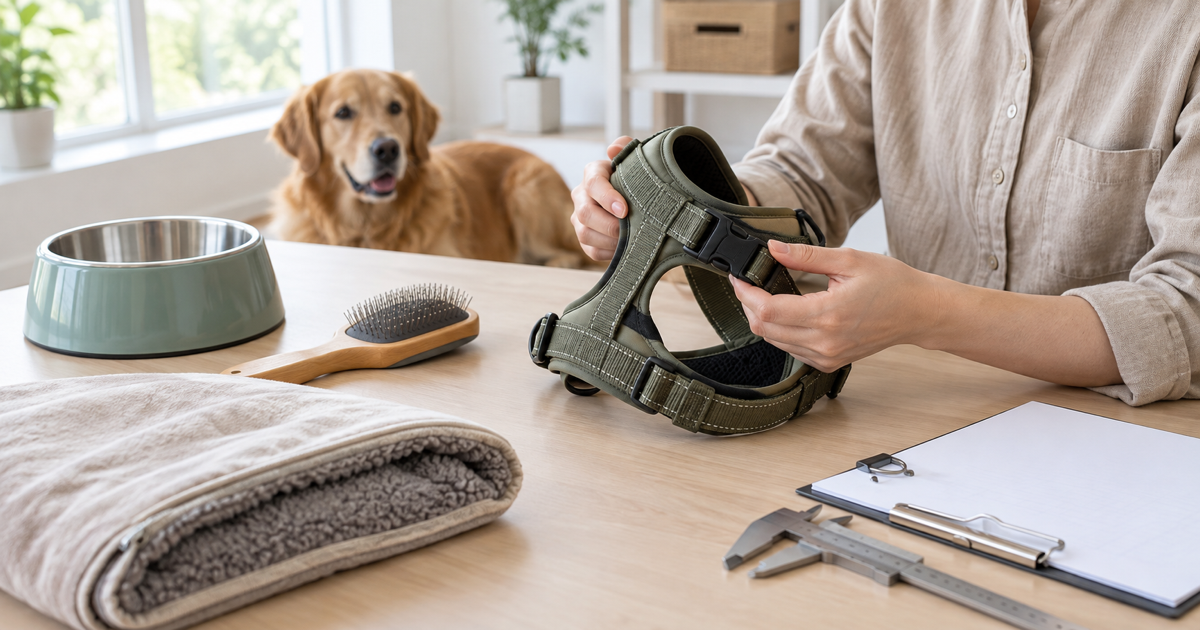
Pet product quality control should not begin when cartons are ready to ship. For a buyer of harnesses, bowls, beds, brushes or similar non-food accessories, the useful checkpoints are: an agreed specification before production, incoming material verification, a first-off check, in-process monitoring, a finished-lot release check and an arrival/feedback review. Each gate needs a named owner, a measurable criterion, a record tied to the production lot and a decision to release, hold or investigate. A clean final inspection cannot recover missing material evidence or a process that drifted for weeks. ISO's supply-chain guidance distinguishes a supplier's management system from proof that a specific product meets the buyer's requirements.
This is a buyer's framework for ordinary non-food pet accessories, not a universal regulatory checklist. Food, medicated products, chemical formulations and electrical devices need category- and destination-specific controls. Start by identifying exactly what is being made, where it will be sold and how a pet and owner will use it.
Define the Release Rules Before the First Checkpoint
Use the approved drawing or specification revision as the reference for every inspection. It should identify the model, size range, materials, color, components, labels, packaging configuration, intended use and agreed test methods. Translate vague requirements such as "strong stitching" into observable criteria: seam pattern, stitch condition, the agreed method for checking seam performance and the action when a result fails. Do not borrow an arbitrary strength number from another product and call it a safety standard.
Assign an owner for each decision. Production staff may measure a part, but a separate quality role or the buyer's authorized representative should decide whether a deviation can be accepted. Record which revision and lot were checked; otherwise a passing report can be attached to the wrong design. ISO explains that ISO 9001 does not set the requirements for the particular product a buyer orders: those needs must be made clear to the supplier. A certificate for a quality-management system is not a product approval.
Pet Product Quality Control: Six Checkpoints
| Gate | Question to answer | Minimum evidence | Release decision |
| --- | --- | --- | --- |
| 1. Pre-production | Are the specification, risk list and test plan current? | Signed revision, bill of materials, inspection plan | Do not start against an obsolete or ambiguous brief. |
| 2. Incoming materials | Are received components the approved ones? | Supplier lot IDs, material identity, visual/measurement records, required documents | Quarantine unverified or nonconforming inputs. |
| 3. First-off unit | Does the actual setup make a conforming product? | First-piece measurements, photos, functional results, approver | Correct setup before the run continues. |
| 4. In-process | Is the process still producing the approved design? | Time/line-linked checks, defect log, tool or machine changes | Hold affected output when a trend or critical fault appears. |
| 5. Finished lot | Does this identified lot meet release criteria and packaging requirements? | Inspection report, test records, label/carton checks, disposition | Release, sort/rework and recheck, or reject. |
| 6. Arrival and feedback | Did transit or use reveal an issue missed earlier? | Receiving checks, damage/complaint records, corrective-action follow-up | Contain affected inventory and revise controls if needed. |
This sequence is a practical application of a risk-based process approach, not a claim that every item requires the same tests. ISO describes quality assurance as combining planning, testing, inspection, monitoring and improvement across the value chain, rather than relying only on finished-product inspection.
Gate 1–2: Control the Design Baseline and Incoming Inputs
Before production, identify the features most likely to affect fit, function or foreseeable misuse. For a walking harness, these might include size adjustment, webbing, stitching, buckle engagement and attachment hardware. For a feeding bowl, check the intended food-contact use, material and finish, stability and cleaning instructions. Those are examples of buyer-selected checkpoints, not assertions that one material or construction is automatically safe.
At receipt, match supplier paperwork and labels to the actual component lot. Look for substitutions in fabric, foam, resin, metal, coatings or closures; check dimensions and visible defects against the approved specification. Put uncertain inputs in a clearly identified hold area. A document for one material grade or an earlier production date should not silently stand in for evidence about the material now on the line. Escalate any material change for product-specific assessment before it is consumed.
Gate 3–4: Inspect the First Output, Then Watch the Process
A first-off check tests the real line setup against the approved sample and specification. Measure critical dimensions, operate closures, inspect seams or joints, and confirm markings and assembly. Record the result and who authorized production to continue. Repeat a first-off check after a meaningful change such as a new tool, material lot, machine setup or label file—not merely at the start of the week.
During production, check characteristics that can drift or vary: cut lengths, seam appearance, adhesive application, molded edges, fastener fit or print placement. Sample from different times and lines according to the agreed plan, rather than selecting only attractive units. If results move outside an agreed limit or a potentially harmful defect appears, identify the last known good check, hold output made since then, investigate and verify the correction. NIST describes process control as acting on monitoring results to return an out-of-control process to control.
Gate 5: Release the Lot, Not Just a Few Attractive Units
Define the lot boundary before sampling: which production dates, lines, material batches and purchase-order quantities are included? Then apply a documented sampling plan to the specified defect classes and test methods. Randomly selected units should represent the lot, including different cartons or pallet positions when relevant. Do not invent an "AQL pass" by choosing a small convenient sample and calling it a standard plan. NIST explains that acceptance sampling supports a decision about a lot; it does not prove every unit is defect-free or estimate the exact quality of all units.
The release check should cover more than appearance. Confirm function, dimensions, workmanship, surface finish, cleanability and any product-specific test evidence. Match the retail label and carton markings to the approved files, verify count and assortment, and inspect closures and protective packing. For a route with meaningful distribution hazards, define a packaging test plan suited to the packed product and route; ASTM D4169 describes laboratory evaluation of shipping units against anticipated distribution hazards. It is a method for evaluating a shipping system, not a substitute for the product specification or a promise that no shipment will be damaged.
Match Checks to the Failure Mode
The inspection plan should explain why a check exists. A generic photo of a finished carton cannot answer all of these questions:
| Product example | Failure to prevent | Useful checkpoint |
| --- | --- | --- |
| Harness or leash | Closure slips, seam separates, size cannot be adjusted | Incoming hardware identity; first-off fit and assembly; in-process seams; finished-lot function |
| Washable bed or mat | Fill or cover differs from specification; seams open; care instructions mismatch | Material and cover identity; cut/seam checks; agreed cleaning test evidence; final label review |
| Bowl or storage container | Rough edge, poor lid engagement, cleaning difficulty | Incoming material/finish; first-off edge and closure check; finished-lot fit and cleanability review |
| Brush or grooming tool | Loose pins, handle joint failure, sharp contact surface | Incoming component fit; in-process attachment; finished-lot tactile and functional check |
Do not assume these observations replace laboratory work. If a claim or destination market requires chemical, food-contact, mechanical or electrical evidence, map that requirement to the correct product and a competent test method. The required scope differs by category and jurisdiction.
What Happens When a Gate Fails?
Use one disposition rule that the factory and buyer both understand:
1. Contain: identify and separate the affected material or finished lot; stop shipment while status is unresolved.
2. Characterize: document the defect, quantity, locations, photos, test method and first/last known conforming check.
3. Decide: reject, sort, rework under an approved instruction, or grant a documented concession only if it is permissible and does not compromise safety or mandatory requirements.
4. Verify: reinspect or retest the affected scope after correction. A promise to be careful next time is not evidence.
5. Prevent recurrence: record root cause, the process change, owner and date for checking whether it worked.
Preserve traceability from finished carton back to production lot and key material lots. Without it, even a small defect may require a much wider inventory hold than necessary. ISO's supply-chain guidance covers supplier monitoring, nonconformity and corrective action as parts of quality management.
Keep Category-Specific Compliance on a Separate Track
A single accessory checklist must not be copied onto pet food or treats. In the United States, facilities subject to the FDA's animal-food preventive-controls rule have requirements covering current good manufacturing practice, hazard analysis and risk-based preventive controls; applicability and exemptions must be checked for the actual business and product. FDA's animal-food overview explains that framework. Other markets and categories may impose different requirements. Treat compliance evidence, routine workmanship inspection and marketing-claim substantiation as related but separate decisions.
Buyer Release Checklist
Before authorizing shipment, ask for the current specification and lot identity; the incoming, first-off, in-process and finished-lot records; the list of open deviations and their dispositions; any required test reports tied to the correct product revision; and approved label, carton and packing evidence. Make sure one named person has authority to release the lot. If a record is missing, request it before changing the status from hold to release.
This framework begins after a sample has been approved. For the earlier decision, see how to review pet product samples before bulk orders. If you are preparing a wholesale or OEM/ODM order, share your product brief with ShineePets and ask which specification, inspection and evidence fields should be agreed before production. ShineePets should not be assumed to have performed any test until its scope and report are confirmed for the specific product.
Sources and Further Reading
- ISO 9001 in the Supply Chain — ISO
- Quality Assurance: A Critical Ingredient for Organizational Success — ISO
- What Is Process Control? — NIST
- What Is Acceptance Sampling? — NIST
- ASTM D4169: Performance Testing of Shipping Containers and Systems — ASTM International
- Food Safety Modernization Act and Animal Food — U.S. FDA
For retailers, distributors and pet brands
Turn this insight into a sourcing plan
Browse the ShineePets B2B catalog or discuss product selection, packaging, private-label and OEM/ODM requirements.
Explore the Wholesale Catalog Discuss OEM/ODMFrequently Asked Questions
Does a passed final inspection prove every unit is defect-free?
No. A sampling plan helps decide whether to accept a defined lot; it does not inspect every unit or guarantee zero defects. Match sample size and acceptance rules to the agreed plan and the risk of each defect.
Who should sign a pet product lot release?
Name the authorized quality or buyer representative in the purchase and inspection plan before production. The person collecting measurements and the person granting a deviation need not be the same.
When should first-off inspection be repeated?
Repeat it after a meaningful setup change, such as a new tool, material lot, machine setting, component supplier or label revision, according to the agreed control plan.
Can an ISO 9001 certificate replace a product inspection report?
No. A management-system certificate concerns the supplier system. Buyers still need product-specific requirements and evidence for the identified lot.
Sources and References
- ISO 9001 in the Supply Chain — ISO
- Quality Assurance: A Critical Ingredient for Organizational Success — ISO
- What Is Process Control? — NIST
- What Is Acceptance Sampling? — NIST
- ASTM D4169: Performance Testing of Shipping Containers and Systems — ASTM International
- Food Safety Modernization Act and Animal Food — U.S. FDA
Continue Reading

How to Review Pet Product Samples Before Bulk Orders
A practical framework for checking pet product samples, documenting defects, approving a golden sample and connecting approval to bulk inspection.
How Pet Product Durability Testing Protects Buyers
Learn how tensile, abrasion, fatigue, impact, wash and transit testing help pet-product buyers compare suppliers and prevent predictable failures.