Retail & Distribution
Pet Food Storage Containers: Materials and Seal Quality
Quick answer
Compare pet food storage containers by food-contact material, gasket design, closure strength, cleanability and practical sample testing.
By ShineePets Editorial Team · Published · Updated
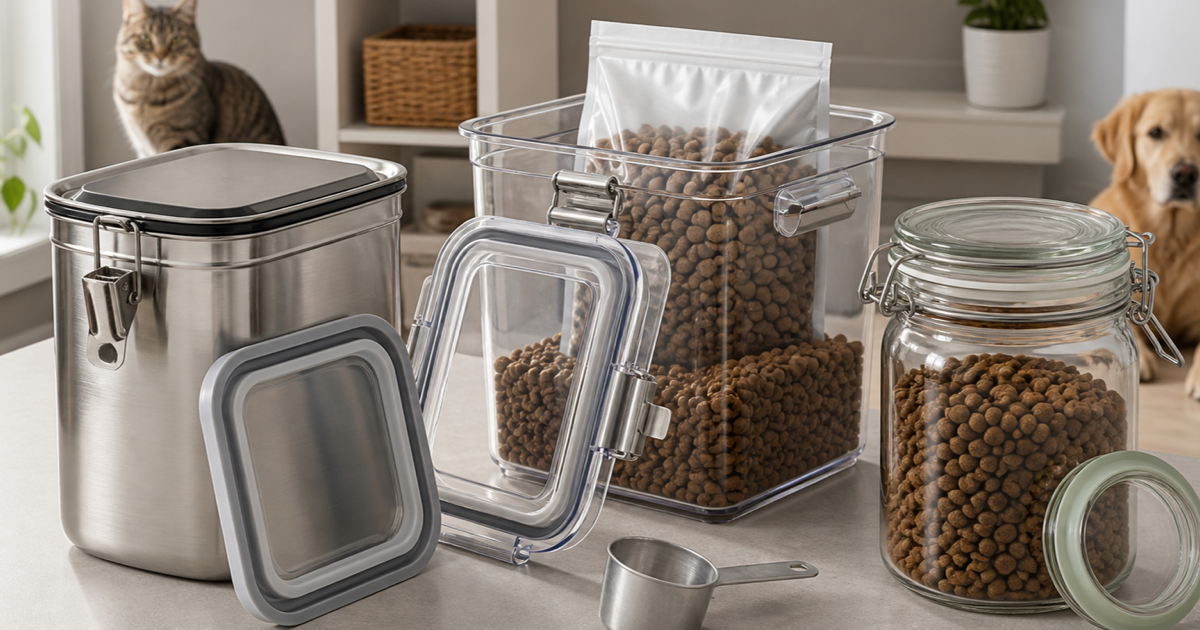
A pet food storage container should be selected by four criteria: documented food-contact suitability for the intended market and use, cleanable construction, a well-fitted gasket, and a closure that keeps the gasket compressed after repeated opening. For dry food, the container does not replace the original package. The U.S. Food and Drug Administration advises keeping dry pet food in its original bag and placing the entire bag inside the secondary container when possible. Retail buyers should therefore evaluate pet food storage containers as protective systems, not approve them from a material name or an “airtight” claim alone.
This guide compares common materials, explains what creates a reliable seal, and gives buying teams a repeatable sample-approval plan.
How to Evaluate Pet Food Storage Containers
Define the food type, bag dimensions, fill load, storage location, opening frequency, cleaning method and destination market before comparing samples.
Use five decision gates:
- Material compliance: Every food-contact component should be suitable for its intended use, including the body, lid, gasket, coating, colorant, adhesive and scoop.
- Seal design: The lid, rim, gasket, hinge and latch must work as one system.
- Cleanability: Users must be able to remove crumbs and oily residue without inaccessible crevices.
- Mechanical durability: The body and closure must tolerate foreseeable filling, lifting, opening and transport.
- Traceability: The supplier should identify materials, revisions, test reports and production lots.
The FDA treats packaging components, colorants and adhesives as food-contact substances when used in contact with food. Authorization depends on intended use, not a vague “food grade” statement. Request evidence matching the material, food type, temperature, contact duration and repeated-use conditions. FDA explains this framework here.
Keep the Original Pet Food Bag
A container can improve organization and help restrict access, but it can also separate the food from information needed during a recall. The original package normally carries the product name, manufacturer, lot code, UPC and best-by date. The FDA recommends retaining that information and, where practical, storing the entire bag inside the container rather than pouring kibble directly into it. The agency also recommends washing and fully drying a container before a new bag is added. See the FDA storage guidance.
The container should accept the stated original bag without forcing it against the lid. Because food density and bag shape vary, validate fit with representative commercial bags rather than loose pellets alone.
Material Comparison: Stainless Steel, Plastic and Glass
No material is universally best. The right choice depends on compliance evidence, size, handling, price, cleanability and the closure design.
| Material | Practical strengths | Main buyer checks | Less suitable when |
|---|---|---|---|
| Stainless steel | Opaque, rigid and resistant to everyday knocks; premium appearance | Steel grade, interior finish, seams, coating status, dent resistance and lid alignment | The product needs visibility, very low weight or a low opening price |
| Food-contact plastic | Lightweight, moldable and suitable for integrated handles, wheels and complex lids | Resin identity, intended-use declaration, colorants, repeated-use conditions, wall thickness, odor, scratching and heat distortion | Users may apply cleaning temperatures or loads outside the validated conditions |
| Glass | Easy visual inspection, rigid walls and low odor retention | Food-contact suitability, wall uniformity, chip resistance, closure attachment and protective packaging | Large capacity, frequent lifting, children or pets may knock it over, or parcel transit is demanding |
| Hybrid construction | Can combine a rigid body with a flexible gasket and functional hardware | Evidence for every food-contact component and compatibility between materials | The supplier documents only the main body and ignores the lid, liner, gasket or coating |
For U.S. sales, do not treat “FDA approved container” as a complete compliance file. Ask which regulations, notifications or other authorizations support each food-contact component and its intended use. For EU sales, Regulation (EC) No 1935/2004 requires food-contact articles to be made so that, under normal or foreseeable use, their constituents do not transfer to food in amounts that could endanger health, unacceptably change food composition or deteriorate sensory characteristics. It also requires presentation not to mislead consumers. Read the regulation on EUR-Lex.
For recycled plastic, request destination-market documentation specific to the recycling process, resin and intended use; a recycled-content percentage alone does not establish food-contact suitability.
Seal Quality Is a System, Not a Gasket
An attractive silicone ring cannot compensate for a flexible rim or weak latch. Seal performance depends on six connected details:
1. Rim flatness: A warped rim creates a local gap even when most of the lid feels tight.
2. Gasket continuity: Corners and molded joints should not be thin, twisted or interrupted.
3. Compression: The closed lid should compress the gasket consistently around the perimeter.
4. Closure force: Latches must create enough force without becoming difficult for the intended user.
5. Hinge control: The hinge must guide the lid into the same position after repeated cycles.
6. Body stiffness: Filling, lifting or stacking must not distort the opening and release compression.
“Airtight” is not a useful procurement requirement unless the supplier states the test method, sample condition, acceptance limit and test duration. A dry-food container is not automatically liquid-tight, and passing a short water test does not prove long-term control of air or humidity. Use claims that match verified performance, such as “gasketed lid” or “secure latch,” when stronger barrier claims have not been demonstrated.
A Repeatable Seal and Closure Test Plan
Retailers and brand owners can screen samples with the following sequence. These checks do not replace laboratory testing, but they expose inconsistent construction before a purchase order is approved.
1. Map gasket compression
Close the empty container on narrow paper strips positioned at the corners and along each side. Pull each strip with the same motion. A strip that slides out much more easily identifies a low-compression area. Record the position and repeat the check on several samples; do not rely on one hand-picked unit.
2. Check closure repeatability
Open and close the lid for a buyer-defined number of cycles that reflects expected use. Inspect latch engagement, hinge play, gasket movement and rim alignment at intervals. Repeat the paper-strip check after cycling. The acceptance requirement should state what may change and what constitutes failure.
3. Test with representative load
Place a sealed bag of the claimed size inside. Use only intended handles and wheels, watching for body flex, lid release, deformation and instability. Do not treat a volume claim as a carrying-load claim.
4. Run the labelled cleaning cycle
Clean the sample exactly as the proposed instructions state, then dry it completely. Look for retained water under the gasket, swelling, corrosion, clouding, odor, coating damage and lid distortion. If a gasket is removable, confirm that users can reinstall it in the correct orientation without tools.
5. Recheck after transit
After a representative shipping trial, inspect for rim dents, hinge stress, chipped glass and other damage that can weaken the seal. Connect these checks to a broader pet-product durability test plan.
Cleanability and Everyday Use
Storage containers accumulate crumbs and surface fats. The FDA recommends washing and drying the container between bags. A product that is technically washable but difficult to dry is not well designed for repeated food storage. FDA storage guidance supports this between-bag cleaning step.
During sample review, check that:
- a hand or cleaning tool can reach every food-contact surface;
- the interior does not contain blind channels that trap crumbs;
- the gasket can be inspected and, if removable, replaced;
- the lid can drain after washing rather than holding concealed water;
- the scoop has its own clean storage position and does not fall into the food;
- the instructions state whether components are hand-wash or dishwasher suitable;
- the container can dry fully before the next bag is loaded.
Do not approve strong claims such as “non-toxic,” “completely safe” or “odor proof” without a defined basis. Clear, limited instructions are more useful than broad marketing language.
Packaging, Labelling and Supplier Documentation
Transit packaging should prevent chipped glass, dented steel rims and permanently warped plastic lids. Do not hold a gasket under uneven compression unless that packing condition has been validated.
The retail pack should identify capacity, usable dimensions, intended food-contact use, material information required by the destination market, cleaning instructions, cautions and supplier traceability. Keep compliance claims aligned with documents. For a broader review of front- and back-panel information, use the ShineePets guide to pet product packaging labels.
For EU supply, food-contact materials are also subject to good manufacturing practice requirements under Commission Regulation (EC) No 2023/2006, including an effective quality-assurance system and appropriate documentation. The official regulation is available on EUR-Lex. Buyers should connect that documentation to the approved material specification and production revision.
Common Buying Mistakes
- Approving by material name: “Stainless steel” or “plastic” does not identify grade, additives, coating, use conditions or compliance status.
- Testing only the body: Gaskets, colorants, adhesives, scoops and lid liners may also contact food.
- Using one golden sample as proof of consistency: Seal quality is sensitive to molding, rim flatness and assembly variation; review multiple samples.
- Calling a container airtight after a casual water test: Define a method and acceptance limit that match the claim.
- Ignoring bag fit: A nominal capacity may not accept the intended original package.
- Skipping cleaning validation: A trapped-water lid or difficult gasket can create avoidable maintenance problems.
- Mixing new food with old residue: Finish the bag, remove residue, wash and dry the container, and retain the new lot information.
Buyer Approval Checklist
Before approving a pet food storage container, confirm:
- the primary audience, food type, bag size and fill load are defined;
- food-contact documentation covers the body, lid, gasket, colorants, coatings and scoop;
- documents match the destination market and foreseeable conditions of use;
- the original bag fits without preventing lid closure;
- gasket compression is consistent on multiple samples;
- closure cycling does not create hinge play, latch failure or seal gaps;
- cleaning and drying instructions are realistic and verified on samples;
- handles, wheels and stacking features work under the stated load;
- packaging protects the rim, closure and body during distribution;
- marketing claims are limited to demonstrated performance;
- material and production revisions are traceable to the approved sample.
The best buying decision is not the container with the most aggressive “airtight” claim. It is the one whose materials, closure, cleaning method and use limits are documented and repeatable in production.
When Stored Pet Food Should Not Be Used
Do not use pet food that develops a foul or unusual odor, contains a foreign object, or comes from swollen or leaking packaging. If a pet becomes ill after eating a product, stop feeding it and contact a veterinarian; report the issue to the manufacturer and the appropriate regulator. Keep the original package or at least a dated photo of the lot code and best-by information because those details support traceability. FDA explains why lot codes matter. This article provides general product-selection information and does not replace veterinary diagnosis.
Sources and Further Reading
- Proper Storage of Pet Food & Treats — U.S. Food and Drug Administration
- Food Packaging and Other Food-Contact Substances — U.S. Food and Drug Administration
- Save Your Pet Food Lot Number — U.S. Food and Drug Administration
- Regulation (EC) No 1935/2004 on Food-Contact Materials — EUR-Lex
- Commission Regulation (EC) No 2023/2006 on Good Manufacturing Practice — EUR-Lex
Frequently Asked Questions
What is the best material for a pet food storage container?
There is no universal best material. Choose documented food-contact suitability, cleanability, mechanical durability and a closure that stays aligned under expected use.
Should dry pet food be poured directly into a storage container?
The FDA recommends keeping dry pet food in its original bag and placing the whole bag inside the secondary container when possible, so lot and product information remain available.
How can a buyer check a container seal without laboratory equipment?
Paper-strip compression mapping, repeated closure cycling and post-cleaning inspection can reveal uneven sealing or distortion, but they do not by themselves prove an airtight claim.
Is glass always better than plastic or stainless steel?
No. Glass is easy to inspect and resists odor retention, but it is heavy and breakable. Large or frequently moved containers may be better served by another verified material.
Can new kibble be added on top of old kibble?
Avoid topping off a container. Remove residue, wash and fully dry the container between bags, then retain the new package or its lot and best-by information.
About this article
ShineePets publishes practical guidance for pet-product retail, sourcing and quality teams.
ShineePets is a commercial B2B pet-supply sourcing brand. Read our editorial standards and commercial disclosure.