Cat Care
Cat Litter Types Compared: Clay, Tofu, Wood and Silica
Quick answer
Compare clay, tofu, wood and silica cat litter by texture, clumping, dust, tracking, cleaning and cat comfort before changing products.
By ShineePets Editorial Team · Published · Updated
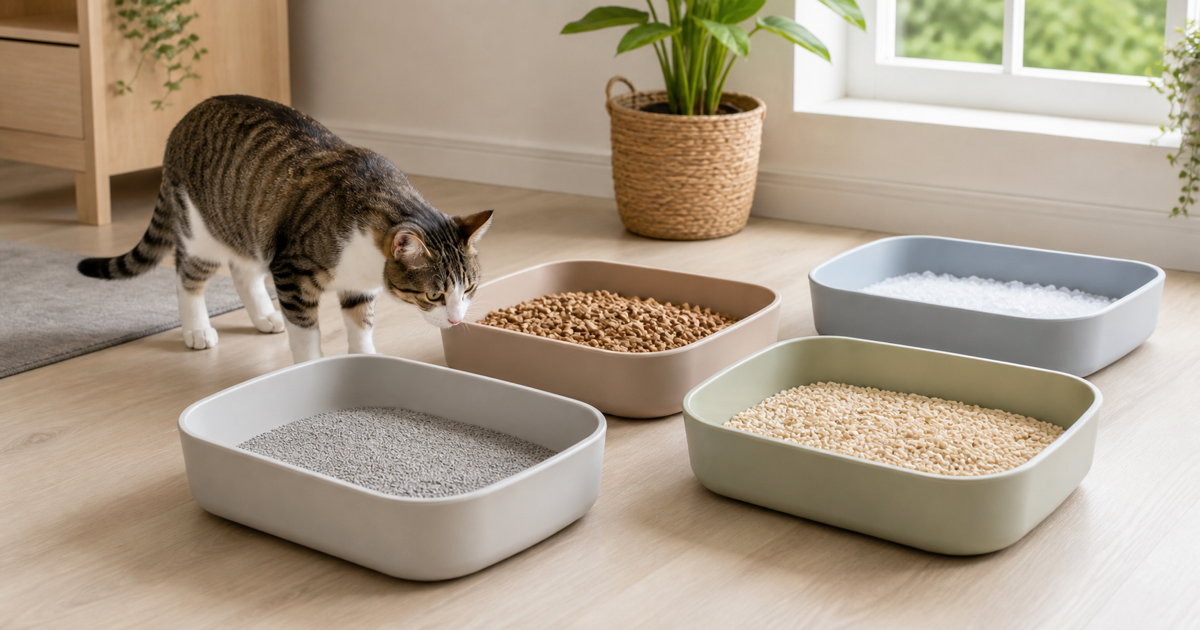
Cat litter types differ in texture, clumping, weight, dust, tracking and cleaning method, but no single material is right for every cat. Fine, unscented, scoopable litter is a dependable starting point because many cats accept its texture, yet an individual cat may prefer clay, tofu, wood or silica based on previous experience and paw comfort.
First ensure the box is large, accessible and clean, then test one change at a time. The best choice is one the cat uses comfortably and the owner can maintain consistently.
Cat Litter Types Compared at a Glance
| Type | Typical format | Main advantages | Main tradeoffs | Often suits |
|---|---|---|---|---|
| Clay | Fine clumping granules or non-clumping mineral litter | Familiar sand-like texture; clumps can make daily removal and urine observation easier | Heavy; dust and tracking vary widely; mined material | Cats already comfortable with fine granular litter |
| Tofu | Lightweight plant-fiber pellets or granules, usually clumping | Light to carry; compact clumps; some larger formats track less | Formulas vary; can soften in humidity; plant ingredients and binders need checking | Homes seeking a lighter clumping option |
| Wood | Compressed pellets, fibers or granules; clumping or non-clumping | Often light; large pellets may spread less; some products work with sifting trays | Pellets can feel coarse; non-clumping formats require a different cleaning routine | Cats that accept pellets and owners who prefer sifting systems |
| Silica | Porous silica-gel crystals, usually non-clumping but sometimes clumping | Light; absorbs moisture; longer service interval in some products | Crystal texture may be disliked; tracking and dust still vary; urine volume may be harder to judge | Cats that accept crystals and households following a clear replacement routine |
These are tendencies, not promises. Products within one category can differ in particle size, fragrance, additives, dust and clump strength, so judge the actual label and product.
Clay Litter: Familiar Texture and Firm Clumps
Clay litter comes in clumping and non-clumping forms. Clumping products commonly use swelling clay to bind wet areas, making it possible to remove urine clumps while leaving dry litter in the box. Non-clumping clay absorbs liquid but normally requires more frequent complete replacement.
American Association of Feline Practitioners guidance notes that many cats prefer fine-grained, unscented litter and that depth preferences vary. Read the AAFP feline behavior guidance. Visible clumps may also make changes in deposit size or frequency easier to notice, but cannot diagnose disease.
Clay is heavy, and dust and tracking vary. “Low dust” does not mean dust-free: pour close to the box and reject products that create visible clouds or coat nearby surfaces. Fragrance does not replace scooping.
Choose clay when: the cat already likes fine granules, daily clump removal is important and the owner can manage the bag weight.
Reconsider it when: visible dust remains high, tracking is unmanageable or the cat avoids touching the surface.
Tofu Litter: Lightweight Plant-Fiber Clumping
“Tofu litter” is not a standardized recipe. Products may combine soybean by-products, pea fiber or other plant material with starches, gums or minerals. Check the ingredients and particle format.
Most tofu litters clump and are lighter than mineral litter. Longer pellets may track less but feel unfamiliar to a cat used to sand-like grains. Test whether wet clumps lift without crumbling.
Store it sealed and dry; reject water-damaged, musty or infested bags. A “flushable” claim does not override local wastewater, septic or building rules. Bag used litter when permission is unclear.
Choose tofu when: a light clumping litter is valuable and the cat accepts its particle shape.
Reconsider it when: clumps break apart, humid storage affects the product or the cat perches on the box edge to avoid the pellets.
Wood Litter: Pellets, Fibers and Sifting Systems
Wood litter comes as compressed pellets, granules or clumping fibers. Traditional pellets break down when wet and may use a compatible sifting tray; clumping products require a different routine.
Large pellets may spread less but can feel coarse. In a 2018 field study, 18 indoor cats preferred clay or silica over wood pellets; a 12-cat second phase favored clay over silica for defecation. The small samples support offering choice, not declaring a universal winner. Review the *Journal of Veterinary Behavior* study.
Use litter labeled for cats, not fuel pellets or unidentified workshop material. Offer a finer alternative to seniors, cats with sore paws or any cat avoiding coarse surfaces.
Choose wood when: the cat accepts pellets or fibers and the owner understands the specific sifting or clumping routine.
Reconsider it when: the cat digs less, balances on the rim, eliminates beside the box or the owner cannot remove damp broken-down material reliably.
Silica Litter: Light Crystals and Moisture Absorption
Crystal litter uses porous silica gel to absorb moisture. Many versions require daily feces removal plus mixing or replacement as directed; clumping formats also exist, so confirm the cleaning method.
Silica is light, but coarse crystals can feel unfamiliar and may still track. Judge low-tracking or low-dust claims in the actual box.
Color-changing crystals cannot diagnose illness. Veterinary examination and urinalysis investigate disease. Consider whether non-clumping crystals make urine changes too difficult to monitor for a cat with urinary history.
Choose silica when: the cat willingly digs and eliminates on crystals and the owner follows the product's stirring and replacement directions.
Reconsider it when: the cat avoids the texture, crystals scatter widely or urine changes become harder to monitor.
Compare What Matters to the Cat
Material is only one part of acceptance. Evaluate the complete setup:
1. Texture: Does the cat step fully into the box, dig and cover normally?
2. Scent: Is the litter unscented rather than masked with perfume?
3. Dust: Is there a visible cloud during pouring, digging or scooping?
4. Clumping: Are wet areas removable without breaking apart or sticking excessively to the box?
5. Tracking: How far does material travel, and does a soft mat control it without blocking access?
6. Observation: Can the owner notice changes in urine, stool and box-use frequency?
7. Maintenance: Can the box be kept clean using a routine the household will actually follow?
8. Storage and disposal: Will the bag stay dry, sealed and manageable, and is disposal permitted locally?
Respiratory needs deserve extra care. Cornell lists dusty kitty litter among suspected allergens or irritants associated with feline asthma. See Cornell's feline asthma overview. A cat with coughing, wheezing or a diagnosed airway condition needs veterinary guidance; choosing a visibly low-dust, unscented product is an environmental step, not a treatment.
Run a Two-Box Preference Test
Do not remove a familiar litter and replace it everywhere overnight. A better trial keeps one reliable option available:
1. Place two matching, clean boxes in comparable quiet locations.
2. Keep the familiar litter in one box and put the new litter in the other.
3. Use similar litter depth and do not add fragrance or deodorizer to either.
4. Scoop both on the same schedule.
5. Record which box receives urine and stool, whether the cat digs, and whether it perches or leaves quickly.
6. Continue only if the cat uses the new surface comfortably; do not force the switch by letting the old box become dirty.
In multi-cat homes, one cat's deposits can hide another's rejection. Use separate locations and observation when identity is unclear. The ShineePets guide to managing food, water and litter in multi-cat homes explains access and escape routes.
Keep Any Litter Type Clean
Scoop feces and removable urine clumps at least daily, top up as needed and replace the litter often enough to keep it dry and acceptable. Follow the product's full-change schedule because a non-clumping pellet or crystal litter cannot be maintained exactly like clumping clay. Wash the empty box with mild soap and water, rinse it and dry it before refilling.
A fine-grained litter depth of roughly 1–2 inches (about 2.5–5 cm) is a common starting range, but the cat's digging behavior and the product format should guide adjustments. Deep pellet beds and shallow clumping layers can both perform poorly. Box size, entrance height and location also affect use; see the room-by-room litter box placement guide.
Know When It Is Not a Litter Preference
New elimination outside the box, repeated visits, straining, crying, blood in urine, very small deposits or genital licking can indicate a medical problem rather than dislike of a material. Cornell identifies these as lower urinary tract signs and notes that urethral obstruction is potentially life-threatening, with male cats at greater risk. Read the Cornell FLUTD guidance.
If a cat repeatedly strains but produces little or no urine, seek emergency veterinary care immediately. Arrange a veterinary examination for other new box-use changes, even when they began near a litter switch. Do not keep changing products while delaying assessment.
Check the Package Before Buying
Look for:
- the primary material and any disclosed binders, fragrance or additives;
- clumping or non-clumping instructions;
- particle format and recommended litter depth;
- scooping, stirring and complete-change directions;
- storage and disposal instructions;
- a sealed, dry package with a lot or production code;
- a responsible manufacturer or distributor contact;
- specific support for claims such as low dust, biodegradable or flushable.
Avoid absolute claims such as “zero dust,” “completely safe” or “best for every cat.” Packaging should tell you how to use and trace the product, not substitute marketing language for evidence.
Cat Litter Types: Final Choice Checklist
Before switching, confirm that:
- the cat's current texture and scent preferences are understood;
- the new litter is unscented or has a clear reason for any added scent;
- dust, clumping, tracking and cleaning method have been assessed separately;
- the box remains large, accessible, quiet and easy to leave;
- the old litter stays available during a side-by-side trial;
- every box is scooped on the same reliable schedule;
- the owner can still observe urine and stool changes;
- packaging, storage and disposal instructions are practical for the home;
- rejection is not being mistaken for a urinary, digestive or mobility problem.
Clay is often the easiest starting point for cats that favor fine granules. Tofu can provide lightweight clumping, wood can work well in an accepted sifting system, and silica can offer light moisture-absorbing crystals. The deciding vote belongs to the cat, supported by a clean box and careful observation.
*This article provides general pet-care and product-selection information. It does not replace veterinary diagnosis or treatment.*
Sources and Further Reading
- Feline Behavior Guidelines — American Association of Feline Practitioners
- Feline Asthma: A Risky Business for Many Cats — Cornell University College of Veterinary Medicine
- Field Assessment of Cats' Litter Box Substrate Preferences — Journal of Veterinary Behavior
- Feline Lower Urinary Tract Disease — Cornell University College of Veterinary Medicine
Frequently Asked Questions
Which cat litter type is best for most cats?
There is no universal winner. Fine, unscented, scoopable litter is a practical starting point, but the best choice is the material the individual cat uses comfortably and the owner can keep clean.
Can tofu cat litter be flushed?
Do not rely only on a flushable claim. Wastewater, septic and building rules vary, so bag used litter for disposal under local requirements when explicit permission is unavailable.
Is silica crystal litter dust-free?
Not necessarily. Silica products vary in particle size and dust, just like other categories. Check the actual product during pouring and digging rather than treating a low-dust claim as zero dust.
Why does my cat refuse wood pellet litter?
Large pellets may feel less comfortable or less familiar than fine granules. Keep the familiar litter available, test pellets in a separate matching box and stop the switch if the cat avoids the surface.
How should I change from clay to another litter?
Offer the new and familiar litters in separate clean boxes under similar conditions. Let the cat show a stable preference, keep both boxes clean and never force use by making the old option unpleasant.
About this article
ShineePets publishes practical, source-checked guidance for pet owners and pet-product professionals.
ShineePets is a commercial B2B pet-supply sourcing brand. Read our editorial standards and commercial disclosure.