Dog Care
Dog Portion Control: Bowls, Scoops and Feeding Habits
Quick answer
Control dog portions by translating daily calories into weighed meals, calibrating scoops, choosing practical bowls and tracking every treat and handoff.
By ShineePets Editorial Team · Published · Updated
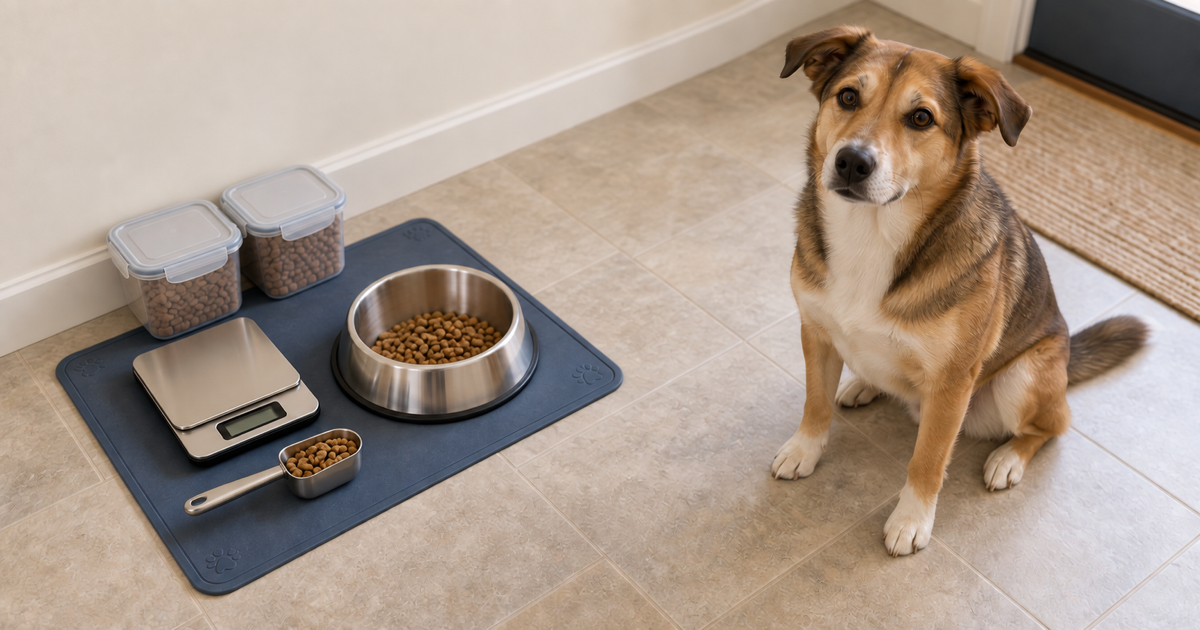
Reliable dog portion control starts before food reaches the bowl. Establish one daily calorie target with your veterinarian, convert that target into grams, cans or pouches using the current food label, and include treats, chews and training rewards in the same total. Then divide the ration into meals that fit the dog's age, health and household routine.
A bowl is for serving, not measuring. A scoop is convenient, but its result depends on shape, fill level and kibble density. A digital gram scale is usually the clearest way to repeat a dry-food portion. Whichever tools you use, the system should make overfeeding visible, allow every caregiver to follow the same plan and reveal unexpected changes in appetite or weight.
Dog Portion Control Begins With Three Numbers
Write down three values before choosing a bowl or scoop:
1. Daily calorie target: set for this dog, not for an average dog of similar weight.
2. Food energy density: stated on the exact recipe's label in kcal per kilogram, cup, can, pouch or piece.
3. Calories outside meals: treats, dental chews, toppers, table food and food used in training.
The American Animal Hospital Association's nutrition and weight management guidelines recommend an individualized assessment that includes body weight, body condition score, muscle condition score, diet and feeding management. The WSAVA nutrition toolkit provides calorie and body-condition resources, but its ranges are starting points. Puppies, working dogs, seniors, neutered dogs and dogs with disease can have very different needs.
The feeding chart on a package is also a starting point. AAFCO's pet-food label guidance explains that feeding directions may need modification for an individual pet and that calorie content is expressed per kilogram and a familiar unit. Use the label for the bag or can currently being fed; a reformulation can change calories even when the product name looks familiar.
Convert Calories Into an Actual Portion
Use the unit that can be measured consistently:
- Dry food: grams per day = daily food calories ÷ kcal per gram.
- If the label gives kcal/kg: kcal per gram = kcal/kg ÷ 1,000.
- Canned food: cans per day = daily food calories ÷ kcal per can.
- Mixed feeding: subtract wet-food, treat and chew calories before calculating the dry portion.
Example: if a veterinarian assigns 600 kcal per day and 60 kcal are reserved for rewards, complete meals must supply 540 kcal. If the dry food provides 3.6 kcal per gram, the daily dry-food amount is 150 g. This arithmetic demonstrates the method only; it is not a calorie recommendation for a particular dog.
Do not assume one cup of every kibble has the same weight or energy.
Why a Gram Scale Usually Beats a Scoop
A 2019 *Veterinary Record* study indexed by PubMed asked 100 dog owners in Canada to measure quarter-, half- and one-cup dry-food portions with one of three common devices. Relative errors ranged from about 48% below to 152% above the target, and smaller volumes were generally harder to measure accurately. This single study used one dry food and a controlled task, so it cannot predict every owner's error; it does show why an uncalibrated scoop is weak evidence of a consistent portion.
Use a scale in four steps:
1. Place the empty bowl on the scale.
2. Press tare so the display returns to zero.
3. Add food until the prescribed gram amount is reached.
4. Remove leftovers before weighing a clean bowl at the next meal.
Choose a level scale that reads in grams and keeps its display visible. Check and clean it according to the manufacturer's instructions.
If You Use a Scoop, Calibrate It
A dedicated scoop can support consistency when a scale is temporarily unavailable, but “one scoop” is not a unit until it is defined. Fill it the same way each time—level, not heaped—and weigh that level scoop several times. Record the average grams for that food and mark the intended fill line.
Recalibrate when the recipe, kibble shape or bag changes. Do not use the serving bowl as a scoop: the fill level varies, and dipping it into stored food can transfer moisture and residue. The U.S. Food and Drug Administration's pet-food handling advice specifically recommends a clean, dedicated measuring utensil and washing bowls and utensils with soap and hot water after use.
| Tool | Best role | Common failure |
|---|---|---|
| Digital gram scale | Repeating dry-food portions | Forgetting to tare the bowl |
| Calibrated level scoop | Quick backup after weighing | Heaping or switching foods without recalibration |
| Bowl | Serving and observing intake | Treating bowl capacity as a portion |
| Daily ration container | Preventing duplicate meals | Refilling it before the day is complete |
| Treat pouch | Tracking training rewards | Adding rewards without reducing the daily food budget |
Choose a Bowl That Makes the Portion Visible
An oversized or deep bowl can make a correct portion look small and encourage unplanned top-ups. Choose a stable bowl with enough capacity for the meal but no need to mound the food. Smooth stainless steel or properly finished ceramic is easy to inspect when intact; replace any bowl with chips, cracks, sharp edges or residue-trapping damage.
Match the bowl to the dog's muzzle, mobility and food format. A senior with discomfort may need an individualized height or placement recommendation. Elevated bowls are not a universal improvement, particularly for dogs at risk of gastric dilatation-volvulus (GDV), so discuss the setup with a veterinarian.
For a fuller fit comparison, see choosing dog bowls for puppies, adults and seniors.
Build a Household Feeding Habit That Prevents Extras
Weigh the entire daily ration in the morning and place it in one clean, closed container. Every meal, training piece and food-puzzle portion comes from that container. When it is empty, the day's measured dry-food allowance is complete. Keep treats and chews on a separate written budget.
Use a simple handoff rule when more than one person feeds the dog:
- move a meal token or mark a checklist immediately after feeding;
- never top up an apparently small bowl without checking the plan;
- record appetite, leftovers, vomiting or diarrhea; and
- keep the veterinary portion instruction where every caregiver can see it.
Scheduled meals make intake easier to observe than repeatedly filling a communal bowl. Meal frequency still depends on the dog. Puppies usually require more frequent meals than adults, while medication or disease may dictate timing. Transition gradually from free feeding so the dog's intake does not change abruptly.
Count Treats, Chews and Training Food
Portion drift often happens outside the bowl. Write down the calorie value and daily number of dental chews, biscuits, stuffed toys and table-food pieces. When the label gives calories per piece, multiply by the pieces actually offered. For products without useful calorie information, ask the manufacturer or veterinarian rather than guessing.
Use part of the complete daily kibble ration for training when appropriate. Break rewards into smaller pieces, but remember that cutting a treat changes the piece size, not the calories in the original treat. Family members should draw from one shared allowance.
Food puzzles and slow feeders can change eating speed or add activity, but they do not reduce calories by themselves. Select difficulty and shape for the individual dog, supervise introduction and stop if the device causes frustration, injury or food refusal. Review the ShineePets guide to slow feeder bowl benefits and risks before choosing one.
Separate Dogs Before Serving Portions
In a multi-dog home, one dog's measured portion can become another dog's extra meal. Feed separately, pick up leftovers before releasing the dogs and prevent access to special diets or medication hidden in food. A shared bowl cannot show who ate what.
Use the same scale but separate clean bowls and written portions for each dog. For room layout, pacing and resource-guarding precautions, follow multi-dog feeding safety.
Match Meal Size to Medical and Activity Risk
Large, deep-chested dogs and dogs with a family history of GDV need a veterinarian-led prevention plan. The Merck Veterinary Manual describes GDV as an acute, life-threatening condition and notes that guidance for higher-risk dogs may include multiple smaller meals, exercise restriction around meals, lower mealtime stress and avoiding elevated bowls.
Repeated unproductive retching, a suddenly enlarged abdomen, heavy drooling, restlessness, weakness or breathing difficulty after eating requires immediate emergency veterinary care. Do not wait to see whether the signs pass.
Dogs with diabetes, kidney disease, pancreatitis, gastrointestinal disease, food allergies or a prescribed weight-loss plan also need individualized food, amount and timing. Do not sharply cut portions to accelerate weight loss or change a therapeutic diet without veterinary direction.
Review the Result, Not Just the Recipe
Record body weight on the same suitable scale at the interval your veterinary team recommends. Check body condition and muscle condition, energy, stool quality, coat, appetite and performance. Growing puppies need more frequent reassessment because both body size and energy needs change.
If weight trends unexpectedly, confirm the food's energy density, scale tare, treat budget and household handoff. Then ask the veterinary team whether to adjust the target.
Contact a veterinarian promptly for persistent appetite change, unexplained weight loss or gain, difficulty chewing or swallowing, repeated vomiting or diarrhea, increased thirst or urination, marked lethargy, or pain around meals.
This guide supports routine portion measurement for generally healthy dogs. It does not replace an individualized veterinary nutrition plan, diagnosis or treatment.
Final Dog Portion Control Checklist
- Confirm the daily calorie target with the veterinary team.
- Read calories from the exact food and recipe label.
- Subtract treats, chews, toppers and training food.
- Convert the remaining calories into grams or packages.
- Use a tared gram scale; calibrate any backup scoop.
- Serve in an intact, stable, washable bowl.
- Pre-portion the day and use a household handoff rule.
- Separate dogs so each receives only its own food.
- Monitor body weight, condition, appetite and leftovers.
- Recalculate after any food, health, growth or activity change.
Good portion control is not about making every bowl look full. It is a repeatable measurement system that connects the veterinarian's target, the food label, the household routine and the dog's changing condition.
Sources and Further Reading
- 2021 Nutrition and Weight Management Guidelines — American Animal Hospital Association
- Global Nutrition Guidelines — World Small Animal Veterinary Association
- Reading Pet Food Labels — Association of American Feed Control Officials
- Dog Owners' Accuracy Measuring Dry Food — PubMed
- Tips for Safe Handling of Pet Food and Treats — U.S. Food and Drug Administration
- Gastric Dilatation and Volvulus in Small Animals — Merck Veterinary Manual
Frequently Asked Questions
Is it better to weigh dog food or use a measuring cup?
A digital gram scale is generally more repeatable for dry food. If you use a cup or scoop, weigh and record a level portion for the exact food and recalibrate when the recipe or kibble changes.
Should I measure my dog's food before or after adding water?
Measure the food in the form used by its calorie statement, usually before adding water. Added plain water changes weight and volume but does not add food calories.
How do I count treats in my dog's daily portion?
Record the calories per treat or chew, multiply by the number offered, and subtract those calories from the veterinarian-approved daily total. Use part of the measured meal ration for training when appropriate.
Can I use the dog bowl as a food scoop?
No. Bowl fill levels are inconsistent, and dipping a used bowl into stored food can transfer moisture or residue. Use a clean dedicated scoop or a tared gram scale.
How often should I change my dog's portion?
Reassess after changes in food, growth, body condition, activity or health. Confirm unexpected weight trends with the veterinary team before making a large adjustment.
Sources and References
- 2021 Nutrition and Weight Management Guidelines — American Animal Hospital Association
- Global Nutrition Guidelines — World Small Animal Veterinary Association
- Reading Pet Food Labels — Association of American Feed Control Officials
- Dog Owners' Accuracy Measuring Dry Food — PubMed
- Tips for Safe Handling of Pet Food and Treats — U.S. Food and Drug Administration
- Gastric Dilatation and Volvulus in Small Animals — Merck Veterinary Manual
About this article
ShineePets publishes practical, source-checked guidance for pet owners and pet-product professionals.
ShineePets is a commercial B2B pet-supply sourcing brand. Read our editorial standards and commercial disclosure.