Dog Care
Dog Waste Bag Guide: Strength, Size and Sustainability
Quick answer
Choose dog waste bags by finished-bag strength, usable dimensions, dispenser fit and verified sustainability claims—not vague labels.
By ShineePets Editorial Team · Published · Updated
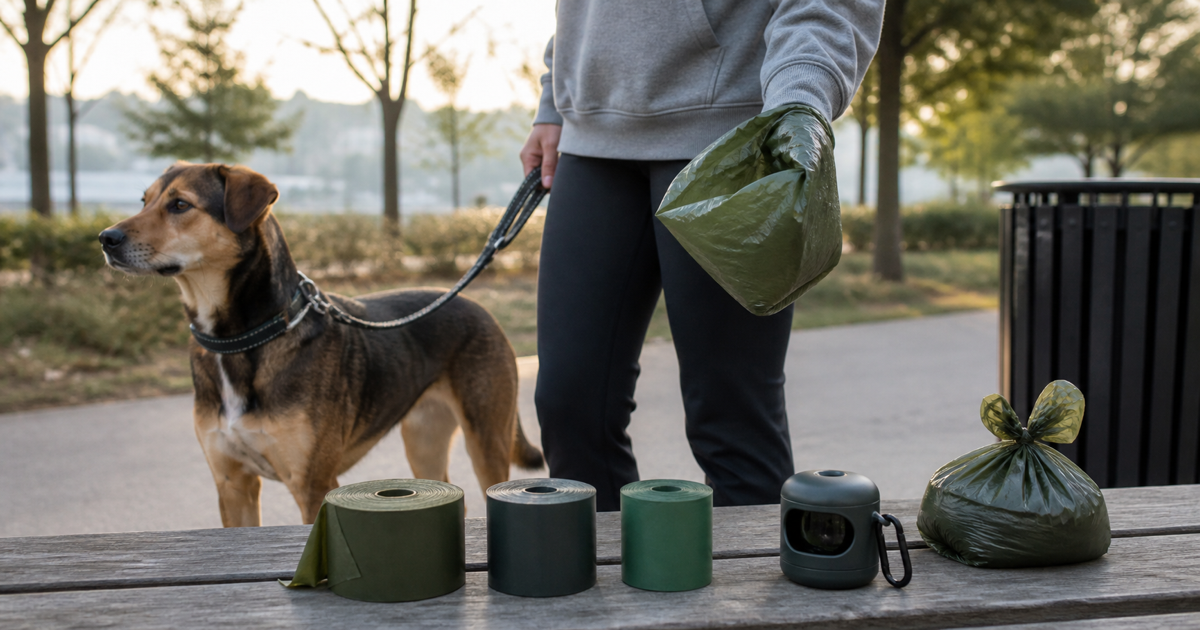
A useful dog waste bag should be large enough to cover the hand, collect the expected waste and leave room for a secure knot. It should also resist puncture, tearing and bottom-seal failure without becoming unnecessarily thick. Sustainability comes after reliable containment: compare verified recycled, biobased or compostable claims with the disposal system actually available where you walk.
This dog waste bag guide explains how to judge strength, size and environmental claims without relying on vague words such as “heavy duty” or “eco-friendly.”
Dog Waste Bag Guide: Quick Comparison
| Decision | What to check | Why it matters |
|---|---|---|
| Strength | Film consistency, puncture resistance, tear behavior and bottom seal | A thick-looking bag can still split at a weak seam or perforation |
| Size | Lay-flat width, usable length and knot allowance | Dog size labels do not reveal the actual opening or tie space |
| Usability | Opening, separation, opacity, hand feel and dispenser fit | A bag that is difficult to open or tear off is more likely to be wasted |
| Sustainability | Exact material claim, percentage, certification scope and accepted disposal route | Biobased, biodegradable and compostable describe different things |
| Hygiene | Secure closure, prompt disposal and handwashing | The bag is a handling barrier, not a substitute for clean hands |
Strength Is More Than Film Thickness
Thickness does not describe the whole bag. Film formulation, variation, perforation and seal design also affect performance. ASTM D1709 measures film impact resistance under defined dart-drop conditions and cautions that impact does not have a simple relationship with thickness. Review ASTM D1709.
For everyday use, examine four separate failure points:
1. Puncture resistance: The film should tolerate contact with grass stems, grit and a fingernail without creating a pinhole.
2. Tear propagation: A small nick at the roll perforation should not run down the bag when it is opened.
3. Bottom-seal integrity: The sealed edge should remain continuous when the bag is lifted, turned and tied.
4. Knot-zone strength: The top should have enough material and stretch to close without tearing under normal hand force.
“Leakproof” should refer to the finished bag, not merely the film. Reject fused openings, incomplete seals, holes, brittle film or bags that separate below the perforation.
Run a Clean At-Home Strength Check
Test a new product before taking only one bag on a long walk. Use clean materials over a sink or washable surface:
- Pull bags from different positions in the roll and check for visible thin spots or seal gaps.
- Separate each bag at the perforation using normal hand force; the next bag should remain intact.
- Open the bag fully and inspect the corners and bottom seal against light.
- Add damp, crumpled paper roughly matching the bulk you expect to collect.
- Turn the bag right-side out around the clean contents, lift it, tie it and hold it briefly.
- Apply light pressure around the contents and check for splits, holes or moisture transfer.
This usability screen is not laboratory certification. If a roll fails, test another and contact the seller with the lot code. Never squeeze or reopen a used bag.
Choose the Right Width and Length
Ignore size names until you find dimensions. A bag needs enough width to open over the hand and enough length to collect, invert, gather and tie.
When comparing dimensions:
- Measure width while the bag lies flat; gussets may create extra capacity only after opening.
- Check whether the stated length includes the sealed edge and tie handles.
- Reserve a generous clean section above the contents for twisting and knotting.
- Allow more space for large dogs, multiple pickups on one outing or bulky soft stool.
- Consider glove use in cold weather, limited hand mobility and long fingernails.
Choose the smallest size that still gives reliable hand coverage, collection space and closure allowance.
Flat-top bags versus handles
Flat-top bags use the upper film for a knot and usually fit compact dispensers. Handles may simplify tying but can reduce the opening or add material. Check usable internal area.
Check Roll and Dispenser Compatibility
A refill bag is only convenient when the roll rotates and dispenses correctly. Compare:
- roll width and outside diameter;
- core diameter or coreless design;
- bags per roll;
- perforation direction;
- dispenser slot size and closure;
- whether the first and last bags can be used without damage.
Load one roll, pull several bags through the slot and confirm that the perforation appears outside the case. Avoid a compressed roll or loose dispenser.
Carry a spare separately. The ShineePets dog travel gear guide also includes waste bags in a practical cleanup kit.
Opacity, Scent and Opening Experience
Opacity is useful, but dark film can hide holes. Hold a clean bag against light; it should unfold without excessive static and open easily by touch.
Fragrance does not improve containment. Stop using a pack that smells sharply chemical, feels oily or has changed texture, and contact the seller.
Understand the Main Material Claims
The word *plastic* does not identify feedstock or end-of-life behavior. Common options include:
| Claim or material | What it may mean | What it does not prove |
|---|---|---|
| Conventional polyethylene | Fossil-based flexible film engineered for thin, strong bags | Compostability or recycled content |
| Recycled-content polyethylene | Some or all resin came from recovered material | That the used bag is recyclable after containing waste |
| Biobased or plant-based plastic | Some carbon feedstock came from biological resources | Biodegradability, compostability or a specific percentage |
| Certified compostable material | The finished product met a named test or certification for stated conditions | Acceptance with dog waste in the local organics program |
| “Biodegradable” | A degradation claim that should specify conditions and evidence | Rapid breakdown in a landfill, on a trail or in the ocean |
The European Commission explains that biobased plastics are not necessarily biodegradable or compostable, while compostable plastics normally require collection and controlled industrial conditions. Read the EU policy framework. Never leave a bag outdoors because it carries a degradation claim; responsible disposal remains necessary.
Read Sustainability Claims Precisely
Broad words such as “green,” “earth friendly” and “eco” do not tell a buyer what changed. Prefer specific, measurable statements:
- the percentage and type of recycled or biobased content;
- whether the percentage applies to the bag, the roll core or only the carton;
- the name and scope of a compostability certification;
- industrial versus home-composting conditions;
- a comparison baseline for “less plastic” or “reduced material” claims;
- current disposal instructions for the markets where the product is sold.
The U.S. Federal Trade Commission says compostable claims need reliable evidence and should be qualified when safe home composting or suitable facilities are not broadly available. It also warns that unqualified degradable claims are inappropriate for items that will not completely break down within a reasonably short time after customary disposal. Review the FTC Green Guides summary. Requirements differ by market, so consumers and commercial buyers should check current local rules rather than applying one country's terminology globally.
Material reduction matters only when containment remains reliable. A bag that routinely needs doubling may use more material in practice.
Dispose of Dog Waste Correctly
Dog waste can carry germs. The U.S. Centers for Disease Control and Prevention advises always picking it up, disposing of it properly and washing hands after contact even when a bag was used. Read the CDC guidance for dog owners.
Use this order of decisions:
1. Pick up the waste promptly without touching it directly.
2. Turn the bag over the waste, gather the top and tie it securely.
3. Follow the park, municipality or waste hauler's instructions.
4. Use a designated dog-waste or general-waste bin when that is the stated route.
5. Wash hands with soap and running water as soon as practical.
Do not place a used bag in recycling. Do not put it in a food-scrap or garden-waste stream unless that specific program explicitly accepts both dog waste and the certified bag. “Compostable” on the bag describes material performance under stated conditions; it does not guarantee local collection acceptance.
Keep unused rolls away from dogs and children. Thin bags and roll cores are not toys, and damaged bags should be discarded before a walk.
What Retail-Quality Packaging Should Tell You
A useful package should state:
- individual bag dimensions and bag count;
- roll count and dispenser compatibility;
- material composition or a clear, qualified material claim;
- storage and disposal instructions;
- manufacturer or responsible distributor contact;
- lot, batch or production traceability;
- certification owner, standard and scope when a logo is used.
Compare the complete label, not just a leaf graphic. The ShineePets guide to pet product packaging labels provides a broader checklist for identity, claims, directions and traceability.
Common Buying Mistakes
- Choosing by bag color instead of dimensions and closure room.
- Assuming thicker film guarantees a stronger bottom seal.
- Buying the largest roll without checking dispenser fit.
- Treating “plant based” as proof of compostability.
- Paying for a certification logo without checking what product and conditions it covers.
- Expecting a compostable bag to be accepted in every organics program.
- Selecting the thinnest bag, then routinely using two.
- Ignoring opening difficulty, fused edges and poor perforations.
- Leaving home with exactly one bag.
For retailers and brand owners, finished-bag testing should cover film impact, puncture and tear behavior, seal consistency, perforation, dimensions, roll unwind and aged samples—not only resin data. The ShineePets article on pet product durability testing explains how to connect a test method to real use and acceptance criteria.
Dog Waste Bag Guide: Final Checklist
Before buying a larger pack, confirm that:
- the bag covers the user's hand and leaves enough clean material for a knot;
- width, length and count are stated rather than hidden behind size names;
- samples separate cleanly at the perforation and open with one hand;
- the film, corners and bottom seal pass a consistent clean-use check;
- opacity and scent suit the household;
- the roll fits and turns inside the intended dispenser;
- material claims specify content, conditions and certification scope;
- the local disposal route accepts the bag and its contents;
- a spare bag can be carried on every walk;
- hands are washed after handling dog waste, even when containment works.
The strongest choice is not necessarily the thickest, and the most sustainable-looking package is not necessarily the lowest-impact option. Start with dependable containment and correct sizing, then choose the most credible material claim that matches the real disposal system.
*This article provides general product-selection and hygiene information. Follow local waste rules and seek professional medical or veterinary advice for health concerns.*
Sources and Further Reading
- Dogs: Healthy Pets, Healthy People — U.S. Centers for Disease Control and Prevention
- Environmental Claims: Summary of the Green Guides — U.S. Federal Trade Commission
- Biobased, Biodegradable and Compostable Plastics — European Commission
- ASTM D1709: Impact Resistance of Plastic Film — ASTM International
Frequently Asked Questions
How large should a dog waste bag be?
Choose a bag wide enough to open over your hand and long enough to collect the expected waste, invert, gather and tie while leaving a clean handling zone. Compare actual dimensions rather than dog-size labels.
Are thicker dog waste bags always stronger?
No. Thickness is only one variable. Film consistency, puncture and tear resistance, perforation quality and the bottom seal also determine whether the finished bag contains waste reliably.
Are plant-based dog waste bags compostable?
Not automatically. Biobased describes feedstock, while compostable describes performance under specified conditions. Look for a named certification and verify that the local program accepts dog waste and that bag.
Can used dog waste bags go in recycling?
No. Waste-contaminated flexible bags do not belong in ordinary recycling. Follow local dog-waste or general-waste instructions unless a specific collection program says otherwise.
Why do dog waste bags tear at the perforation?
The perforation may be too aggressive, uneven or poorly aligned, or the user may be pulling against a tight dispenser. Test roll fit and separate at the marked line without stretching the next bag.
About this article
ShineePets publishes practical, source-checked guidance for pet owners and pet-product professionals.
ShineePets is a commercial B2B pet-supply sourcing brand. Read our editorial standards and commercial disclosure.