Fish Care
Freshwater Aquarium Substrates: Gravel, Sand and Soil
Quick answer
Compare gravel, sand and aquarium soil by fish behavior, plant needs, water chemistry, filtration and realistic maintenance.
By ShineePets Editorial Team · Published · Updated
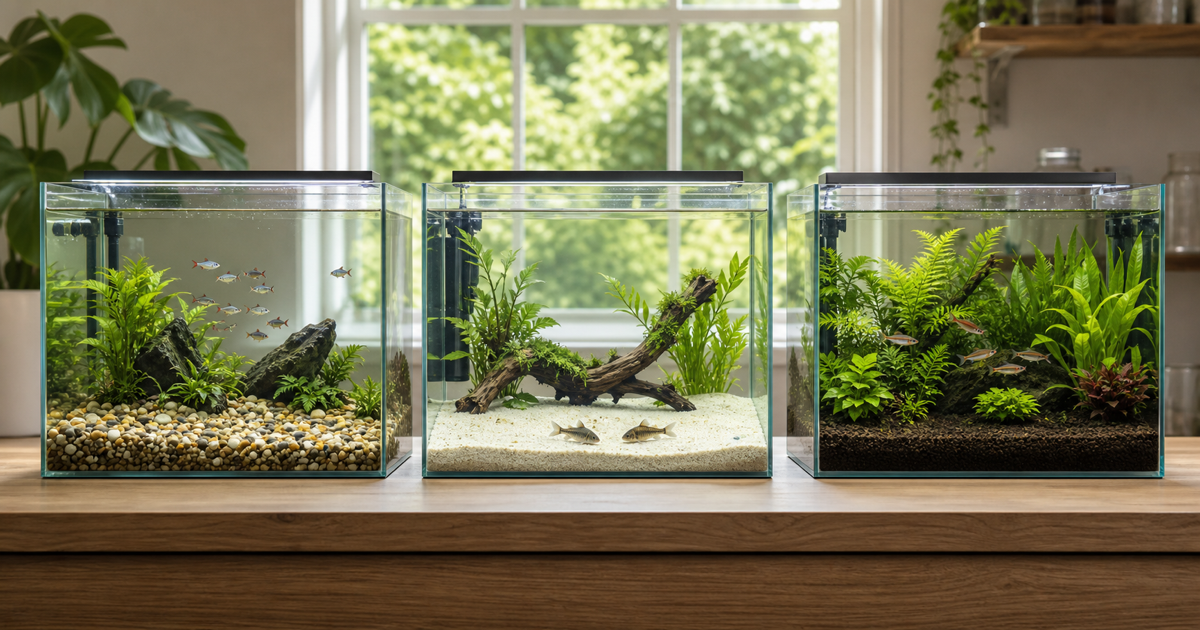
Choose freshwater aquarium substrates by livestock first, plants second and maintenance third. Rounded inert gravel is versatile and can be vacuumed between the grains. Fine aquarium sand supports natural sifting and foraging for suitable bottom-dwelling fish, but debris usually stays on its surface. Active aquarium soil can support rooted plants and alter water chemistry, so it requires product-specific setup and monitoring. None of these materials replaces fishless cycling, filtration or water testing.
This guide compares gravel, sand and soil so you can match the substrate to the animals, planting plan and water conditions in a freshwater aquarium.
Freshwater Aquarium Substrates at a Glance
| Substrate | Strongest fit | Main advantage | Main trade-off |
|---|---|---|---|
| Rounded inert gravel | General community tanks and adaptable planted tanks | Stays in place and accepts deeper gravel-vacuum cleaning | Waste can settle between larger grains |
| Fine aquarium sand | Sifting or bottom-foraging species and natural-looking layouts | Smooth, compact surface supports species-appropriate behavior | Fine grains can enter a filter intake and need gentle surface cleaning |
| Active aquarium soil | Rooted planted tanks designed around softer, more acidic water | Granules support roots and some formulas supply nutrients | Product may change pH or KH and require intensive startup care |
The best choice is the material that is safe for the species and predictable in your water—not the substrate that looks most advanced.
Start With Fish and Invertebrates
Before choosing color or grain size, research how every planned species feeds, rests, digs and reproduces. A peer-reviewed aquarium-welfare review notes that substrate should be safe, nontoxic and free of pathogens, and that species preferences matter. It specifically reports that Corydoras prefer sand over larger gravel because sand facilitates normal foraging. Read the fish-welfare review.
Ask whether each species sifts, buries, excavates or rests on the bottom; whether sharp grains could damage skin or barbels; and whether an acidifying soil would oppose its required water chemistry.
Avoid garden soil, potting mix, builders' sand, painted decorative stones and collected material of unknown composition. “Natural” does not prove that a material is aquarium-safe or chemically inert.
One controlled study found that goldfish spent longer foraging over coarse sand and preferred smaller particles under its test conditions. Review the goldfish study. Do not generalize one species study to every aquarium fish.
Gravel: Flexible and Easy to Deep-Clean
Aquarium gravel is usually the most forgiving choice when it is smooth, appropriately sized and chemically inert. It anchors décor, permits water movement between grains and is less likely than fine sand to be pulled into a filter intake.
Grain size still matters. Merck Veterinary Manual advises rinsing gravel to remove dust that can clog filters or damage pumps, and notes that substrate size should suit the fish: some fish sift fine gravel, while others can get gravel stuck in the mouth or swallow it. See Merck's fish-home guidance.
Choose rounded grains rather than sharp chips. Carbonate-rich stone can increase hardness and alkalinity, so verify the specification and test pH, KH and GH after setup.
Gravel does not automatically feed plants. Epiphytes such as Anubias and Java fern attach to wood or rock, while heavy root feeders may need a compatible buried fertilizer. Follow the plant and fertilizer instructions, especially in tanks with shrimp or sensitive livestock.
Sand: A Different Cleaning Pattern
Aquarium sand creates a smooth surface and allows suitable fish to sift, nose through or rest on the bottom. Because food and waste tend to remain visible on top, maintenance is less about plunging a siphon deeply and more about removing debris without removing the sand.
During cleaning, hover the siphon above the surface so the flow lifts light debris. Control the hose if sand rises, and keep the filter intake high enough that fish activity cannot continually pull in grains.
Do not assume sand is maintenance-free or inherently dangerous. Problems depend on depth, grain shape, animal activity, planting, water circulation and organic load. Avoid allowing uneaten food and waste to accumulate. If the surface forms a hard crust, develops persistent foul odors or releases dark debris during disturbance, stop major digging, check water quality and correct the maintenance problem gradually.
Aquarium Soil: For Planted Tanks With a Water Plan
In aquascaping, “aquarium soil” usually means manufactured porous granules—not loose garden soil. Many active products are designed for rooted plants and can lower pH or carbonate hardness. Formulas differ, and nutrient release may also differ, so an active soil must be selected alongside the tank's target water parameters.
Tropica states that its Aquarium Soil lowers pH and slightly affects water chemistry. Its instructions recommend changing 25–50% of the water at least twice weekly during the first four weeks. The same page gives a quantity formula based on tank footprint and layer depth. Read the product-specific instructions. Those directions apply to that product; another soil may require a different rinsing rule, cycling period or water-change schedule.
Check whether the product is active or inert, its expected pH/KH and nutrient effects, rinsing rule, recommended depth, startup schedule, livestock compatibility and replacement guidance.
Active soil is a poor automatic choice for fish that need reliably hard, alkaline water. Its buffering effect may also weaken with use. Treat water-test results—not the substrate's age or appearance—as the evidence for current conditions.
Match the Substrate to the Tank
| Tank plan | Practical starting point | Important check |
|---|---|---|
| Low-tech community tank with hardy plants | Rounded inert gravel or aquarium sand | Fish behavior, grain safety and plant feeding method |
| Corydoras-focused community | Fine, smooth aquarium sand | Species needs, clean surface and protected filter intake |
| Dense rooted aquascape | Active soil or inert substrate with a planned fertilizer system | Target pH/KH, startup instructions and livestock timing |
| Hard-water species tank | Verified inert sand or gravel | Confirm that décor and substrate support—not oppose—the target hardness |
| Shrimp aquarium | Inert or active substrate chosen for the exact shrimp species | Stable parameters matter more than a generic “shrimp soil” label |
| Quarantine or hospital tank | Often bare-bottom for observation and cleaning | Follow veterinary guidance and provide appropriate shelter |
Calculate Depth and Quantity Without Guessing
Start with volume rather than bag weight because substrate density varies. For a level bed:
Liters needed = tank length (cm) × tank width (cm) × average depth (cm) ÷ 1,000
A 60 × 30 cm footprint with an average 5 cm bed requires about 9 liters before allowing for hardscape displacement. A slope can be estimated using the average of the front and rear depths. Then use the manufacturer's coverage chart and allow a small margin for settling.
There is no universal ideal depth. Rooted plants need anchoring room, while deeper beds change cleaning and circulation. Follow the substrate system and tank plan rather than copying a photograph.
Install a New Substrate Safely
Use this sequence for a new aquarium:
1. Secure the hardscape so it cannot shift when animals dig.
2. Rinse inert gravel or sand unless the manufacturer says otherwise; do not rinse active soil when its instructions prohibit it.
3. Add the measured substrate, then fill slowly over a plate to limit disturbance.
4. Start the filter, heater and other life-support equipment.
5. Cycle without fish and test until the biological filter is established.
6. Confirm temperature, pH and hardness before adding compatible livestock gradually.
RSPCA Australia explains that a new biological filter does not yet contain enough beneficial bacteria to process fish waste and that cycling takes time. It also recommends regular water-quality testing, partial water changes and substrate cleaning without soap or detergents. Read the aquarium water-quality guidance. Clear water alone does not prove that ammonia and nitrite are safe.
Clean Gravel, Sand and Soil Differently
| Material | Routine method | Avoid |
|---|---|---|
| Gravel | Siphon selected sections into the grain so trapped debris rises | Deep-cleaning the entire bed and filter on the same day |
| Sand | Hover the siphon above the surface and remove visible debris | Stirring the whole bed aggressively or pulling sand into the filter |
| Active soil | Remove surface debris gently and follow product instructions | Crushing granules, deep plunging or repeatedly uprooting the layout |
Clean only with aquarium-dedicated tools. Never use household soap or detergent. Match water-change frequency to measured water quality, stocking, feeding and the manufacturer's startup directions rather than to a fixed internet rule.
Switching Substrates in an Established Aquarium
A full substrate change can release trapped debris, cloud the water and remove some colonized surfaces. Plan it as a life-support task, not a cosmetic afternoon project.
- Prepare dechlorinated, temperature-matched water and a safe aerated container if fish must be moved.
- Keep established filter media wet in aquarium water and running whenever possible.
- Do not replace all filter media or deep-clean the filter during the same change.
- Remove plants and hardscape carefully, then siphon debris before lifting the old substrate.
- Rebuild securely, refill slowly and restart heat and filtration promptly.
- Test ammonia and nitrite afterward and base water changes on results.
If fish gasp, lose balance, clamp fins or show sudden distress, test water immediately and seek advice from an aquatic veterinarian or experienced qualified fish-health professional. Do not add medication simply because the substrate changed.
Common Substrate Mistakes
- Choosing color before checking species behavior.
- Using sharp, painted or unknown material.
- Assuming every aquarium soil has the same chemistry.
- Adding fish before cycling is complete.
- Making the bed deeper without adapting cleaning and flow.
- Burying plant rhizomes that should remain exposed.
- Letting sand enter the filter intake.
- Deep-cleaning all substrate and filter media together.
- Changing substrate without monitoring ammonia and nitrite.
- Treating clear water as proof of safe water.
For broader context on how tank size, life-support equipment and welfare affect modern fish keeping, read the ShineePets analysis of the micro-aquascaping and pet fish market.
Freshwater Aquarium Substrates: Final Checklist
Before buying gravel, sand or soil, confirm:
- the material and grain size support the normal behavior of every planned species;
- edges are smooth and the product is sold for aquarium use;
- any effect on pH, KH, GH or nutrients matches the water plan;
- rooted plants have an appropriate substrate and fertilization method;
- the filter intake and flow suit the grain size;
- depth and quantity were calculated from the tank footprint;
- rinsing, installation and startup instructions are understood;
- the aquarium will be cycled and tested before livestock are introduced;
- the cleaning method is realistic for the keeper's routine;
- a substrate change can be completed without drying established filter media.
Gravel, sand and soil can all support healthy freshwater aquariums when they are matched to the animals and managed correctly. Make the decision from the bottom up: behavior, water chemistry, plants, filtration and maintenance—then appearance.
*This article provides general aquarium-care information and cannot replace diagnosis or treatment by a qualified aquatic veterinarian.*
Sources and Further Reading
- Providing a Home for Fish — Merck Veterinary Manual
- Why Is Water Quality Important When Setting Up a Fish Aquarium? — RSPCA Australia
- Fish Welfare in Public Aquariums and Zoological Collections — Animals
- Goldfish in a Tank: The Effect of Substrate on Foraging Behaviour — Animal Welfare
- Aquarium Soil — Tropica Aquarium Plants
Frequently Asked Questions
Which is better for a freshwater aquarium, gravel or sand?
Neither is universally better. Rounded gravel is easy to deep-vacuum and stays away from most filter intakes; smooth sand better supports sifting species. Choose by fish behavior, planting plan and maintenance method.
Can aquarium plants grow in gravel or sand?
Yes. Some plants feed mainly from the water column, while rooted species may need a compatible buried fertilizer. Do not bury the rhizomes of plants such as Anubias or Java fern.
Should aquarium soil be rinsed before use?
Follow the exact product instructions. Many active soil granules should not be rinsed because washing can damage them or remove intended components, while inert gravel and sand are commonly rinsed to remove dust.
How deep should freshwater aquarium substrate be?
There is no single depth for every tank. Use a shallow layer for simple décor and greater depth where rooted plants need anchoring, while accounting for grain type, animal behavior and cleaning access.
Can I change aquarium substrate without restarting the cycle?
Much of the biological filter may remain in established filter media if it stays wet and operational, but a major substrate change can still disturb debris and bacteria. Preserve the filter, avoid simultaneous deep cleaning, and monitor ammonia and nitrite closely.
About this article
ShineePets publishes practical, source-checked guidance for pet owners and pet-product professionals.
ShineePets is a commercial B2B pet-supply sourcing brand. Read our editorial standards and commercial disclosure.