Product Sourcing
Heated Pet Beds: Safety Features Buyers Should Check
Quick answer
Evaluate heated pet beds by electrical evidence, overheat protection, cord design, temperature control, cleaning limits and batch traceability.
By ShineePets Editorial Team · Published
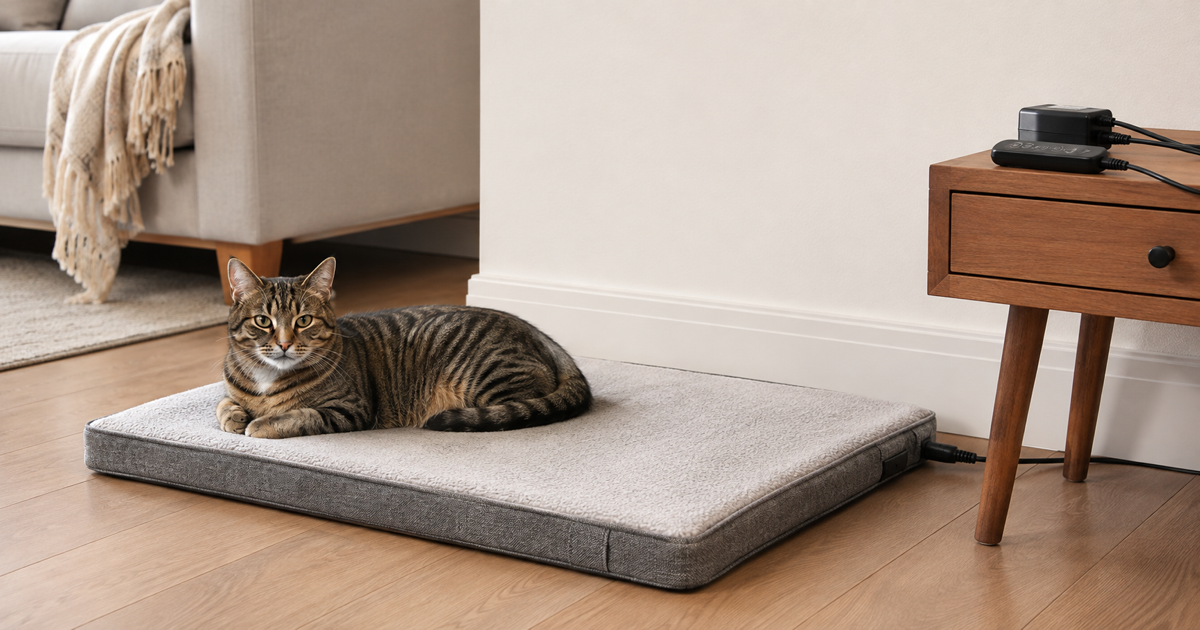
A heated pet bed should be evaluated as an electrical appliance, not simply as a soft bed with a warmer surface. Buyers should confirm the exact model's market-appropriate electrical assessment, independent over-temperature protection, protected wiring, usable instructions, washable-part boundaries and batch traceability. They should also test whether the pet can leave the heated area easily and whether surface temperatures remain controlled under foreseeable misuse.
A low-voltage label, chew-resistant cord or automatic shutoff describes one design element; it does not prove that the complete product is safe. Connect every claim to a document, every document to the exact model and every critical feature to a repeatable test.
Why Heated Pet Beds Need a Separate Buying Process
Ordinary pet-bed checks still matter, but heating introduces documented burn, fire and electric-shock hazards. A 2012 U.S. Consumer Product Safety Commission recall of indoor pet heating mats cited poor wiring and construction, two fire reports and one dog's death. A 2024 UK Office for Product Safety and Standards pet heating pad report identified inadequate insulation, possible live accessible metal parts, overheating and deficiencies in marking, labelling and documentation.
These cases show why buyers must assess the whole system: bed, heater, controller, cord, power supply, cover and instructions.
Start With the Intended Pet and Use Case
Write the intended-use statement before requesting samples. It should identify:
- species and approximate weight range;
- indoor or permitted outdoor use;
- normal ambient-temperature range and whether use is continuous, timed or supervised;
- whether the animal must always be able to move off the heated area;
- expected contact with claws, chewing, urine and spills; and
- animals specifically excluded by the instructions.
A heated bed is not automatically appropriate for every pet. VCA Animal Hospitals warns that heating pads can cause burns, with elderly, arthritic or sick pets at particular risk because they may sleep deeply or struggle to rise. Its pet heating-pad guidance also emphasizes supervision and the animal's ability to get away from the heat. Buyers should therefore reject positioning that implies universal, unsupervised or therapeutic use without evidence.
Heated Pet Beds: Eight Safety Features to Verify
1. Certification tied to the exact model
Ask which safety standard and conformity route apply in each destination market. The answer may differ by voltage, product construction and intended use, so do not copy a standard from a competitor's listing. The International Electrotechnical Commission's scope for IEC 60335-2-71:2018, for example, covers certain electrical heating appliances for breeding and rearing animals; an accredited laboratory should determine whether that or another standard applies to a particular consumer pet bed.
For North American sourcing, a certification logo alone is insufficient. OSHA explains that each Nationally Recognized Testing Laboratory has a defined scope and authorizes its own mark after certification. Check the current NRTL list, verify the model or file number, and obtain evidence showing the exact model, ratings, components and standard. A report for a similar heater or adapter is not evidence for the complete product.
2. Independent over-temperature protection
The design should have normal temperature control plus separate protection if that control fails. Ask the supplier to identify the sensor, independent thermal cutoff or other protective device, its location and failure behavior. “Auto shutoff” is useful only when its trigger and reset behavior are documented.
Request abnormal-operation evidence for foreseeable conditions such as a blocked sensor, bunched surface, covered bed, elevated room temperature and failed controller. The method must come from the applicable standard and laboratory.
3. Controlled surface temperature and even heat
Ask for a surface-temperature map, not one center-point reading. The report should state ambient temperature, warm-up time, input voltage, bedding or load used, measurement locations and steady-state duration. Look for hot spots around wire turns, connectors and sensor locations.
There is no single surface temperature suitable for every animal and situation. Check the declared use, maximum under normal and abnormal conditions, and space to move away. Reject claims such as “completely safe temperature” or “cannot burn.”
4. Safer power architecture
A correctly designed external low-voltage supply can reduce the voltage at the bed, but “low voltage” is not a complete safety argument. Confirm the ratings, isolation, connector, current limit and compatibility of the power supply. The adapter, controller and bed must be evaluated as sold.
Check that plugs, voltage and frequency match the destination market. Do not approve improvised travel adapters or an instruction that depends on a third-party power supply the certification did not cover.
5. Cord protection and strain relief
“Chew-resistant” should describe a tested construction, not promise that no animal can damage it. Inspect the cable jacket, protective sleeve, bend radius, connector retention and strain relief where the cord enters the bed. The cord should route away from the sleeping surface and remain accessible for human inspection.
The U.S. Fire Administration advises replacing appliances with cracked, damaged or loose cords and avoiding cords where they may be pinched or damaged. Its electrical appliance guidance supports a simple consumer rule: stop using the bed if the plug, controller, connector or cable shows damage, discoloration, unusual heat or looseness.
6. Moisture protection with a defined cleaning boundary
Pets create realistic exposure to spills, urine and damp cleaning. Ask for the claimed ingress-protection level and the test basis behind any water-resistant or waterproof language. Confirm whether the electrical insert, connector and controller are protected to the same level; they often are not.
Instructions must distinguish among a machine-washable cover, wipe-clean heated insert and parts that must never be immersed. After repeated cover-removal and wash cycles, verify fit, zipper and seam strength, and safe insert refitting.
7. A bed layout that allows heat avoidance
A pet should not be trapped on the heated surface. For many designs, heating only part of a larger bed gives the animal a cooler area, but the final layout must match the intended species, body size and instructions. Do not market the product for use in a closed carrier or confined crate unless the design and evidence specifically support that use.
The bed should lie flat and remain stable. Thick bolsters, foam layers or added blankets can change heat transfer, so the approved construction and permitted coverings must be unambiguous.
8. Traceable labels and usable warnings
The product, power supply, retail package and instructions should use consistent identifiers. At minimum, buyers need:
- manufacturer and responsible economic operator details where required;
- model, batch or serial identification;
- electrical input and output ratings;
- indoor/outdoor and moisture-use limitations;
- setup, supervision, cleaning and storage instructions;
- inspection and stop-use criteria; and
- a customer contact and recall route.
Market duties vary. UK government electrical-equipment guidance requires importers to check conformity and technical documentation, provide traceability, ensure understandable instructions and act when equipment presents a risk. One label set is not automatically sufficient worldwide.
Use a Pass, Clarify or Reject Decision Table
| Check | Pass evidence | Clarify before approval | Reject signal |
|---|---|---|---|
| Electrical conformity | Exact model, market and full system covered | Report scope or model suffix unclear | Logo only, altered adapter or unrelated certificate |
| Temperature control | Mapped temperatures and independent protection | Test conditions incomplete | Uncontrolled hot spots or no failure protection |
| Cord system | Protected route, retention and strain-relief evidence | “Chew-resistant” method undefined | Exposed joints, loose connector or easy access to cable |
| Moisture and cleaning | Claims match test evidence and instructions | Cover care is clear but insert care is vague | Whole product called washable without proof |
| Labels and traceability | Ratings, model, batch and responsible party align | Minor translation or placement correction needed | Missing identity, mismatched rating or illegal plug |
| Pet escape from heat | Size and layout provide a cooler option | Suitability depends on pet size | Product requires confinement on heat |
Do not average away a critical safety failure. A good cover, attractive price or low power rating cannot compensate for missing electrical evidence.
Sample Approval and Production Quality Control
Create a controlled golden sample after document review. Record its model, critical components, power supply, cover material and labels, then retain it for comparison.
For pre-production and shipment inspections, use a qualified laboratory or trained quality team to verify:
1. model, plug, adapter and rating-label match;
2. controller functions and shutdown behavior;
3. heating uniformity under the approved test procedure;
4. cable pull, bend and connector retention;
5. enclosure, seam, zipper and cover fit;
6. dielectric, leakage or other electrical tests required by the applicable standard;
7. instructions, warnings, batch code and carton contents; and
8. packaging protection against cable crushing, moisture and controller impact.
Set sampling plans before production. Treat safety-critical defects more strictly than cosmetic defects. Any substitution of the heater, sensor, cutoff, cable, controller, adapter or insulation should trigger engineering review and, when required, re-evaluation.
Post-Sale Monitoring Is Part of Product Safety
Keep complaints linked to model and batch. Escalate overheating, odor, melting, intermittent power, shock, burn, connector or fire reports instead of treating them as ordinary returns. Check recall databases before ordering and after launch.
At home, users should unplug and stop using a bed that becomes unusually hot, smells scorched, cycles unpredictably or shows cable damage. If a pet develops skin redness, blistering, pain or unusual distress after heat exposure, prevent further exposure and contact a veterinarian promptly. This guide supports product selection and routine safety checks; it does not replace veterinary diagnosis or market-specific product-compliance advice.
Final Buyer Checklist
- Is the complete exact model covered by credible market-specific evidence?
- Are normal control and independent over-temperature protection documented?
- Were surface temperatures mapped under normal and abnormal conditions?
- Does the pet have an easy cooler escape area?
- Are the cord, connector and adapter protected and inspectable?
- Do moisture claims match the tested construction?
- Can users remove and refit the cover without disturbing the heater?
- Are ratings, model, batch, instructions and responsible-party details consistent?
- Are safety-critical substitutions controlled during production?
- Is there a complaint, stop-sale and recall process by batch?
Buy heated pet beds on evidence, not feature names. Trace every safety claim to the exact design, production checks and clear user instructions.
Sources and Further Reading
- Heated Mats for Pets Recall — U.S. Consumer Product Safety Commission
- Pet Heating Pad Product Safety Report — UK Office for Product Safety and Standards
- Heating Pads and Pet Safety — VCA Animal Hospitals
- Current List of NRTLs — Occupational Safety and Health Administration
- IEC 60335-2-71:2018 — International Electrotechnical Commission
- Electrical Equipment Safety Regulations: Great Britain — UK Government
- Appliance and Electrical Fire Safety — U.S. Fire Administration
For retailers, distributors and pet brands
Turn this insight into a sourcing plan
Browse the ShineePets B2B catalog or discuss product selection, packaging, private-label and OEM/ODM requirements.
Explore the Wholesale Catalog Discuss OEM/ODMFrequently Asked Questions
Are low-voltage heated pet beds automatically safe?
No. Lower voltage at the bed can reduce one type of electrical exposure, but buyers still need evidence for the complete power supply, controller, heater, insulation, connector and over-temperature protection.
What certification should a heated pet bed have?
It depends on the destination market, voltage, architecture and intended use. Ask an accredited laboratory to identify the applicable standards, then verify that the certificate or report covers the exact model and complete sold system.
Can a heated pet bed be left on overnight?
Only if the product instructions explicitly permit that use and the pet can move away from the heat. Pets with limited mobility, illness or reduced sensation need veterinary guidance and closer supervision.
Can the whole heated pet bed be machine washed?
Do not assume so. Many products have a washable removable cover but an electrical insert, connector, controller or adapter that must not be immersed. Follow the exact model's instructions.
When should a heated pet bed be replaced?
Stop using it if the cord, plug, controller or connector is damaged, loose, discolored or unusually hot, or if the bed smells scorched, heats unevenly or behaves unpredictably.
Sources and References
- Heated Mats for Pets Recall — U.S. Consumer Product Safety Commission
- Pet Heating Pad Product Safety Report — UK Office for Product Safety and Standards
- Heating Pads and Pet Safety — VCA Animal Hospitals
- Current List of NRTLs — Occupational Safety and Health Administration
- IEC 60335-2-71:2018 — International Electrotechnical Commission
- Electrical Equipment Safety Regulations: Great Britain — UK Government
- Appliance and Electrical Fire Safety — U.S. Fire Administration
About this article
ShineePets publishes practical, source-checked guidance for pet owners and pet-product professionals.
ShineePets is a commercial B2B pet-supply sourcing brand. Read our editorial standards and commercial disclosure.
Continue Reading
Orthopedic Pet Beds: Foam, Support and Product Quality
Compare orthopedic pet beds by foam density, firmness, layer design, covers, liners, testing and certification scope instead of relying on marketing labels.
Pet Product Packaging Labels: What Buyers Should Check
Learn how to inspect pet product packaging labels for identity, ingredients, directions, warnings, quantity, claims, and traceability before buying.
How Pet Product Durability Testing Protects Buyers
Learn how tensile, abrasion, fatigue, impact, wash and transit testing help pet-product buyers compare suppliers and prevent predictable failures.