Product Sourcing
Orthopedic Pet Beds: Foam, Support and Product Quality
Quick answer
Compare orthopedic pet beds by foam density, firmness, layer design, covers, liners, testing and certification scope instead of relying on marketing labels.
By ShineePets Editorial Team · Published · Updated
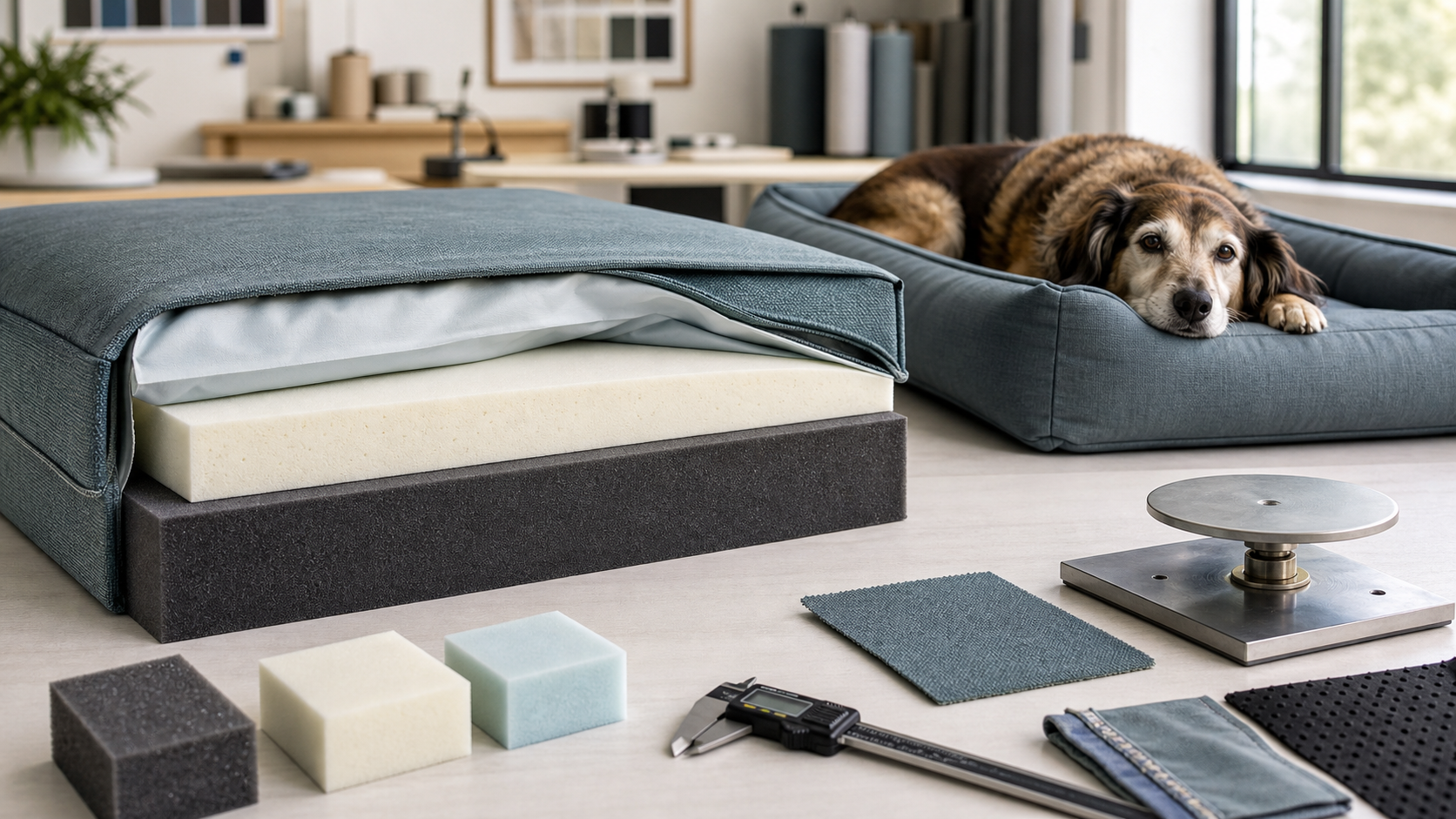
“Orthopedic” can describe a thoughtfully engineered pet bed—or simply appear as a marketing word. The label alone does not reveal the foam density, firmness, usable thickness, recovery, seam strength or whether the bed will support a particular animal without bottoming out.
A better buying decision starts with construction and evidence. Look at the complete system: comfort layer, support core, liner, cover, base, dimensions and quality controls. Then match that system to the pet’s size, sleeping posture, movement and care needs.
Quick recommendation: Ask for specifications by layer and measurable test results. “Memory foam,” “premium grade” and “orthopedic support” are not substitutes for density, firmness, thickness, tolerances and product-level quality data.
What “Orthopedic” Should and Should Not Mean
In the pet-bed market, “orthopedic” does not automatically identify one regulated construction or performance level. Two products using the same word may contain very different foam types and amounts.
A credible orthopedic-positioned bed should aim to:
- distribute the pet’s weight over a stable surface;
- provide cushioning without allowing heavy areas to reach the floor;
- make lying down, turning and rising manageable;
- retain useful support after repeated use;
- maintain a dry, clean sleeping surface;
- avoid unstable edges or loose materials that create new hazards.
The product name should not be used to imply guaranteed outcomes that the finished bed has not been shown to deliver. The U.S. Federal Trade Commission states that objective advertising claims must be truthful, not misleading and supported by an appropriate basis. Describe measurable construction and performance instead of suggesting that the word “orthopedic” proves a result.
Start with the Pet, Not the Foam Name
Before comparing materials, record how the pet uses a bed:
1. Body weight and approximate body length while resting.
2. Preferred posture—curled, side sleeping, sprawled or leaning against a bolster.
3. Ability to step over an edge and rise from a soft surface.
4. Temperature preference and tendency to seek cool or warm areas.
5. Incontinence, drooling, skin sensitivity or frequent cleaning needs.
6. Chewing, digging or nesting behavior.
7. Care instructions or professional recommendations relevant to rest and movement.
A heavy dog may need a thicker or firmer support core than a lighter animal of the same length. A small senior cat may need a low entrance more than a very thick mattress. The best design is not simply the product with the largest foam number.
Foam Types Commonly Used in Pet Beds
Most foam pet beds use one or more flexible polyurethane foam layers. The performance depends on the formulation and physical properties, not just the category name.
Conventional support foam
This is often used as the structural base. A suitable grade can provide stable support and keep the pet away from the floor. A low-quality grade may soften, form a permanent hollow or crumble earlier.
Viscoelastic or memory foam
Memory foam responds slowly to pressure and temperature, creating a contouring surface. It can improve pressure distribution, but a thick, very soft memory-foam layer can make turning or rising harder for some animals. Memory foam still needs an appropriate support layer beneath it.
High-resilience foam
High-resilience polyurethane foam is designed for responsive support and recovery. The term should be tied to a supplier specification or applicable criteria rather than used casually as another name for any springy foam.
Rebonded foam
Rebonded foam uses bonded pieces of foam and can create a firm, dense layer. Its quality depends on composition, bonding consistency and intended use. A buyer should understand whether it is used as the full core, a base layer or a low-cost filler.
Fiber and shredded-foam fill
Loose fill can create softness and nestability but tends to shift. It may not provide the uniform support expected from a solid foam core. If a product combines fiber, shredded foam and slab foam, the listing should state that clearly.
Density Is Not the Same as Firmness
Foam density expresses mass per unit volume. Firmness describes the force required to indent or compress foam under a defined test. A high-density foam can be formulated to feel soft, and a lower-density foam can feel firm.
Density can help compare durability potential within a similar foam family, but it is not a complete quality score across all formulations. Ask for:
- density for every foam layer, with units;
- whether the figure is a nominal target or measured range;
- manufacturing tolerance;
- the test method used;
- whether the value applies to the current production foam, not an old sample.
Avoid listings that state one density for a multi-layer bed without identifying which layer was measured. A thin memory-foam topper and a large support core have different functions.
Firmness Needs a Test Method and Context
Indentation force deflection—often abbreviated IFD or informally called ILD—describes the force needed to compress foam by a specified percentage under defined conditions. The number is only meaningful when the sample thickness, indentation percentage, conditioning and test method are known.
ASTM D3574 provides standardized test methods for flexible polyurethane foams and is used for research, quality control and specification acceptance. A buyer should not compare two firmness numbers as if they were identical when the suppliers used different specimens or methods.
Ask the manufacturer:
- Which test method produced the number?
- At what indentation percentage was it measured?
- What specimen thickness and conditioning were used?
- Is the result a target, range or single laboratory reading?
- Which layer does it describe?
For consumers, detailed values may not always be published. In that case, look for a clear weight range, a meaningful description of construction and a return policy that allows a real fit check.
Thickness Matters, but Usable Support Matters More
A product can advertise a thick profile while using a soft core that compresses almost completely under the pet. Conversely, a thinner, well-specified system may provide better support for a lighter animal.
Evaluate:
- total bed height;
- individual layer thicknesses;
- foam firmness and density by layer;
- the pet’s weight distribution and sleeping posture;
- clearance above the hard floor under load;
- entry height and ease of rising.
Bolsters should not be counted as mattress thickness. Measurements should refer to the usable sleeping area after the bed has fully expanded and the cover is installed.
A Layered Construction Can Balance Comfort and Support
A common effective arrangement uses a thinner contouring layer over a firmer support core. The top layer accommodates the body; the base controls deeper compression.
The layers should work together. Watch for:
- a topper so thick that the pet becomes trapped in a depression;
- a support base that is too soft for the stated weight range;
- layers that slide, wrinkle or separate inside the cover;
- adhesive application that creates hard ridges or inconsistent zones;
- a cover so tight that it pre-compresses the foam;
- a cover so loose that folds form beneath the animal.
Zoned or sculpted foam can be useful when the geometry is intentional and tested. Decorative surface cutting is not proof of pressure distribution.
Compression Set, Fatigue and Recovery
Foam may feel supportive when new but lose height or firmness with repeated loading. Product quality therefore includes how it changes over time.
Useful evaluations can include:
- compression set: how much thickness remains lost after defined compression and recovery;
- dynamic fatigue: how properties change after repeated loading;
- recovery time: how the material returns after unpacking or use;
- dimensional stability: whether length, width and thickness stay within specification;
- visual uniformity: whether cells, color and surface show voids, tears or inconsistent bonding.
ASTM D3574 contains multiple physical test methods for flexible polyurethane foam. The test result applies to the tested material and conditions; it does not automatically predict every real-world use. Brands should define acceptance ranges that reflect the intended pet weight, design and warranty.
Foam Certification: Read the Scope
Third-party certification can provide useful evidence, but only within its stated scope.
CertiPUR-US states that its program certifies flexible polyurethane foam for specified content, emissions and durability criteria. It also clearly explains that it does not certify the furniture, product line or company. For a pet bed containing certified foam, verify the foam producer or participating product company through the program directory and confirm that the current foam family is covered.
Certification of the foam does not automatically verify:
- the finished bed’s support for a particular pet;
- cover fabric, zipper, thread, adhesives or waterproof coating;
- seam durability or wash performance;
- the truth of finished-product performance claims;
- final-product cleanliness or assembly quality.
Avoid changing “low emissions” into “zero emissions.” CertiPUR-US specifically notes that certified foam is tested to low-emission criteria, not guaranteed to have no off-gassing at all.
Textile Certification and Cover Claims
OEKO-TEX STANDARD 100 is a testing and certification system for textiles and components evaluated for harmful substances. The organization states that certified articles are tested according to intended use and that each thread, button and accessory in a certified item is covered.
Scope still matters. A certificate for a fabric roll does not necessarily certify the completed pet bed, foam or waterproof liner. Buyers should obtain:
- certificate number and validity;
- certified article description;
- product class or applicable test program;
- issuing institute;
- confirmation that the supplied color and construction match the certificate.
Verify labels through the certification body rather than accepting an untraceable logo in a sales presentation.
The Cover Is a Performance Component
The cover controls grip, cleaning, breathability and resistance to everyday wear. Inspect more than appearance.
Surface fabric
The pet-facing fabric should provide traction for rising and resist pilling, snagging and rapid abrasion. A very slick cover can undermine a supportive foam core.
Seams
Load-bearing seams should use consistent stitch density and adequate seam allowance. Corners, bolster connections and zipper ends often need reinforcement. Loose thread tails and skipped stitches are early warning signs.
Zipper design
A concealed or protected zipper reduces direct contact and chewing access. The slider should move smoothly without catching the liner or foam. A zipper garage or covered end can improve finish.
Fit after washing
The cover should reinstall without extreme stretching or excess wrinkles. Brands should define acceptable dimensional change after the stated wash and dry cycle and test colorfastness, seam integrity and appearance.
Non-slip base
A non-slip base should work on the intended floor, remain attached after laundering and avoid flaking. Test it on clean, dry flooring; no base performs equally on every surface.
Waterproof Liners Involve Tradeoffs
A moisture barrier protects foam from urine, drool and wash water, but a poorly designed liner can trap heat, make noise, tear at the zipper or restrict the feel of the foam.
Evaluate:
- actual water resistance or waterproof test method;
- seam and zipper-area protection;
- flexibility at low and high room temperatures;
- noise during movement;
- resistance to repeated folding and removal;
- whether the liner is replaceable;
- breathability claims and how they were measured.
“Waterproof” and “water-resistant” are not interchangeable. A finished liner with unsealed seams may perform differently from the base fabric tested in a laboratory.
Adhesives, Odor and Initial Expansion
Layered foam may use adhesives. Ask which adhesive system is approved, how application is controlled and whether testing covers the assembled material when relevant.
Compressed shipping can reduce package volume, but the brand should define:
- maximum compression time;
- acceptable storage conditions;
- unpacking instructions;
- normal recovery window;
- dimensional acceptance after recovery;
- what customers should do if the bed remains undersized.
A temporary new-material odor does not by itself identify safety, and absence of odor does not prove a product is low-emission. Persistent, intense or irritating odor should be reported to the seller, and the bed should be kept away from the pet until the concern is resolved. Follow the manufacturer’s ventilation and use instructions.
Product-Level Quality Tests
Foam reports are only one part of finished-bed quality. A practical test plan can include:
- finished dimensions and weight;
- foam layer thickness, density and firmness;
- support under representative static loads;
- repeated compression or use simulation;
- seam strength and stitch inspection;
- zipper cycling;
- cover abrasion, pilling and snag resistance;
- wash shrinkage, colorfastness and appearance;
- liner water-resistance and flex testing;
- non-slip base adhesion and durability;
- packaging compression and post-unpacking recovery;
- odor or emissions testing when claimed or required.
Test methods, sample conditioning, sample size and acceptance limits should be written before production. A “passed” result without the underlying criteria is not enough for supplier approval.
Factory Quality Control for Bulk Orders
For OEM, ODM or private-label production, control the exact bill of materials. Foam can change without looking dramatically different, so specify supplier, family or grade, color where relevant, density, firmness, thickness and allowable substitutions.
The quality plan should address:
1. Incoming verification of foam, fabric, liner, zipper and thread.
2. Layer identification and cutting tolerances.
3. Adhesive coverage and curing controls.
4. Sewing workmanship and critical seam checks.
5. Finished dimensions after the defined recovery period.
6. In-process and final sampling.
7. Batch traceability for foam and textile components.
8. Written approval before material or supplier changes.
9. Retained samples and complaint investigation.
10. Corrective action for compression, odor, seam or wash failures.
The approved sample should be supported by a written specification. A visually similar sample is not proof that production uses the same foam.
Claims Buyers Should Question
Pause when a listing uses claims such as:
- “professional grade” without a defined standard;
- “proven results” without testing on the same finished product and claimed outcome;
- guaranteed comfort or movement outcomes without supporting evidence;
- “100% orthopedic” without a construction specification;
- “zero VOC” based only on a low-emission foam certificate;
- “certified bed” when only one foam component is certified;
- “waterproof” when only the unsewn fabric was tested;
- “high density” without a number, unit or layer identification;
- “will never flatten” without test conditions and warranty terms.
FTC guidance emphasizes the overall impression of advertising, including implied claims. A disclaimer should not contradict a bold promise elsewhere on the page.
Consumer Inspection Checklist
When the bed arrives:
- confirm model, size and care instructions;
- allow the stated recovery time on a flat surface;
- measure the usable sleeping area and mattress thickness;
- check that layers lie flat and the cover fits without severe tension;
- inspect seams, zipper ends and non-slip backing;
- confirm the pet can step on, turn and rise without instability;
- watch whether heavy areas remain separated from the floor;
- check movement, stability and temperature comfort during early use;
- keep purchase records and photograph any defect promptly.
Do not let a pet use exposed foam. Chewed foam, liner fragments, zipper pieces and loose threads can create ingestion or entanglement hazards. Replace or repair damaged components according to manufacturer guidance.
Retailer and Brand Documentation Checklist
Before listing an orthopedic pet bed, obtain:
- construction drawing and bill of materials;
- layer-by-layer foam specifications and tolerances;
- current physical test reports with sample identification;
- certification numbers and verified scope;
- cover, liner, zipper and base specifications;
- wash-care validation;
- finished-product inspection criteria;
- packaging and recovery validation;
- approved claims with supporting evidence;
- traceability, complaint and recall procedures;
- warranty terms aligned with tested durability.
Review documents again after any material, color, factory or sub-supplier change. Evidence from a previous construction should not be carried over automatically.
Final Recommendation
Choose an orthopedic pet bed by system performance, not by one foam word. A useful design combines a stable support core, an appropriate comfort layer, sufficient usable thickness, an accessible profile, a durable washable cover and a moisture strategy suited to the pet.
For brands and buyers, require measurable foam data, product-level tests, verified certification scope and controlled production tolerances. For pet owners, match the bed to body weight, sleep posture, movement and cleaning needs, and seek appropriate professional advice when the pet’s ability to rest or rise has changed.
The strongest product claim is not “orthopedic.” It is a transparent specification that the finished bed consistently meets.
Frequently Asked Questions
Does the word orthopedic guarantee a specific pet-bed construction?
No. In the pet-bed market, the word alone does not identify one universal foam density, firmness, thickness or test threshold. Compare the layer construction, measurable specifications, finished-product tests and suitability for the individual pet.
Is higher-density foam always firmer?
No. Density measures mass per unit volume, while firmness measures resistance to indentation under defined conditions. A high-density foam can feel soft, and a lower-density foam can be formulated firm. Compare both values within the correct foam family and test method.
How thick should memory foam be in an orthopedic pet bed?
There is no universal thickness for every animal. The correct design depends on pet weight, posture, movement, comfort-layer firmness and support-core performance. The bed should cushion without bottoming out or making it difficult for the pet to turn and rise.
Does CertiPUR-US certify the complete pet bed?
No. CertiPUR-US states that it certifies flexible polyurethane foam, not the finished furniture, product line or company. Covers, liners, seams, zippers, adhesives and finished-bed performance need their own verification.
How can I tell if a pet bed is bottoming out?
Observe the pet lying in its usual position and check whether hips, shoulders or other heavy areas compress the bed close to the hard floor. Also watch for a permanent hollow, slow recovery or difficulty rising. Stop using a damaged or unstable bed and seek appropriate advice if the pet’s movement has changed.
Sources and References
- ASTM International - D3574-25 Standard Test Methods for Flexible Polyurethane Foams
- CertiPUR-US - Technical Guidelines
- CertiPUR-US - Frequently Asked Questions
- OEKO-TEX - STANDARD 100
- Federal Trade Commission - Advertising and Marketing Guidance
- Federal Trade Commission - Advertising FAQs for Small Business
About this article
Independent pet-industry guidance from the ShineePets Editorial Team for pet owners, retailers, distributors and sourcing professionals.
ShineePets is a commercial B2B pet-supply sourcing brand. Read our editorial standards and commercial disclosure.