Pet Care
Interactive Pet Toys: Choosing the Right Challenge Level
Quick answer
Choose interactive pet toys at the right difficulty by matching species, skills and behavior, then adjusting challenge without causing frustration.
By ShineePets Editorial Team · Published · Updated
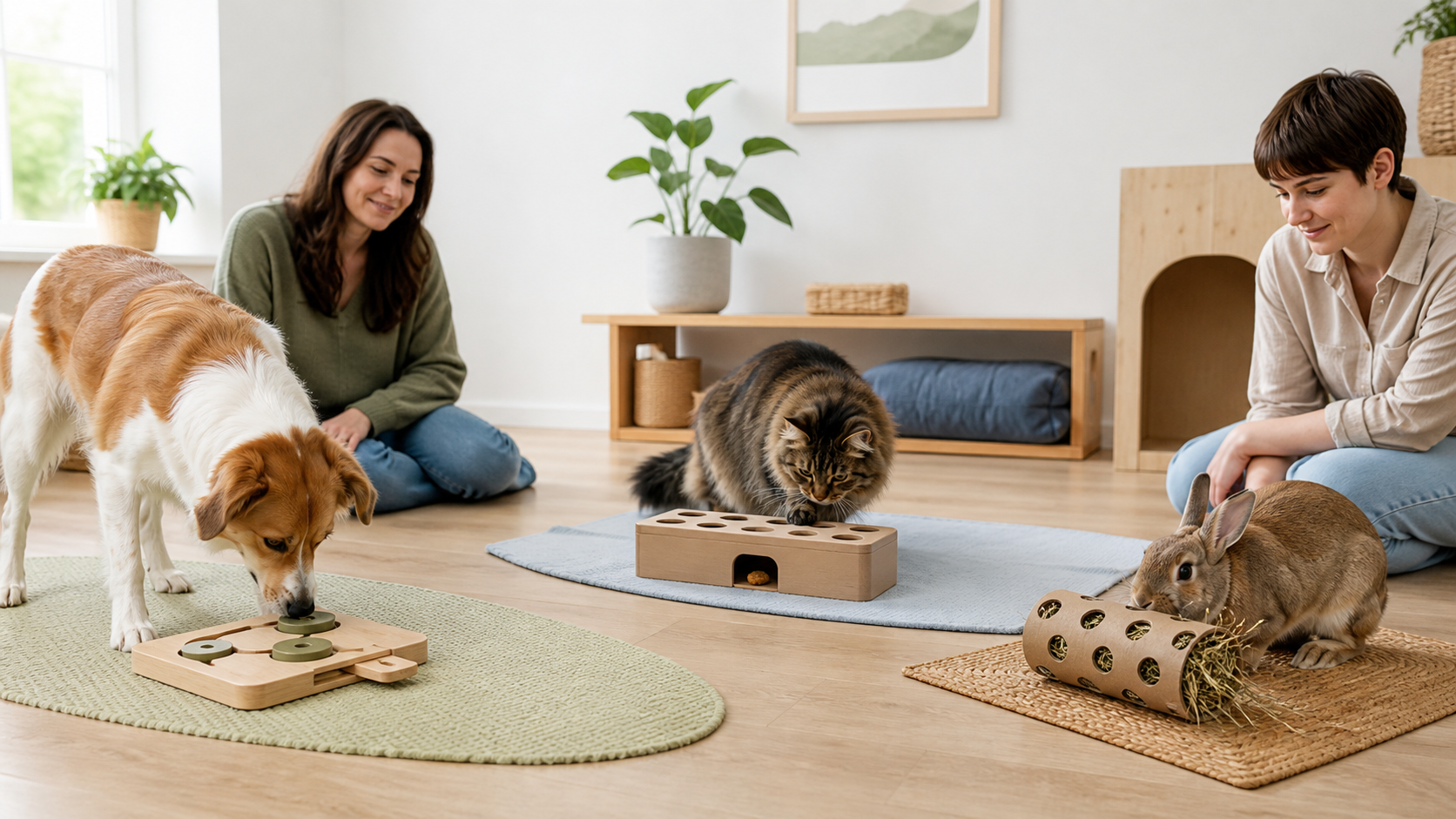
An interactive pet toy should invite an animal to do something meaningful—sniff, paw, nudge, roll, pull, forage, chase, or solve a simple sequence—and then provide understandable feedback. The best toy is not the most complicated one. It is the toy that is safe for the species, achievable at the pet’s current skill level, and adjustable as confidence grows.
Choosing the right challenge level means finding the middle ground between instant, mindless access and a task so difficult that the pet becomes frustrated, frightened, destructive, or simply walks away.
Key Takeaways
- Match the toy to the species, natural behavior, body size, mobility, senses, motivation, and previous experience of the individual pet.
- Begin with visible, easy rewards and a simple action. Increase only one difficulty variable at a time.
- A suitable challenge produces steady investigation, small successes, pauses, and voluntary return.
- Repeated biting, frantic pawing, freezing, avoidance, guarding, or giving up can mean the task is too hard, unsafe, or poorly introduced.
- Food used in interactive toys should usually come from the pet’s measured daily allowance, and new or homemade toys require close supervision.
The right puzzle teaches the pet, “My actions work.” The wrong puzzle teaches either “nothing is required” or “nothing I do makes a difference.”
What Counts as an Interactive Pet Toy?
Interactive toys respond to the pet’s behavior or require the pet to manipulate, search, or make a choice. They include:
- food puzzles with openings, sliders, lids, or moving parts;
- snuffle mats and scatter-search surfaces;
- rolling or wobbling feeders;
- treat-dispensing balls;
- hide-and-seek boxes;
- supervised wand, chase, or tug toys;
- stacking cups and objects that can be lifted or moved;
- hay-filled tubes and wrapped forage parcels for rabbits;
- digging boxes and simple scent-search stations.
“Interactive” does not have to mean electronic. A cardboard egg box containing part of a cat’s meal or a rabbit-safe tube filled with hay may create more useful interaction than a noisy automated product.
The toy should support natural behavior rather than merely hold attention. Dogs often enjoy sniffing, chewing, retrieving, and problem-solving. Cats benefit from searching, stalking, batting, pouncing, and catching. Rabbits need opportunities to forage, dig, investigate, throw, and manipulate safe objects.
Use a Challenge Ladder Instead of Easy-or-Hard Labels
Commercial difficulty ratings are not standardized, and one pet’s “beginner” toy can be another pet’s impossible task. A more reliable approach is to place the activity on an adjustable ladder.
Level 1: Discover
The reward is visible or partly exposed. One simple action—sniffing, touching, or eating from an open compartment—creates success.
Examples:
- food scattered loosely on a mat;
- an open egg box with food in the cups;
- a shallow tray containing hay and a few suitable food pieces;
- a dog puzzle with all sliders already open.
Level 2: Move one object
The pet nudges, paws, rolls, lifts, or pushes one lightweight part to reach the reward.
Examples:
- one loose cup covering visible food;
- a slow-moving treat ball with a large opening;
- an open cardboard tube with hay extending from both ends;
- one easy slider that travels in a straight line.
Level 3: Search and manipulate
The reward is less visible and the pet must combine searching with one familiar action.
Examples:
- several compartments, only some of which contain food;
- a box with paper hiding a toy or food;
- a rolling feeder with a moderately sized opening;
- a rabbit forage parcel loosely wrapped in plain brown paper.
Level 4: Complete a short sequence
The pet performs two learned actions in a clear order, such as sliding a piece and then lifting a cover.
This level suits pets who already solve the component actions separately. It should not be introduced by locking every section of a new puzzle at once.
Level 5: Generalize the skill
The basic mechanism stays familiar, but the location, scent, object position, or combination changes. Advanced challenge should test flexible problem-solving without making the reward inaccessible.
Not every pet needs to reach Level 5. Repeating an enjoyable Level 2 activity can provide excellent enrichment.
Start With the Pet, Not the Packaging
Before buying a toy, consider six individual factors.
1. Species and natural behavior
A toy designed for a dog may be unsafe for a rabbit to chew, and a cat puzzle may have openings that can trap a smaller animal’s foot or head. Use products made for the species unless a reputable welfare source or veterinarian confirms another use is appropriate.
2. Body size and mouth or paw size
The pet should not be able to swallow the toy or remove small components. Openings must allow food to exit without trapping teeth, claws, paws, beaks, or whiskers.
3. Mobility and posture
A senior dog with neck discomfort may struggle with a floor-level puzzle. A cat with arthritis may prefer wide, stable access and minimal reaching. A rabbit needs enough clear space to move away, stand upright, and investigate without the toy blocking normal movement.
4. Sensory ability
Pets with reduced vision may rely more on scent, texture, and sound. Pets who are noise-sensitive may avoid hard plastic toys that rattle or crash. Strong fragrances and unfamiliar sounds can reduce confidence instead of adding interest.
5. Motivation
Food motivates many animals, but not all. Some prefer a moving toy, a familiar scent, social play, or access to hay. Use something the pet values without making the reward so exciting that the pet becomes frantic.
6. Learning history and frustration tolerance
A pet who has used several puzzles may understand sliding and lifting. A first-time user needs a clear demonstration and easy access. Confidence in one mechanism does not guarantee confidence in another.
The First-Session Test
Introduce a new toy in a quiet, familiar space. Remove competing pets and place the toy on a stable, nonslip surface.
1. Let the pet approach without pushing the toy toward them.
2. Make the first reward visible and easy to obtain.
3. Demonstrate one movement if appropriate, then allow investigation.
4. Watch the body, not only whether the reward is eaten.
5. Finish after a few clear successes.
6. Store or clean the toy according to its materials and food-contact instructions.
Do not wait for obvious distress before helping. If the pet cannot find a starting action, open another compartment, expose the reward, or simplify the mechanism.
Signs the Challenge Is Too Easy
A toy may be ready for a small adjustment when the pet:
- empties it immediately without pausing or investigating;
- repeats one automatic action with little searching;
- loses interest as soon as the food is gone;
- can solve every section before the caregiver finishes setting it down.
“Too easy” is not automatically bad. Easy toys are useful for first introductions, low-energy days, recovery, senior pets, and confidence-building. Increase difficulty only when the pet remains relaxed and enjoys the activity.
Signs the Challenge Is Just Right
Look for:
- voluntary approach and a loose body;
- sniffing, looking, pawing, nudging, or manipulating with purpose;
- early success followed by continued exploration;
- brief pauses and re-engagement;
- the ability to leave without guarding the toy;
- calm behavior after the session.
The pet does not need to solve every compartment. A productive session can end after one successful action.
Signs the Challenge Is Too Hard
Make the activity easier or stop if the pet:
- bites, shakes, flips, or scratches the toy with increasing force;
- repeatedly uses the same unsuccessful action;
- barks, whines, vocalizes, or paces around it;
- freezes, crouches, retreats, or refuses to approach;
- takes food but shows a tense body or guards the toy;
- gives up quickly after previously enjoying easier puzzles;
- chews parts that are not intended for chewing;
- becomes fixated and cannot settle afterward.
These signs do not mean the pet lacks intelligence. The mechanism may be unclear, the reward may be inaccessible, the surface may move, another animal may be creating pressure, or the pet may be tired, unwell, or not motivated by that reward.
Adjust One Difficulty Variable at a Time
Challenge can be changed without buying another toy.
Reward visibility
- Easier: leave food fully visible.
- Harder: partly cover it after the pet understands the action.
Number of active sections
- Easier: use one open compartment.
- Harder: add one more working compartment.
Movement resistance
- Easier: loosen lids and sliders.
- Harder: use the normal setting only after movement is familiar.
Never tighten a component beyond its intended adjustment or create a pinch hazard.
Dispensing opening
- Easier: use a larger approved opening so food exits frequently.
- Harder: reduce the opening gradually, while confirming the food still passes through.
Search area
- Easier: place rewards close together in one visible zone.
- Harder: increase distance or add safe hiding locations.
Number of steps
- Easier: teach lifting, sliding, or rolling separately.
- Harder: combine two familiar actions.
Environmental distraction
- Easier: use a quiet familiar room.
- Harder: move to another calm area only after the skill is reliable.
Changing one variable allows the caregiver to see what helped or caused difficulty.
Choosing Interactive Toys for Dogs
Dogs Trust recommends considering health, ability, dietary needs, preferences, and frustration when selecting enrichment. For dogs, a useful progression is:
Beginner dog
- food scattered on a clean mat;
- an open slow feeder;
- a large stable toy with one loose slider;
- a cardboard search box with food near the top.
Intermediate dog
- a rolling feeder with frequent dispensing;
- two easy sliders;
- a snuffle mat with food placed at different depths;
- a toy search using one familiar hiding place.
Advanced dog
- two separately learned mechanisms used in sequence;
- a multi-location scent search;
- a task combining a target, search, and retrieve;
- rotating puzzle types across the week.
Strong chewers need especially durable products, but “durable” does not mean indestructible. Supervise until you know how the dog interacts, and remove any toy that cracks, splinters, frays, or loses pieces.
Choosing Interactive Toys for Cats
Cats often learn best when food is visible and the toy allows natural pawing or hunting behavior. Cats Protection recommends starting with an open egg box and building complexity gradually, such as partly closing the lid only after the cat understands the puzzle.
Beginner cat
- food in an open egg box;
- a shallow tray with a few lightweight cups left uncovered;
- a stationary feeder with wide openings;
- a supervised wand toy that moves away and allows frequent catches.
Intermediate cat
- one loose cover over visible food;
- a rolling feeder with a large opening;
- food hidden under loosely crumpled paper;
- two different compartments on a stable puzzle board.
Advanced cat
- a familiar puzzle with one partly closed section;
- a search station combining boxes and tubes;
- a sequence of stalk, catch, and food-search activities;
- the same mechanism placed in a new calm location.
Cats should be able to catch moving “prey” regularly. Store wand toys, elastic, feathers, and string securely after supervised play. Count puzzle food within the cat’s daily allowance.
Choosing Interactive Toys for Rabbits
Rabbit enrichment should support foraging, digging, investigating, and manipulating safe objects. RSPCA guidance suggests hay-filled tubes, cardboard boxes, brown-paper parcels, stacking cups, tunnels, and digging opportunities.
Beginner rabbit
- hay extending visibly from both ends of an open cardboard tube;
- food placed under one lightweight cup;
- an open box containing hay and plain shredded paper;
- a wide tunnel with clear entry and exit routes.
Intermediate rabbit
- hay packed a little more firmly into a tube;
- several cups with food under one or two;
- a food item loosely wrapped in plain brown paper;
- shallow digging material with forage near the surface.
More experienced rabbit
- a combination of cups and forage locations;
- a loosely closed paper parcel inside an open box;
- a changed arrangement of familiar safe objects;
- several forage points across a spacious enclosure.
Rabbits must be able to move away and hide from new items. In multi-rabbit homes, provide enough toys and feeding points to reduce competition. Remove tape, staples, plastic coating, glossy paper, handles, and small swallowable parts. Supervise fabrics because ingestion can be dangerous.
What About Birds, Rodents, and Other Pets?
The same challenge principles apply—start easy, support natural behavior, observe, and adjust gradually—but the materials, opening sizes, foods, and mechanisms must be species-specific. A toy that is safe for a dog, cat, or rabbit may be hazardous to a bird, hamster, guinea pig, ferret, reptile, or other animal.
Choose toys designed for the species and consult a veterinarian or reputable welfare organization when unsure. Avoid adapting a product merely because the pet can physically reach it.
Food Puzzle Safety and Calorie Control
Food puzzles can make daily feeding more engaging, but they should not create an unplanned second diet.
- Measure the pet’s normal daily food allowance.
- Reserve a portion for puzzles and training.
- Confirm food pieces move through the toy without becoming stuck or spoiled.
- Wash food-contact surfaces and dry them fully.
- Do not mix animals’ prescription diets or allow one pet to access another’s toy.
- Ask a veterinarian about food choices for pets with allergies, dental problems, digestive disease, obesity, kidney disease, or other medical needs.
If the pet cannot obtain enough food from a puzzle, provide the remaining meal in an accessible way. Enrichment must not prevent appropriate nutrition.
Multi-Pet Household Rules
Interactive toys can create competition even among animals who usually live calmly together.
1. Introduce new food toys individually.
2. Use separate rooms or barriers when needed.
3. Provide more resources than the number of animals when species guidance recommends it.
4. Do not force pets to solve side by side for a photograph or video.
5. Watch for blocking, staring, guarding, chasing, or one animal waiting at a distance.
6. Remove toys calmly through an established trade or after animals leave the area.
Separate use also makes it easier to judge whether the difficulty suits each individual.
A Seven-Day Introduction Plan
Day 1: open access
Present the toy with rewards visible and all movable sections open. Allow a few easy successes.
Day 2: repeat the same setup
Consistency helps reveal whether the pet truly understands the mechanism.
Day 3: add one action
Partly cover one reward or activate one easy moving component.
Day 4: return to easy mode
An easier session protects confidence and confirms the pet still enjoys the toy.
Day 5: repeat the successful challenge
Use the same adjustment as Day 3. Do not add another step unless the pet remains relaxed.
Day 6: change one location or reward position
Keep the mechanism familiar while making a small environmental change.
Day 7: review
Record:
- approach and body language;
- time to first clear success;
- actions the pet used;
- frustration or avoidance;
- damage or safety concerns;
- ability to settle afterward.
Keep the most successful level for another week before increasing complexity.
Interactive Toy Buying Checklist
Before purchasing, confirm that:
- the product is intended for the species;
- the dimensions suit the pet’s body, mouth, paws, or beak;
- the beginner setting provides an obvious first success;
- difficulty can be changed in small steps;
- parts cannot trap or pinch;
- food can exit and the toy can be cleaned thoroughly;
- materials and coatings are clearly identified;
- replacement parts are available if the design needs them;
- supervision requirements are realistic for the household;
- the toy still offers value at an easier setting.
Do not choose solely by the number of compartments or the word “advanced.” Adjustability is usually more useful than maximum complexity.
Final Recommendation
Start one level below the difficulty you think the pet can handle. Make the reward visible, teach a single action, and finish after several calm successes. Increase only one variable when the pet shows relaxed, purposeful engagement.
A suitable interactive toy gives the pet control and produces repeatable success. If the animal becomes frantic, worried, destructive, or excluded by another pet, simplify the task or choose a different design. The right challenge is the one the individual pet willingly returns to—not the highest level printed on the box.
Frequently Asked Questions
How do I know if an interactive toy is too difficult?
Repeated unsuccessful actions, frantic biting or pawing, barking, freezing, avoidance, guarding or giving up can indicate that the task is unclear, unsafe or too difficult.
Should I help my pet solve a puzzle toy?
Make the first reward visible, demonstrate one movement when appropriate and simplify the toy if the pet cannot find a starting action. Avoid physically forcing paws, noses or bodies through the mechanism.
When should I increase the challenge level?
Increase one variable only after the pet repeatedly approaches with a relaxed body, achieves early success and can disengage calmly. Easy sessions can remain part of the routine.
Can dogs, cats and rabbits use the same interactive toy?
Usually they should use species-appropriate toys. Differences in chewing, paw size, food, materials and natural behavior can make a toy suitable for one species but dangerous for another.
Do food puzzles cause weight gain?
They can if puzzle food is added on top of normal meals. Measure the daily allowance and reserve part of it for puzzles, while following veterinary advice for special diets or weight management.
Sources and References
About this article
The ShineePets Editorial Team creates practical, source-based guides for pet owners, retailers, and product buyers.
ShineePets is a commercial B2B pet-supply sourcing brand. Read our editorial standards and commercial disclosure.