Pet Care
Pet Odor Control Products: Safe and Practical Choices
Quick answer
Compare pet odor control products by cleaning function, surface, species, fragrance, label directions and realistic safety checks.
By ShineePets Editorial Team · Published · Updated
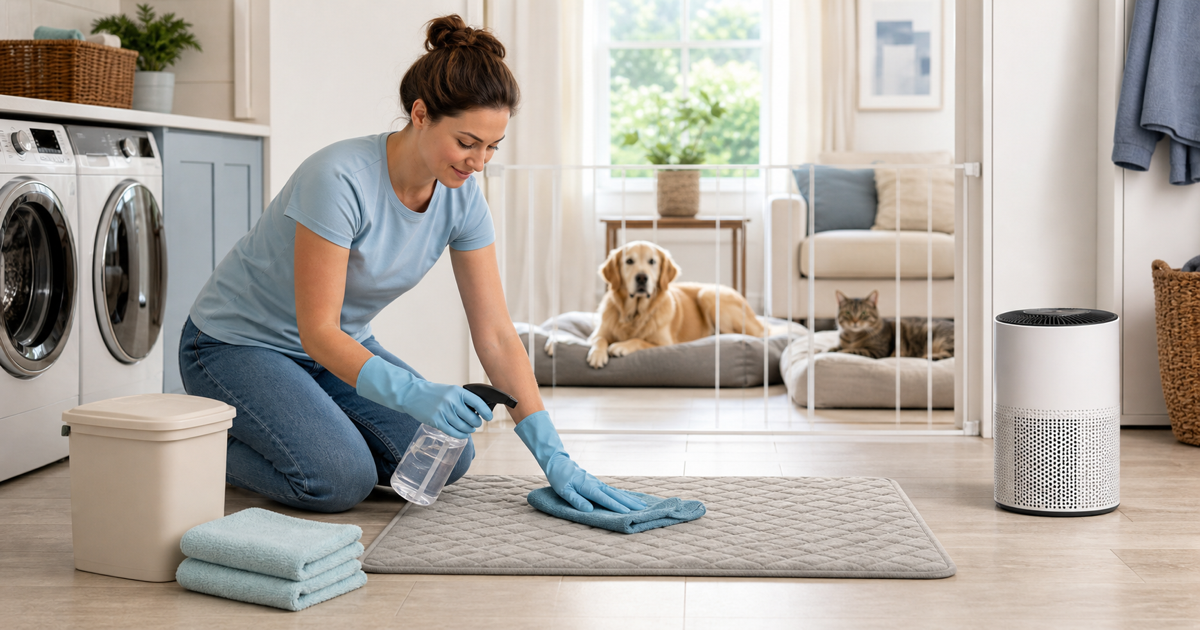
Effective pet odor control products remove the source of an odor, work on the affected material and can be used exactly as the label directs without exposing the animal. Start with waste removal, washing and drying. Use an enzyme or microorganism-based cleaner for a compatible urine or fecal stain when its label supports that use; use an adsorbent or air filter only as secondary control. Fragrance is not proof of cleanliness, and disinfectants are not automatically odor removers.
This guide helps pet owners compare odor products by function, surface, species, instructions and realistic results. Persistent or suddenly changing odors from an animal can signal a health problem and should not simply be covered with scent.
Pet Odor Control Products at a Glance
| Product type | Useful role | Main limitation |
|---|---|---|
| Detergent or surface cleaner | Removes visible soil and washable residues | May not fully address old contamination below the surface |
| Enzyme or microorganism-based cleaner | Breaks down specified organic residues when directions are followed | Performance depends on formula, surface access, contact time and complete coverage |
| Absorbent or adsorbent | Helps manage moisture or some airborne compounds | Capacity is limited; it does not replace source removal |
| Disinfectant | Controls listed microorganisms on approved surfaces | Requires prior cleaning, label contact time and pet separation; odor control is not its primary purpose |
| Fragranced deodorizer | Changes how a room smells | Can mask rather than remove a source and may be unacceptable around some animals |
| Air cleaner with suitable gas-phase media | May reduce some airborne odors while media remains effective | Particle filters alone do not capture every gas; media needs replacement |
Choose the narrowest product that solves the identified problem. One product does not need to clean carpet, deodorize litter, disinfect crates and freshen the air.
Identify the Odor Source Before Buying
Separate fresh waste from contamination inside porous materials, routine buildup in litter areas or bedding, and odors coming from the air or animal. Each needs a different response.
Use a white light to inspect surfaces and follow a UV product's instructions if using it to locate old urine. Check beyond the visible spot because liquid can spread underneath carpet or upholstery. A deodorizer applied only to the top cannot reach contamination in padding or subfloor.
Cornell University notes that medical conditions can contribute to feline house-soiling and recommends veterinary examination when a cat begins eliminating outside the box. It also advises neutralizing rather than merely deodorizing odors. Read Cornell's house-soiling guidance. Sudden changes in any pet deserve veterinary attention.
Remove, Clean, Then Reassess
For a fresh accident on a washable surface:
1. Move pets away and ventilate the area.
2. Remove solids, then blot liquid without rubbing it farther into the material.
3. Check the surface-care label and odor product directions.
4. Apply enough compatible cleaner to reach the affected depth, without oversaturating materials that cannot be dried.
5. Allow the stated working time; extract, rinse or wipe only as directed.
6. Dry completely with pets kept away.
7. Recheck when the surface is dry, because moisture and fragrance can hide the remaining odor.
If odor returns after drying, contamination may remain underneath. Carpet padding, foam or unfinished wood may need professional extraction, replacement or repair rather than more spray.
When an Enzyme Cleaner Makes Sense
Enzyme and microorganism-based products are commonly designed for organic soils such as urine, feces, vomit or food. The active system and intended materials vary, so “enzyme cleaner” is a category—not a guarantee of performance.
Compare labels for:
- the exact soil and surface covered;
- dilution and required application volume;
- working time and temperature limits;
- whether rinsing or extraction is required;
- colorfastness and hidden-area testing;
- species or area restrictions;
- storage temperature and expiration information.
Do not combine an odor remover with bleach, ammonia, disinfectant, vinegar or another cleaner unless the manufacturer explicitly provides that sequence. Use one product, complete its directions and allow the area to dry before reassessing.
Match the Product to the Surface
| Surface or area | Practical approach | Check before use |
|---|---|---|
| Sealed hard floor | Remove soil, use a compatible cleaner, rinse if directed and dry | Finish compatibility and slippery residue |
| Carpet or rug | Blot, reach the contaminated depth and extract as directed | Colorfastness, backing, pad saturation and machine warranty |
| Upholstery or mattress | Use minimal compatible moisture and thorough drying | Cleaning code, hidden-area test and internal foam contamination |
| Washable bedding | Pre-treat if permitted, wash to care instructions and dry fully | Fragrance/dye sensitivity and waterproof-layer limits |
| Litter box or cage tray | Remove waste, wash with a mild compatible detergent, rinse and dry | Material cracks, retained odor and species-specific restrictions |
| Air | Remove the source, ventilate safely and consider suitable filtration | Room size, gas-media type, replacement schedule and ozone claims |
The CDC distinguishes cleaning from disinfecting: cleaning removes dirt, while disinfection is a separate step. Its pet-supply instructions say to clean first, follow disinfectant contact time, and let items dry fully before pets use them; rinsing afterward may add protection where appropriate. Review CDC cleaning and disinfecting guidance.
Litter Boxes and Small-Animal Areas Need Source Control
Remove clumps, feces, wet bedding and spoiled food promptly, and replace cracked plastic that retains odor. Scented powder cannot compensate for an overloaded litter area.
The AAFP/ISFM feline house-soiling guidelines warn that aromatic litter and litter deodorizers can be offensive to cats and that no product removes the need for regular box maintenance. Read the feline house-soiling guidelines. For cats, start with a clean box and unscented litter instead of adding perfume. For rabbits, rodents and birds, use only products specifically compatible with the species and housing system; avoid airborne powders around food, water and respiratory spaces.
Fragrance-Free Is Different From Unscented
“Unscented” can mean a formula includes ingredients that mask an odor, while a verified fragrance-free product contains no fragrance materials under the applicable standard. EPA's Safer Choice program evaluates product ingredients and offers an additional fragrance-free label for qualifying products. Learn about EPA Safer Choice. This is a useful screening tool, not permission to ignore directions or apply a household cleaner to an animal.
Fragranced sprays and diffusers mainly change the perceived air. Do not spray them on pets, into cages, near bowls or onto bedding unless labeled for that use. Concentrated essential oils can harm pets through skin contact or ingestion; ASPCA advises avoiding essential-oil diffusers in homes with birds. Read ASPCA's essential-oil precautions.
Disinfectants Are Not Everyday Deodorizers
Use a disinfectant when microbial control is actually needed—for example, under veterinary or public-health guidance—not simply because a room smells. Select a product approved for the surface and intended setting, remove visible soil first, observe the full wet contact time, and prevent access until the surface is rinsed if required and completely dry.
ASPCA states that many cleaning products can be used around dogs and cats when label directions are followed, while birds require extra caution because fumes can affect them. Suspected toxic exposure warrants immediate veterinary or poison-control advice. Review ASPCA's household-product guidance. Never mix bleach with ammonia, acids or other cleaners.
Air Cleaners Cannot Replace Cleaning
Ventilation and source removal come first. For a portable air cleaner, particle filtration and gas-phase odor control are different jobs. HEPA-type filters capture particles; some odors are gases and require suitable adsorbent media such as activated carbon. Compare the room-size rating, amount and type of gas media, replacement cost, noise and whether replacement filters remain available.
Avoid devices that intentionally generate ozone in occupied pet homes. EPA reports that ozone has little potential to remove indoor contaminants at concentrations within public-health standards, can create irritating by-products, and may mask some odors rather than remove them. Read EPA's assessment of ozone generators. An EPA establishment number on a device is not an EPA safety or effectiveness endorsement.
Read the Entire Product Label
Before purchase, confirm the approved surfaces, function, dilution, contact time, ventilation, rinsing, drying, fragrance disclosure, warnings, storage, lot code and responsible company contact. Check registration details when a product makes disinfecting claims.
Avoid vague promises such as “pet safe,” “chemical free” or “100% natural” without conditions. Safety depends on formulation, concentration, species, route of exposure and correct use. The ShineePets guide to pet product packaging labels explains how to separate evidence from front-panel marketing.
Run a Controlled Home Trial
Test one hidden area. Measure the dilution and working time, then check after complete drying for returning odor, discoloration, residue or material change. Keep pets away during the trial.
For recurring litter odor, change one variable at a time—cleaning frequency, box condition, ventilation or litter—so you know what helped. The ShineePets comparison of clay, tofu, wood and silica cat litter provides a material-specific decision framework.
When to Contact a Veterinarian
Seek veterinary advice when an odor is new, persistent or associated with a change in the pet. Important signs include painful or frequent urination, blood, repeated accidents, diarrhea, vomiting, appetite or thirst changes, skin discharge, ear odor, mouth pain or breathing difficulty. Do not apply deodorizer to the animal to delay an examination.
After possible cleaner, disinfectant or essential-oil exposure, move the animal away from the source without putting yourself at risk. Contact a veterinarian or animal poison-control service promptly, keep the package available and do not induce vomiting or apply a home remedy unless a professional instructs you.
Common Buying and Use Mistakes
- Buying by fragrance strength instead of cleaning function.
- Treating an air spray as a solution for soaked padding.
- Using a disinfectant when simple cleaning is sufficient.
- Skipping the surface patch test.
- Combining products or transferring them into unmarked bottles.
- Letting pets walk on a wet treated surface.
- Adding scented litter deodorizer when a cat avoids the box.
- Assuming an essential oil is safe because it is plant-derived.
- Using an ozone generator in an occupied home.
- Covering a new animal odor instead of investigating its cause.
Pet Odor Control Products: Final Checklist
Choose a product only after you can answer yes to these questions:
- Is the source identified and physically removable?
- Does the label name the soil and surface you need to treat?
- Can the product reach the full contaminated area without damaging it?
- Are dilution, working time, rinsing and drying directions clear?
- Can every pet be kept away during treatment and drying?
- Is the fragrance or airborne exposure appropriate for the species?
- Are disinfecting or “pet safe” claims specific and verifiable?
- Can the package be stored securely in its original container?
- Will the result be judged only after complete drying?
- Has an unexplained or recurring animal odor been discussed with a veterinarian?
The practical order is simple: remove waste, clean the correct surface, dry it, then reassess. Add odor-control products only where they perform a defined job. A neutral-smelling, well-maintained area is a better goal than a room dominated by perfume.
*This article provides general product-selection and pet-care information. It does not replace veterinary diagnosis or poison-exposure advice.*
Sources and Further Reading
- About Cleaning and Disinfecting Pet Supplies — U.S. Centers for Disease Control and Prevention
- Learn About the Safer Choice Label — U.S. Environmental Protection Agency
- Ozone Generators That Are Sold as Air Cleaners — U.S. Environmental Protection Agency
- Poisonous Household Products — ASPCA Animal Poison Control
- The Essentials of Essential Oils Around Pets — ASPCA Animal Poison Control Center
- AAFP and ISFM Guidelines for Diagnosing and Solving House-Soiling Behavior in Cats — Journal of Feline Medicine and Surgery
- Feline Behavior Problems: House Soiling — Cornell University College of Veterinary Medicine
Frequently Asked Questions
What is the best product for removing pet urine odor?
Choose a product labeled for urine and the affected surface, apply enough to reach the full contaminated depth, follow its working-time and extraction directions, and judge the result after complete drying. No single formula fits every material.
Are enzyme cleaners safe around pets?
Safety depends on the finished formula and correct use, not the word “enzyme.” Follow the label, ventilate, prevent access during treatment and drying, and never apply a household surface cleaner directly to an animal.
Can I use baking soda in a litter box?
Some products use odor-adsorbing minerals, but loose powder can become airborne or change the litter's feel and smell. For cats, regular scooping and an accepted unscented litter are better starting points; use additives only when the product is species-appropriate.
Do air purifiers remove pet odors?
A unit with adequate gas-phase adsorbent media may reduce some airborne odors, but particle filtration alone does not remove every odor gas. Source cleaning, ventilation and timely filter replacement remain necessary.
What should I do if my pet licks an odor-control product?
Remove access, keep the product package, and contact a veterinarian or animal poison-control service promptly. Do not induce vomiting or give a home remedy unless a professional specifically instructs you.
About this article
ShineePets publishes practical, source-checked guidance for pet owners and pet-product professionals.
ShineePets is a commercial B2B pet-supply sourcing brand. Read our editorial standards and commercial disclosure.