Retail & Distribution
How to Plan a High-Value Pet Toy Assortment
Quick answer
Plan a pet toy range using play-function coverage, safety gates, supplier evidence, explainable price steps and measurable retail pilots.
By ShineePets Editorial Team · Published · Updated
Discuss Your Sourcing Brief With ShineePets
Planning a pet-product range, private-label project, or supplier brief? Share your target market, product category, MOQ expectations, and timeline with the ShineePets B2B team. Our WhatsApp Business channel is monitored 24/7. Explore our OEM/ODM capabilities, dog product sourcing, and cat product sourcing.A high-value pet toy assortment is not the biggest collection. It covers relevant species, sizes and play functions; passes safety and compliance gates; and earns its inventory space. Start with a demand map, not a supplier catalogue. For every SKU, record the pet profile, play job, access level, evidence, landed economics and difference from the closest listed product. Reject unsafe or unsupported items before comparing margin. Pilot a controlled range and expand only products that add demand rather than divide sales among near-duplicates.
Key Takeaways
- Define value through pet-use fit, shopper clarity, safety evidence, commercial contribution and supply reliability.
- Map toys by species, size, play function and supervision level before choosing designs or colors.
- Treat compliance, traceability and critical product safety as pass/fail gates, not points that a high margin can offset.
- Require a product-specific evidence pack and approved sample; a generic certificate is not enough.
- Build price steps only around visible, evidence-backed differences.
- Pilot with explicit keep, revise, expand and exit rules.
What Makes a Pet Toy Assortment High Value?
Value combines four tests: fit for the intended pet and behavior; clear shopper choice; commercial contribution without excessive stock or returns; and reliable identification, replenishment and traceability. No single metric proves value. Fast sales with repeated breakage are not a good outcome, while a technically strong product that duplicates three listed SKUs may add little.
Plan the Pet Toy Assortment Around Play Jobs
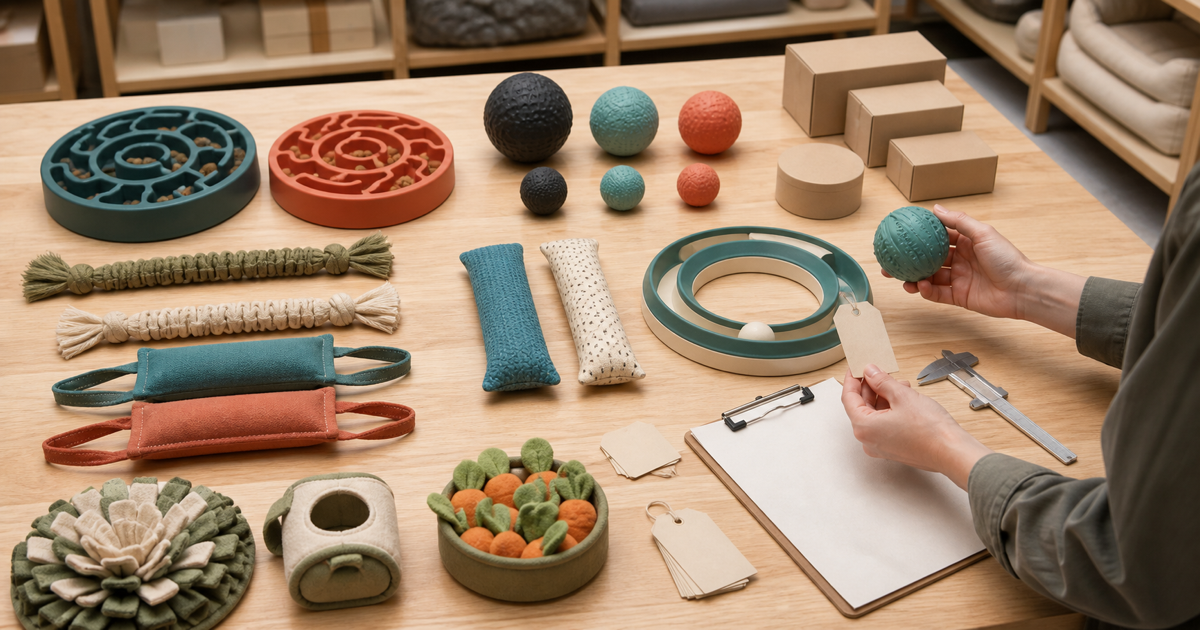
Create a coverage matrix before requesting quotations. Use the play job as the first axis and the relevant pet profile as the second.
| Play job | Examples of product formats | Minimum buyer question | Common assortment gap |
|---|---|---|---|
| Search and forage | Food puzzles, treat dispensers, scent games | Can difficulty and cleaning be managed for the intended user? | Only advanced puzzles, with no accessible starting option |
| Chase and retrieve | Balls, rolling toys, fetch shapes | Are dimensions and materials suitable for the stated pet size and play style? | Many colors but no meaningful size choice |
| Tug and social play | Reinforced tug shapes and handles | Do seams, joints and grip areas withstand the specified use? | Designs that look different but use identical construction |
| Chew and manipulate | Flexible rubber and other species-appropriate chew formats | Is hardness, fragment risk and expected supervision clear? | “Tough” claims without a defined user or evidence |
| Carry and comfort | Soft carry toys and kick toys | Can the item be cleaned, and are seams and components secure? | Decorative items with weak component retention |
| Species-specific activity | Cat hunting toys, small-pet foraging items, bird manipulation toys | Does the design support that species without importing risks from another category? | One generic “all pets” product used to fill several cells |
The UC Davis School of Veterinary Medicine notes that enrichment varies by species and individual, and advises correct sizing and discarding worn products. Do not let one attractive design stand in for incompatible use cases.
Add body-size range, access level, price role and demand evidence to every cell. There is no universal SKU count: fill high-confidence cells first, leave unsupported cells empty and test uncertain demand in controlled quantities.
Stop Near-Duplicate SKUs Before They Enter the Range
Put every candidate beside the closest current item and complete one sentence: “This product is the better choice when the customer needs ___.” The answer might involve size, function, accessibility, construction, cleaning or verified durability. Color alone rarely justifies another inventory position.
Use a simple overlap test:
- same intended species and size;
- same play job;
- same access and supervision level;
- same visible construction and user benefit; and
- similar price.
When all five match, the item is probably a substitute. Replace a weaker SKU, decline it or run a direct comparison pilot.
Apply Safety and Compliance Gates Before Commercial Scoring
Identify the destination market and the retailer's role: seller, distributor, importer or brand owner. Requirements vary by jurisdiction and design; there is no universal “pet toy certificate.”
For EU consumer products where no more specific EU safety legislation covers the risk, the EU General Product Safety Regulation summary requires safe products and considers design, composition, packaging, instructions, warnings and user categories. It also addresses traceability, responsible economic operators and online offers. It has applied since 13 December 2024; this is an EU example, not a global checklist.
UK product safety guidance similarly emphasizes applicable rules, safety evidence, risk communication, traceability and post-sale monitoring. Map the actual product and market before approving labels or claims.
At minimum, the internal gate should answer:
- Who is the intended species, size and user?
- What foreseeable chewing, pulling, dropping, washing and misuse must be evaluated?
- Which materials, coatings, adhesives, fillings, dimensions and detachable parts create risk?
- What warnings, instructions and supervision statements are needed?
- Which market rules and test methods apply, and who confirmed them?
- Can the item be traced to a supplier, model and batch or lot?
- Is there a complaint, corrective-action and recall route?
The American Animal Hospital Association warns that dogs can ingest broken parts or stuffing, choke on small pieces and damage teeth on extremely hard chews. Buyers need product-specific size, construction and use evidence; “durable” is not a safety conclusion.
Request a Product-Specific Supplier Evidence Pack
Ask for one controlled file per SKU or defined product family:
1. signed product specification with dimensions, weight, materials, construction and tolerances;
2. bill of materials or material declaration appropriate to the product and market;
3. intended species, size range, use, exclusions and supervision level;
4. applicable test reports with model, sample, method, date, result and laboratory identity;
5. approved sample and revision status;
6. incoming, in-process and finished-goods inspection plan;
7. packaging, case-pack and transit specification;
8. label artwork with identity, instructions and warnings;
9. product and batch or lot identification; and
10. change-control and corrective-action contacts.
ISO/IEC 17025 sets competence, impartiality and consistent-operation requirements for testing and calibration laboratories. An accredited report helps only when the laboratory's scope covers the method and the tested sample matches the proposed SKU.
Evaluate Samples Against a Written Use Case
Do not ask whether a sample “feels strong.” Define intended use and measurable checks first. Depending on design, assess dimensions, seams or joints, component retention, repeated loading, abrasion, flexing, impact, washing and transit. Record sample quantity, conditioning, equipment, load or cycle and failure criteria.
Our guide to pet product durability testing explains how to turn use into repeatable pass/fail criteria. Results help compare defined samples under defined conditions; they do not make a product indestructible or replace warnings and supervision.
Run a usability review as well:
- Can shoppers identify the intended pet and size quickly?
- Is the toy easy to present, refill or clean as applicable?
- Can residue or moisture become trapped?
- Do packaging and instructions reveal critical dimensions and use?
- Is the item stable on display and efficient to ship?
Build a Price Ladder With Explainable Differences
Do not create “good, better, best” by price alone. A step-up may reflect size, construction, replaceable parts, easier cleaning, verified material attributes or added function. If staff cannot explain it in one evidence-based sentence, the ladder may confuse shoppers and split demand.
Calculate commercial value with consistent inputs:
- net selling price after expected discounts;
- landed unit cost, including freight, duty and packaging;
- gross-margin dollars per unit;
- case quantity, minimum order, lead time and reorder reliability;
- merchandising requirements;
- expected return, complaint and markdown exposure; and
- cash tied up through replenishment.
Commercial scores come after safety. High margin cannot rescue missing traceability or unresolved risk.
Make Product Data and Claims Part of Assortment Quality
Maintain one master record per SKU: name, model, GTIN where used, dimensions, material, intended pet, size, play job, supervision, cleaning, warnings, images, case pack and revision. Verified by GS1 can check product identity and whether a GTIN is unique and follows GS1 standards. A barcode is not safety approval, but reliable identification reduces catalogue and traceability errors.
Challenge vague claims before packaging approval. The US FTC Green Guides summary advises against broad, unqualified claims such as “green” or “eco-friendly” and calls for clear qualification and substantiation. Confirm local rules and retain evidence for every claim.
Pilot the Assortment With Decision Rules
Launch a bounded group with a hypothesis for the customer, pet profile and play job. Test for one replenishment cycle or a predefined period, keeping display, content and staff briefing consistent.
Track at least:
- units and gross-margin dollars;
- sell-through using one documented formula;
- stockouts and replenishment lead time;
- returns, complaints and safety signals per units sold;
- markdowns and aged inventory;
- whether sales are incremental or taken from a near-duplicate; and
- shopper questions that reveal missing size, use or warning information.
Decide in this order:
1. Stop or investigate safety, compliance or traceability issues.
2. Revise correctable content, packaging, price or placement problems.
3. Keep a clear-role SKU that meets the commercial threshold.
4. Expand after repeatable demand and reliable replenishment.
5. Exit products with no distinct role, weak economics or unresolved quality.
Common Assortment Planning Mistakes
- Buying a supplier's complete collection without mapping customer demand.
- Treating colors as assortment breadth while missing sizes or play functions.
- Using one generic safety document for several constructions or materials.
- Accepting “indestructible,” “non-toxic” or “eco-friendly” without scope and evidence.
- Adding premium prices without a visible, supportable step-up.
- Ignoring pack cube, case quantity, lead time and markdown risk.
- Expanding from revenue alone while overlooking returns and substitution.
- Keeping weak SKUs because removing them would make a display look less full.
Final Buyer Checklist
- Every SKU occupies a named species-size-function cell.
- The closest substitute and meaningful difference are documented.
- Destination-market safety and compliance gates are complete.
- Specification, sample, test evidence and revision match.
- Packaging communicates use, size, instructions and warnings.
- Product identity, supplier and batch or lot can be traced.
- Price steps have explainable product differences.
- Economics and inventory exposure meet the threshold.
- Pilot metrics and decision date are assigned before ordering.
- Complaint, correction, recall and exit owners are named.
A high-value pet toy assortment is a controlled portfolio of distinct, evidence-backed products. It gives shoppers useful choices while giving the retailer clear reasons to list, replenish, improve or remove every SKU.
*This article provides general sourcing and product-planning information. It is not legal advice, a product certification or a substitute for destination-market compliance review.*
Sources and Further Reading
- Toys, Towers and Tricks — UC Davis School of Veterinary Medicine
- General Product Safety Regulation (2023) — EUR-Lex
- Product Safety Law: Advice for Manufacturers and Importers — UK Office for Product Safety and Standards
- Don't Chew on This! — American Animal Hospital Association
- ISO/IEC 17025:2017 — International Organization for Standardization
- What Is Verified by GS1? — GS1
- Environmental Claims: Summary of the Green Guides — US Federal Trade Commission
Frequently Asked Questions
How many SKUs should a pet toy assortment include?
There is no universal number. Build coverage around the species, sizes and play jobs supported by actual demand, then add depth only where sales and replenishment justify it.
What documents should a pet toy supplier provide?
Request a signed specification, material information, intended-use statement, applicable test reports, approved sample, inspection plan, packaging and label files, traceability plan and change-control contacts.
Does a children's-toy test report prove a pet toy is suitable?
Not by itself. The buyer must verify the report's standard, scope, sample identity and destination-market relevance, then address risks created by the intended animal and foreseeable use.
How can a retailer test a new toy with no sales history?
Give the SKU a written customer and use-case hypothesis, order a controlled quantity, set a review period, and track sell-through, margin, returns, complaints, substitution and replenishment.
What makes a premium pet toy worth listing?
A higher price needs a clear, evidence-backed improvement such as size, construction, durability, cleaning, replaceable components or function—not presentation language alone.
Sources and References
- Toys, Towers and Tricks — UC Davis School of Veterinary Medicine
- General Product Safety Regulation (2023) — EUR-Lex
- Product Safety Law: Advice for Manufacturers and Importers — UK Office for Product Safety and Standards
- Don't Chew on This! — American Animal Hospital Association
- ISO/IEC 17025:2017 — International Organization for Standardization
- What Is Verified by GS1? — GS1
- Environmental Claims: Summary of the Green Guides — US Federal Trade Commission
About this article
ShineePets Editorial Team creates evidence-informed pet care and product guidance for global readers.
ShineePets is a commercial B2B pet-supply sourcing brand. Read our editorial standards and commercial disclosure.