Cat Care
Vertical Space for Cats: Shelves, Perches and Safe Access
Quick answer
Plan safer vertical space for cats with stable shelves, full-body perches, grippy landings and an accessible route up and down.
By ShineePets Editorial Team · Published · Updated
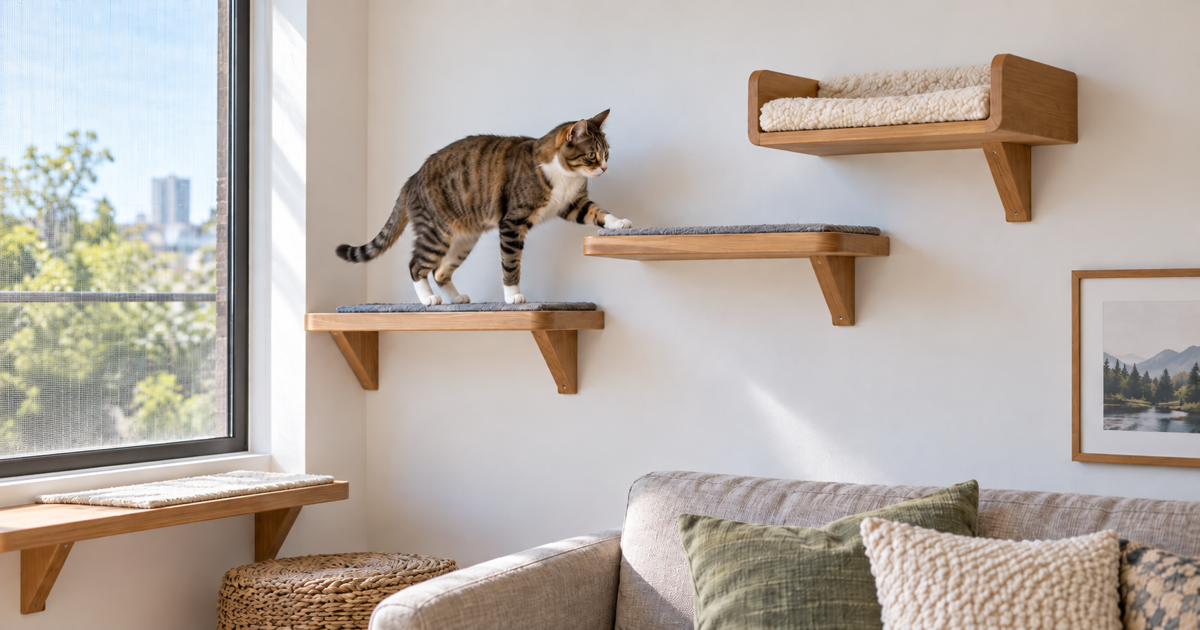
Good vertical space for cats is not simply the highest shelf you can install. It is a stable, grippy and connected route that lets a cat climb, pause, turn, rest and come down without being forced into a difficult jump. Start with the individual cat's body size and mobility, then provide broad landing surfaces, more than one useful level and a clear return path.
Shelves and perches can add territory to a small home, provide observation points and create separation in a multi-cat home. A narrow ledge, slippery finish, weak fixing or dead-end route may look impressive while being hard for the cat to use.
Planning rule: Design the route from the floor up and back down—not just around the final high perch.
Why Vertical Space for Cats Matters
The AAFP and ISFM Feline Environmental Needs Guidelines identify elevated areas as an important environmental resource. A raised safe place can let a cat monitor its surroundings, rest away from disturbance and increase the usable three-dimensional space in the home. The same guidelines say a perch should be large enough for the cat to stretch and that kittens or cats with limited mobility need lower levels or ramp access.
A peer-reviewed review of practical feline enrichment strategies likewise describes shelves and climbing structures as ways to add vantage points, activity and retreat at different heights.
Vertical territory should complement, not replace, the rest of the environment. The 2024 AAFP indoor/outdoor lifestyle position statement says an indoor cat still needs food, water, clean toileting areas, resting places, play and foraging opportunities, as well as safe territory with vertical space. A wall route is one part of that system.
Choose the Right Type of Elevated Space
| Option | Best use | Main safety check | Less suitable when |
|---|---|---|---|
| Wall shelf route | Adds usable levels without taking much floor area | Structural fixing, shelf depth, traction and connected access | Wall construction or tenancy rules prevent secure installation |
| Padded wall perch | Creates a resting or observation destination | Full-body support, washable pad and protected edges | It becomes a dead end or is reached only by a long jump |
| Freestanding cat tree | Provides climbing, resting and scratching in one footprint | Base stability, usable platform size and assembly | The base rocks or platforms do not suit the cat's route |
| Secure window perch | Offers an outdoor view and warm resting place | Window remains securely screened and the mount cannot shift | The window, glass or fitting cannot be made secure |
| Low stool or furniture step | Creates an adaptable intermediate level | Non-slip feet and a clear, stable landing | The furniture is lightweight, wheeled or frequently moved |
| Ramp or closely spaced steps | Reduces jumping effort | Grip, width, edge security and a gentle usable route | The ramp flexes, slides or blocks an essential walkway |
For a broader comparison of freestanding structures, see the ShineePets cat tree buying guide. Wall shelves are most useful when they add a route or destination that a floor-based structure cannot provide.
Map a Safe Cat Shelf Route in Eight Steps
1. Observe before installing
Watch where the cat already climbs, rests and looks outside. Note the surfaces used as takeoff and landing points. A route placed near a favored room is more likely to be useful than one selected only because a wall is empty.
Also record hesitation, slipping or awkward landings. Confidence, age and relationships with other pets affect how a route is used.
2. Pick a useful destination
A route needs a purpose: a quiet perch, a room view, safe window access or a way around a busy floor. Avoid cooking areas, fireplaces, breakables, opening doors and places where people carry hot liquids.
If the destination is near a window, treat the window as a separate safety system. The ASPCA's high-rise safety guidance warns that cats can fall accidentally from windows and recommends snug, sturdy screens. Childproof window guards are not a substitute because cats may fit through them.
3. Measure the cat, not only the wall
Check the cat's body length when resting, turning space and comfortable step or jump pattern. The final perch should support the whole body rather than leaving the cat balanced on a narrow edge. Intermediate shelves need enough usable surface for a controlled landing and stable turn.
Do not rely on one universal spacing rule. A long, athletic adult may use a route very differently from a kitten, a short-legged cat or a cat with reduced mobility.
4. Build small, readable transitions
Place the first level where the cat can approach without a blind leap. Continue with visible, reachable levels rather than one dramatic gap. Keep every landing clear of hard corners, lamps and decorative objects.
Include at least one generous pause point between the floor and the highest destination. A shelf route should work when descending as well as ascending.
5. Avoid dead ends
A cat resting at the top should not have to pass another cat at close range or jump through household traffic to leave. In multi-cat homes, provide a second way down where practical, or connect the route to more than one stable structure.
The environmental-needs guidelines recommend multiple, separated resources and note that safe places in multi-cat homes benefit from more than one entry. Apply that principle to elevated resting zones so one cat cannot easily block another.
6. Match fixings to the structure
Wall-mounted products must be installed according to the manufacturer's instructions and the actual wall construction. The shelf, brackets, fasteners and wall substrate work as one system; a strong shelf on an unsuitable fixing is still unsafe. Account for movement and landing forces, not only the cat's stationary weight.
Check for movement, exposed screws, splinters, sharp corners and paw-trapping gaps. If you cannot identify the wall type or appropriate fixings, use a qualified installer or a stable freestanding alternative.
7. Add traction and cleanability
Smooth painted wood can become slippery under dusty paws. Use securely attached, low-profile grip material that does not bunch, unravel or expose adhesive. Rounded, finished edges reduce abrasion, while removable washable covers make hair and dirt easier to manage.
Inspect fabric, carpet and sisal for loose threads or loops. Replace worn grip material before it becomes a snag or reveals slippery substrate.
8. Introduce the route without forcing it
Let the cat investigate at its own pace. Use play or a small part of the cat's normal food allowance to encourage the first few levels, but never place the cat on a high shelf and walk away. Keep the area quiet while the route is new.
If the cat repeatedly avoids one transition, change the spacing, angle, grip or approach rather than assuming the cat is stubborn.
Adapt Vertical Space by Life Stage and Ability
Kittens
Use lower levels, short transitions and large landings while coordination develops. Secure windows, doors, cables and nearby breakables before opening access. Cats Protection's kitten-proofing guidance specifically advises securing windows and preventing balcony access.
Recheck the route as the kitten grows; a small perch may no longer support the whole body.
Healthy adults
Offer a climbing route, a full-body perch and a lower retreat. Shelves do not provide all enrichment; the ShineePets guide to an indoor cat play routine explains how to combine hunting-style games, solo activities and rest.
Senior cats and cats with reduced mobility
Lower destinations, closer steps, ramps and non-slip surfaces can preserve access to favored places. Cats Protection's older-cat guidance suggests ramps, steps, furniture used as intermediate levels and added grip for older cats that still want elevated resting places.
Do not treat a sudden reluctance to jump as a design preference. Difficulty jumping or climbing can be associated with pain or illness. Arrange a veterinary assessment when movement changes suddenly, the cat appears painful, falls, limps, stops using essential resources or cannot navigate a previously comfortable route. Home modifications support access but do not diagnose or treat the cause.
Run a Safety Check Before Opening Access
Test every component before use and repeat the check regularly.
- Push and pull each shelf in several directions; there should be no wobble or wall movement.
- Confirm every landing supports the cat's whole body and allows a controlled turn.
- Check that ascent and descent are both obvious and reachable.
- Make sure grip surfaces lie flat and cannot slide or unravel.
- Remove sharp hardware, splinters, dangling cords and nearby breakables.
- Keep routes away from hot surfaces, opening doors and busy human walkways.
- Secure windows independently; never rely on the perch to prevent a fall.
- Provide more than one useful resting area and avoid a single guarded bottleneck in multi-cat homes.
- Recheck fixings, pads, seams and surrounding furniture after cleaning or rearranging the room.
- Temporarily restrict access after surgery or injury whenever the veterinarian advises limited jumping.
Common Vertical-Space Mistakes
- Choosing height over access: a dramatic top perch has little value when the cat cannot reach or leave it comfortably.
- Using shelves as decoration: plants, frames and ornaments reduce landing space and may be knocked down.
- Creating one narrow traffic lane: one cat can block another, increasing conflict around the route.
- Ignoring descent: cats may climb confidently and then hesitate when the landing below is hard to see.
- Trusting suction or tension without checks: any mount can loosen; inspect it according to its instructions and after temperature or surface changes.
- Placing the route at an unsafe window: an attractive view does not replace a secure screen.
- Failing to update the layout: age, weight, illness, injury and household changes can make an old route unsuitable.
The best setup does not need to cover an entire wall. A few stable, well-positioned levels with secure traction and an easy return route can add meaningful choice. Build for the cat now, observe use and correct a poor route.
*This guide provides general environmental and product-safety information. It does not replace diagnosis or treatment from a veterinarian.*
Sources and Further Reading
- AAFP and ISFM Feline Environmental Needs Guidelines — Journal of Feline Medicine and Surgery
- 2024 AAFP Indoor/Outdoor Lifestyle Position Statement — Journal of Feline Medicine and Surgery
- Environmental Enrichment: Practical Strategies for Improving Feline Welfare — Journal of Feline Medicine and Surgery
- Elderly Cats: Care Guide for Older Cats — Cats Protection
- Bringing a New Kitten Home — Cats Protection
- High-Rise Syndrome: Lifesaving Tips for Cat Parents — ASPCA
Frequently Asked Questions
How high should cat wall shelves be?
There is no universal height. Start with a reachable first level and use transitions that match the cat's size, confidence and mobility. The route must also provide an easy way down.
How wide should a cat shelf be?
It should give the individual cat full-body support, a controlled landing and enough room to turn where needed. Measure the cat rather than choosing a decorative narrow ledge.
Do cat shelves need carpet or another grip surface?
A secure low-profile grip surface is useful when the base material is slippery. It should lie flat, resist shifting and be inspected for loose threads, worn edges or exposed adhesive.
Can senior cats still use wall shelves?
Often yes, if the route uses lower destinations, close steps, ramps and non-slip surfaces. A new reluctance to jump or climb should be discussed with a veterinarian.
Are window perches safe for cats?
They can be useful only when the perch is secure and the window has a snug, sturdy screen or remains closed. Childproof window guards alone do not reliably contain cats.
Sources and References
- AAFP and ISFM Feline Environmental Needs Guidelines — Journal of Feline Medicine and Surgery
- 2024 AAFP Indoor/Outdoor Lifestyle Position Statement — Journal of Feline Medicine and Surgery
- Environmental Enrichment: Practical Strategies for Improving Feline Welfare — Journal of Feline Medicine and Surgery
- Elderly Cats: Care Guide for Older Cats — Cats Protection
- Bringing a New Kitten Home — Cats Protection
- High-Rise Syndrome: Lifesaving Tips for Cat Parents — ASPCA
About this article
ShineePets publishes practical, source-checked guidance for pet owners and pet-product professionals.
ShineePets is a commercial B2B pet-supply sourcing brand. Read our editorial standards and commercial disclosure.