Small Pet Care
Why Guinea Pigs Need Companionship and Proper Space
Quick answer
Learn why guinea pigs need compatible companions and generous floor space, with practical guidance on pairing, housing, hides and shared resources.
By ShineePets Editorial Team · Published · Updated
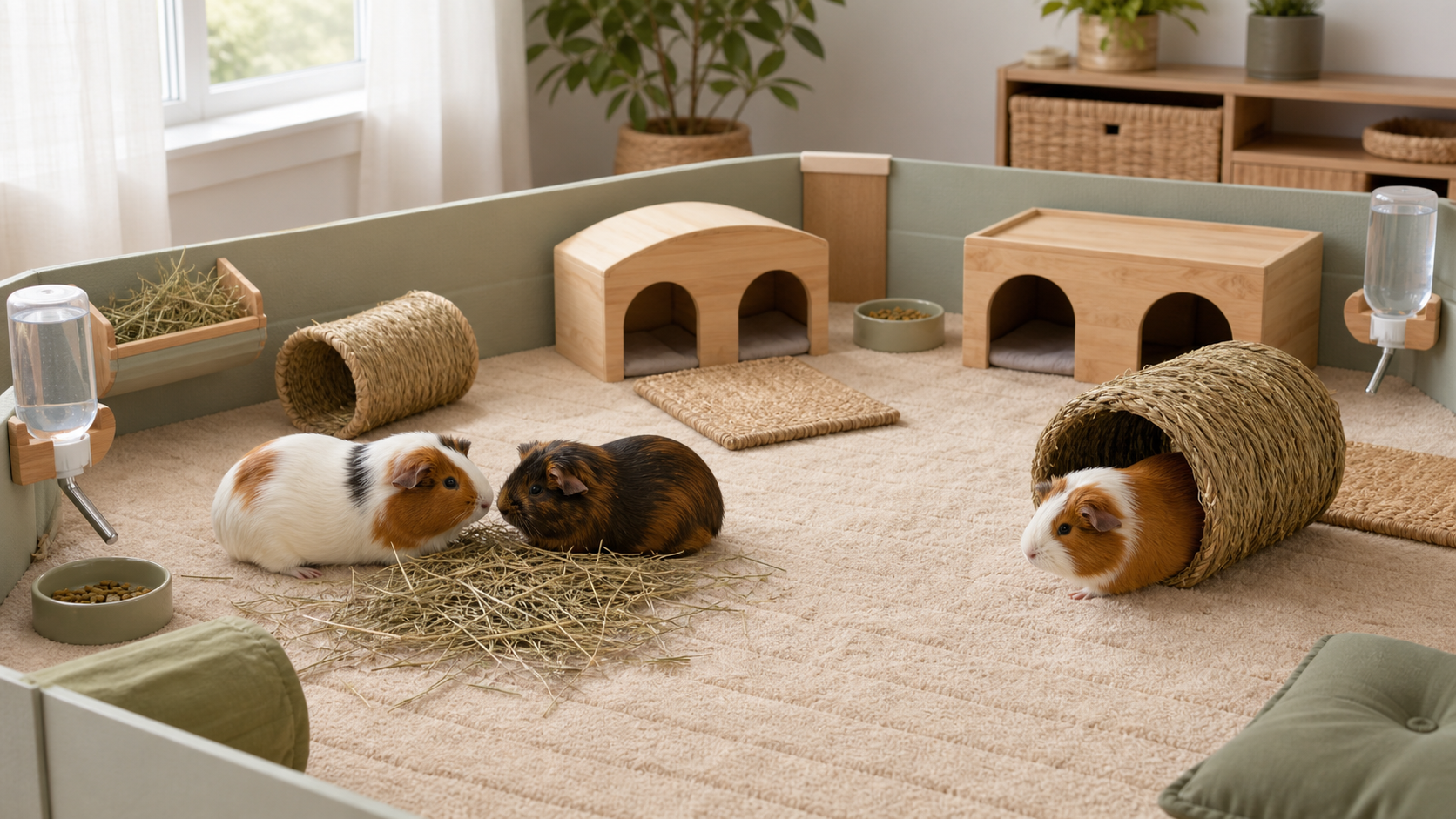
Guinea pigs need more than food and a clean enclosure. They are social animals that should normally live with compatible guinea pig companions, and the group needs enough continuous floor space to move, forage, rest and avoid one another when desired. Guinea pig companionship and proper space work together: a friend cannot compensate for cramped housing, and a large enclosure cannot replace same-species social contact.
Quick recommendation: Plan for at least two compatible guinea pigs, use the most protective current space guidance that fits your housing model, and provide multiple hay, water and hiding resources. If a guinea pig must be alone for medical or quarantine reasons, follow an exotics veterinarian's instructions and preserve safe social contact when possible.
Guinea Pigs Are a Social Species
Guinea pigs communicate constantly through posture, movement, scent and a wide range of sounds. A compatible companion can rest nearby, respond to warnings, explore at the same time and participate in normal social behavior throughout the day and night.
Human attention is valuable, but it is not available continuously and does not reproduce guinea pig communication. A caregiver cannot share a hay pile, move through a tunnel or respond to subtle social cues in the way another guinea pig can.
Welfare organizations including the RSPCA, PDSA and Blue Cross recommend keeping guinea pigs with at least one suitable member of their own species. Long-term solitary housing should not be the routine plan.
Companionship Does Not Mean Any Animal Will Do
A rabbit is not an appropriate substitute for another guinea pig. The species communicate differently, have different dietary requirements and can create injury or infection risks for each other.
The safest social group depends on sex, reproductive status, temperament, age and available space. Common arrangements include:
- Compatible same-sex pairs
- A neutered male with one or more females
- Carefully matched small groups with adequate room and resources
Do not house an intact male and female together unless breeding is being managed by a qualified, responsible program. Guinea pigs can reproduce at a young age, and sex identification errors occur. Ask an exotics veterinarian or experienced rescue to confirm sex and advise on neutering and pairing.
Compatibility Matters as Much as Company
Guinea pigs should have companions, but two unfamiliar animals should not simply be placed into a small established enclosure. Introductions need preparation, neutral space, supervision and a plan for safe temporary housing if the match is not immediately successful.
Rescue organizations may offer matching or bonding support. This can be especially useful for a bereaved guinea pig, a pair of males or a household with limited experience reading guinea pig behavior.
Before introduction:
- Confirm the sex of every guinea pig
- Arrange a veterinary health check when appropriate
- Follow quarantine advice for new arrivals
- Prepare two complete housing setups if temporary separation may be needed
- Choose a neutral, secure introduction area
- Remove single-entry objects that can become traps
- Provide scattered hay and enough room to move away
Do not rush introductions because one guinea pig appears lonely. A careful process protects both physical safety and the chance of a stable bond.
Understand Normal Social Behavior
Not every chase, rumble or mounting attempt means the relationship has failed. Guinea pigs may display dominance and boundary-setting behavior while establishing or maintaining their social arrangement.
Observe the entire pattern. Compatible guinea pigs may:
- Eat near each other without guarding
- Rest together or in separate preferred spots
- Follow one another during exploration
- Vocalize and respond to each other's movement
- Move away without being pursued relentlessly
- Share the enclosure while still choosing personal space
Concerning patterns include repeated biting, wounds, one animal being trapped, continuous high-intensity pursuit, or a guinea pig being prevented from reaching food, water or shelter. Seek advice from an exotics veterinarian or experienced rescue when behavior is difficult to interpret. Use a towel or solid board for emergency separation rather than placing bare hands between fighting animals.
Space Allows Social Choice
Companionship is beneficial only when guinea pigs can choose proximity. A well-designed enclosure lets them graze together, rest within sight of each other and also move away when they want quiet.
Insufficient space increases the chance that one animal can control a hide, food pile or narrow route. It also reduces opportunities for running, exploring and foraging.
The most useful space is continuous, safe floor area. Guinea pigs are ground-dwelling animals, so a tall cage with small platforms does not replace a broad horizontal footprint. Upper levels may add variety when ramps are gentle and guarded, but they should not be counted as the only meaningful exercise space.
Read Space Recommendations in Context
There is no single number that describes every suitable guinea pig home. Current welfare recommendations differ because they describe different group sizes and housing models.
For example:
- PDSA describes a large main shelter of at least 1.5 m × 1 m with an attached exercise area of at least 2 m × 1 m, available so guinea pigs can choose when to be active.
- Blue Cross advises that the main living area for two females should be no less than 5 ft × 2 ft with a separate run. It recommends at least 6 ft × 2 ft for two males or three guinea pigs, again with a separate run.
- Blue Cross gives a larger 6 ft × 4 ft living area when there is no separate run or the guinea pigs live indoors permanently.
These examples should not be mixed into a smaller hybrid. Check what each measurement includes, whether the run is continuously accessible, how many guinea pigs it covers and whether a local rescue or welfare standard requires more.
Treat a published minimum as a planning floor, not a design target. More usable space usually makes it easier to create separate resources, safe routes and enrichment without blocking movement.
Group Size Changes the Layout
Adding a third guinea pig requires more than adding one sleeping box. The group needs additional floor area, another place to retreat and enough resource distribution that no individual must enter a crowded zone.
Pairs of males may benefit from particularly generous spacing because conflict can increase when routes and resources are compressed. Individual personality still matters; a large enclosure supports compatibility but cannot guarantee it.
Before enlarging a group, confirm that the permanent enclosure, exercise area, travel carrier, cleaning routine and veterinary budget can support every animal. Also plan what would happen if illness or a failed bond temporarily required two complete setups.
Build a One-Level Movement Network
Start with a large rectangular or open floor plan rather than a narrow series of compartments. Long, usable runs allow normal movement and make it easier for guinea pigs to pass each other.
A good movement network includes:
- Broad lanes between hay, water and sleeping areas
- No dead-end corridor controlled by one animal
- Low, stable tunnels
- Solid, non-slip flooring
- Easy access for cleaning and observation
- Shelter distributed around the perimeter
- Open areas broken up with safe overhead cover
Guinea pigs often feel vulnerable in exposed space. Tunnels, canopies and low shelters can help them cross the enclosure confidently without filling every running lane with equipment.
Provide More Hides Than Guinea Pigs
Each guinea pig needs a place to retreat, and an extra option reduces competition. For a pair, plan at least three usable hiding choices; larger groups need more.
During introductions and in established groups, favor hides with two or more entrances. A single-door house can allow one guinea pig to block another inside. Double-entry shelters, open-ended tunnels and covered arches provide concealment without creating the same trap.
Hides should be:
- Large enough for comfortable turning
- Stable and free from sharp edges
- Easy to inspect and clean
- Positioned so exits do not face a wall at close range
- Available in different parts of the enclosure
- Suitable for the animals' mobility and body size
Replace items that become chewed into unsafe shapes, damp or difficult to sanitize.
Duplicate Essential Resources
One large hay pile may encourage social feeding, but it should not be the only access point. Spread hay across several safe locations so a guinea pig can eat even when another occupies the preferred area.
For a pair or group, provide:
- Multiple hay access points
- More than one water bottle or bowl
- Separate food dishes when pellets or vegetables are served
- Several resting and hiding choices
- More than one route between major zones
Check every water source daily. Bottles can leak, clog or become difficult for one guinea pig to use. Bowls can be contaminated or tipped. Redundancy protects access and also reveals preferences.
Unlimited access to appropriate feeding hay is a core part of guinea pig care. The related ShineePets hay guide covers storage, rack design and daily checks in more detail.
Use Solid, Foot-Friendly Flooring
Wire-grid floors can injure feet and should not be used as the living surface. The base should be solid, dry, non-slip and covered with an appropriate absorbent system.
Suitable flooring needs to support:
- Comfortable walking and resting
- Traction during running or social movement
- Removal of wet areas
- Regular laundering or replacement
- Inspection of urine and droppings
- Protection from cold, damp and rough surfaces
Whatever bedding system is chosen, remove wet and heavily soiled areas daily. Deep cleaning frequency depends on enclosure size, bedding type and the number of guinea pigs. Clean enough to control moisture and waste without repeatedly stripping every familiar scent unnecessarily.
Keep the Environment Safe and Stable
Guinea pigs are sensitive to temperature extremes, damp and sudden environmental change. Indoor housing should be ventilated but protected from draughts, radiators and direct sun. Outdoor housing requires robust weather protection and predator security, plus a safe plan for seasonal temperature changes.
Check the enclosure for:
- Gaps that allow escape or predator access
- Exposed electrical cables
- Toxic plants or household chemicals
- Sharp fasteners and splintered wood
- Heavy objects that could tip
- Fabric loops or openings that can trap feet
- Direct sun that moves across the enclosure
- Damp areas below bottles or roofs
A generous footprint is not safe if part of it becomes unusable through heat, wet bedding or fear.
Make Exercise Space Continuously Useful
A small sleeping hutch plus occasional supervised floor time does not provide the same choice as a large living system with regular or continuous access to exercise space. Guinea pigs are active in multiple periods across the day and night, so they need to decide when to move.
If the exercise area cannot remain attached, provide it predictably and ensure the main enclosure is still large enough for normal movement. Transfer should be low stress, secure and supported by hides.
Exercise areas should include hay, water and shelter. An empty open pen may look spacious to a person but feel unsafe to a prey animal.
Design for Seniors and Different Abilities
A bonded pair should usually remain together as animals age, but the enclosure may need modification. Senior guinea pigs can benefit from shorter routes, lower-entry hides, softer traction and resources placed within easy reach.
Keep essential areas on one level when mobility declines. Observe whether one animal reaches food more slowly or is displaced at a preferred hay source. Add access points rather than removing social contact without veterinary guidance.
The related ShineePets senior guinea pig guide covers weight monitoring, accessible housing and daily observation. Sudden difficulty moving, reduced appetite, weight loss, abnormal droppings or hiding needs prompt veterinary care.
Clean Without Disrupting the Social System
A large enclosure can be easier to keep hygienic because wet zones are less concentrated, but it still needs a routine.
Daily
1. Check that every guinea pig is eating and moving normally.
2. Refill and inspect all hay and water points.
3. Remove wet bedding and uneaten fresh food.
4. Check droppings and urine areas for changes.
5. Inspect hides, tunnels and barriers.
Regular deep clean
1. Move the group together to a secure temporary area with hay and hides.
2. Remove bedding and clean surfaces with an appropriate pet-safe method.
3. Rinse and dry the enclosure completely.
4. Return some clean familiar items where practical.
5. Rebuild multiple resource points and open routes before the guinea pigs return.
Avoid separating bonded guinea pigs simply for routine cleaning when they can safely remain together.
Monitor Individuals Inside the Group
Social housing should not make individual health invisible. Weigh each guinea pig on a consistent schedule recommended by the veterinary team and record the result separately. Learn each animal's normal appetite, movement and preferred resources.
Look for:
- One guinea pig consistently waiting to eat
- Reduced hay use or smaller droppings
- Weight loss hidden by a healthy-looking group
- Bite marks, hair damage or repeated chasing
- A water source used by only one animal
- Excessive hiding or reluctance to cross open space
- Changes after moving a hide or adding a new item
A group can appear quiet while one individual is being excluded. Resource duplication and regular observation make subtle problems easier to detect.
Plan for Bereavement and Temporary Separation
When one member of a pair dies, the remaining guinea pig may need veterinary assessment and a carefully matched new companion. Contact an experienced rescue or exotics veterinarian rather than assuming an older animal should remain alone.
Temporary separation may be necessary for quarantine, recovery or serious conflict, but it should be medically and behaviorally planned. Depending on the reason, adjacent housing may preserve sight, sound and scent contact without allowing physical interaction.
Do not divide an enclosure with unsafe mesh spacing or leave either side without adequate floor area, hay, water and shelter. A divider creates two homes, and both must be complete.
Avoid These Common Housing Mistakes
- Keeping one guinea pig because the caregiver provides attention
- Pairing a guinea pig with a rabbit
- Counting shelves instead of continuous floor space
- Using the smallest advertised cage for a pair
- Lining every resource along one wall
- Providing only one water source or hay point
- Using single-entry hides during introductions
- Filling running lanes with accessories
- Housing intact males and females together
- Moving unfamiliar guinea pigs straight into one animal's small enclosure
- Separating bonded companions for routine cleaning or travel
- Ignoring weight loss because the group still empties the hay rack
Final Companionship and Space Check
A well-planned guinea pig home should meet all of these conditions:
- At least two compatible guinea pigs live together unless a veterinarian directs otherwise.
- Sex and reproductive status have been confirmed.
- The enclosure follows current guidance for the specific group and housing model.
- Usable horizontal floor space exceeds a bare minimum where possible.
- Every animal can reach hay, water, shelter and resting areas.
- Hides and tunnels offer safe alternative exits.
- Solid flooring remains dry, supportive and easy to inspect.
- Exercise access fits the guinea pigs' activity throughout the day and night.
- The group is observed as individuals, with weights and health changes recorded.
- A rescue or exotics veterinarian is involved when introductions, conflict, illness or bereavement make the plan uncertain.
Companionship and space are not separate extras. Together they allow guinea pigs to communicate, choose closeness, avoid pressure and express the movement and foraging behavior that a small cage or human company alone cannot provide.
Frequently Asked Questions
Can a guinea pig live alone if the owner provides daily attention?
Human interaction is valuable but does not replace continuous communication with a compatible guinea pig. Long-term solitary housing should not be the routine plan unless an exotics veterinarian directs it.
Can guinea pigs live with rabbits for companionship?
No. Rabbits are not suitable substitutes because the species communicate differently, have different needs and can create injury or infection risks.
How much space do two guinea pigs need?
Use current guidance for the specific group and housing model. Recommendations differ depending on sex, group size and whether a separate exercise area is continuously available, so treat published minimums as planning floors rather than universal optimums.
How many hiding places should guinea pigs have?
Provide at least one usable hide per guinea pig plus an additional choice, distributed around the enclosure. During introductions, use hides and tunnels with two or more exits.
What should happen when one guinea pig loses its companion?
Arrange a health check and contact an experienced rescue or exotics veterinarian about careful matching. Age alone is not a reason to leave the surviving guinea pig permanently solitary.
Sources and References
About this article
Evidence-informed pet care and product guidance from the ShineePets Editorial Team.
ShineePets is a commercial B2B pet-supply sourcing brand. Read our editorial standards and commercial disclosure.